

Addressing the Complexity of Community-based Urban Green Space Projects
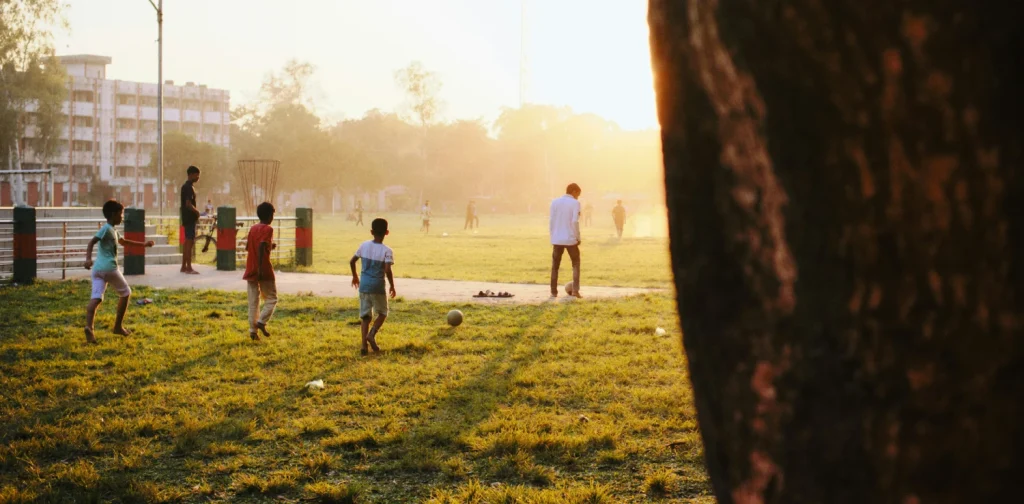
Photo: Kabiur Rahman Riyad on Unsplash.
More than half of the world’s population live in cities today. By 2050, 2.5 billion more people will supposedly have become urban dwellers. With rising heat, more frequent floods, more pollution, and increasing need for social space, the necessity for accessible and inclusive urban green spaces is undeniable. However, the priority functions of these spaces vary from community to community. So, unilateral top-down planning is likely to fail. One key solution lies in implementing highly participatory or community-based urban green space projects. But the process is not so simple.
Unequal Access to Urban Green Spaces
Urban green spaces are open areas—usually parks—that bring nature closer to city residents. These areas have a lot of vegetation, like trees and flowers, or other natural features, like lakes and rivers. In short, they provide elements of nature among the primarily steel-and-concrete landscape of urban areas.
Urban green spaces are necessary for their ecological functions and impact on physical and mental wellbeing. Unfortunately, not everyone has access to these spaces. With urban parks mostly existing in high-income areas, lower-income and marginalized communities often cannot access the benefits.
Community-based Urban Green Space
The characteristics and functions of urban green spaces in lower-income areas are likely to be different. For instance, they may have to primarily address provision needs. Urban green spaces can be urban farms, providing food for those in need. And parks with water features can provide access to clean water for domestic uses. These areas can also become free and safe spaces for children to play in.
With varying contexts and needs, unilateral, one-size-fits-all, top-down urban planning will not work. Therefore, highly participatory or community-based urban green space projects can be a solution.
According to Roy et al., community-based urban green space planning and management offers opportunities for, “A pro-poor urban-planning approach to improve accessibility of green spaces in ways that incorporate more than landscaping and construction matters.”
However, implementing highly participatory or community-based urban green space project planning is not easy. It comes with complex challenges that require nuanced solutions.
Knowledge Gap and a Common Understanding
For one, highly participatory planning must address the knowledge gap. Residents are likely to be unaware of the importance of an urban green space. With lack of awareness of its potential, resistance and land-use conflicts may arise. It is no surprise that for residents, it can be hard to accept new infrastructure development near their homes.
Reaching a common understanding also requires government bodies and private contractors to learn about the community’s needs. This involves facilitating social dialogue with diverse members of the community. More often than not, this process will need multiple rounds of varying types of engagement to really dig into the intersectionality beyond income levels. All in all, it takes a significant amount of resources—budget, time, energy—to meet communities where they are at and embark on a community-based urban green space project.
Accountability and Responsibility
Urban green space projects themselves involve many entities. For instance, the city government is responsible for urban services, but waste management is handled by a combination of public, private, and informal sectors. There may also be other stakeholders involved for vegetation provision as well as water and sanitation. Now, add community members to the pot.
The complicated web of entities is likely to result in confusion regarding accountability and responsibility. While collaboration is key, an unclear framework will lead to projects and initiatives that do not last.
Therefore, it is key to create a clear foundational framework for management, accountability, and monitoring. This framework should be adaptable and scalable, depending on local contexts. It is also vital to actively engage residents in the making of this framework to instill a sense of stewardship.
Addressing Systemic Issues
Community-based urban green space projects go beyond the planning. These spaces should and could last long into the future with proper management and monitoring.
One of the most common issues is neglect. This lack of long-term care may result in environmental degradation with mounting waste, polluted water, and dying urban farms. On the surface, it indicates a behavioral problem among residents. They may dump and burn their garbage at the park, pour their waste water into the river, or use harmful pesticides for the farms. But at their roots, many of these problems are driven by wider, systemic issues.
For example, open dumping is likely due to the lack of proper waste management infrastructure in the area. Meanwhile, the discard of bodily waste in the waters may be the behavioral result of inadequate sanitation infrastructure. The neglect of park upkeep, for instance, can be attributed to time poverty, indicating a lack of time and energy left outside of work to earn livable income.
These issues do not stand alone. They are part of complex, deeply rooted issues and must be addressed as so. Ultimately, community-based urban green space is but a small reflection of societies. Making it work is not easy, but not impossible.

Co-create positive impact for people and the planet.
Amidst today’s increasingly complex global challenges, equipping yourself, team, and communities with interdisciplinary and cross-sectoral insights on sustainability-related issues and sustainable development is no longer optional — it is a strategic necessity to stay ahead and stay relevant.
 Risk of Transboundary Air Pollution Increases as Extreme Heat Continues
  Whimsymaxxing and Beyond: Rethinking the Waste Behind Viral Trends
  Seeking Guidance from Karl Marx to Face the Climate Catastrophe
  Indonesia’s Greenwashing Diplomacy at COP31 and Beyond
  The Textile Industry Is Growing, and So Is Textile Wastewater
  EESG: We Need a New Economic Narrative for Sustainability in the Age of AI, Energy Crisis, and Geopolitical Divide