

Learning from Indigenous Philosophies: Reconnecting People and Nature for Wellbeing
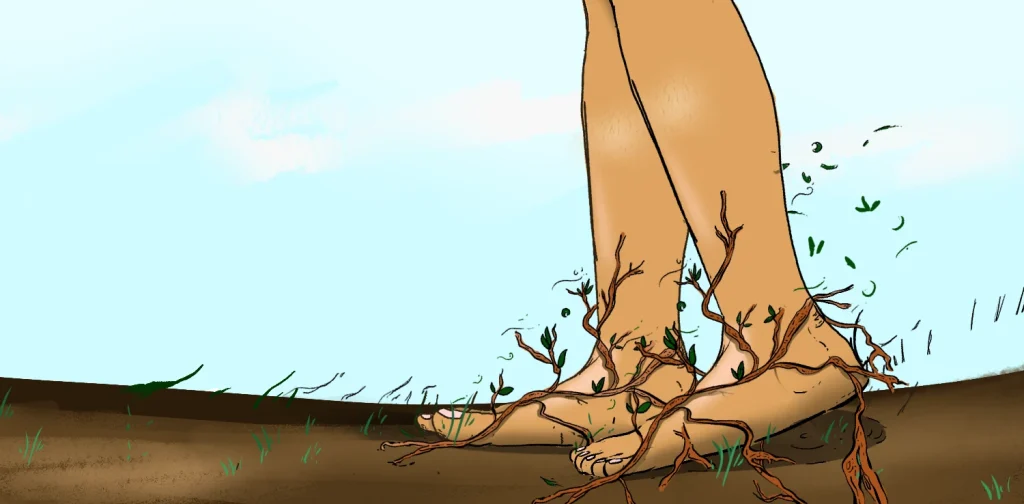
Illustration by Irhan Prabasukma.
Nature protects when she is protected. This Indigenous thought is of value in today’s world, where we have come to believe that nature is separate from us, and urban boundaries bind our minds to a world of concrete and glass. Amidst global crises, there is much to learn from Indigenous philosophies for our ways of life today.
I, Other, and Nature
What made humans intelligent is not this concrete world, but our long-accumulated knowledge of interactions with nature. Rooted in the Indigenous approach to wellbeing and relational love, the “being” in “human being” is integral. This relational love fosters stronger ties with land and community, where there is no “I” without the “other”. Thus, nature becomes a family, not a commodity.
This is a completely different starting point from modern thinking. The relational approach is increasingly eroding in urban societies, which is contributing to the growing mental health crisis. One example is the traditional mud houses in India. Though modern housing does have its benefits, a complete replacement of mud houses with brick ones disconnects people from parts of themselves and their sense of belonging to the planet.
While the dominant Western approach prioritizes a capitalist ideology of discrete consumers, Indigenous philosophies center on the understanding that “an individual” is directly linked to “others”. Like the African Ubuntu, for example, with the principle of “I am because we are”. This simple yet profound idea of connectivity and collectivism needs to be internalized in our societies if we are to shift towards a more resilient and sustainable mental and environmental health.
Adaptive Way of Life
Indigenous ways of resilience rely on the complex interaction between nature and people, and their lived experience as part of nature. The relationship is one that transforms the cognitive process necessary for human development. Fundamentally, this worldview enhances their capacity to adapt to natural processes and challenges.
Their therapeutic systems and cultural practices—such as living in mud houses, using cow dung for plastering floors, growing local foods, and cooking with local resources—evolved to align with this understanding, strengthening self-reliance and adaptive capacity. Strong community bonds further enable collective action in times of crisis. Together, these factors help Indigenous communities cope with adverse situations and recover more quickly than many urban communities.
From Connection to Resilience
Indigenous views emphasize restoring human–nature relationships, fostering emotional and ethical connections with other living beings. For example, psychological research is increasingly finding that emotions such as love, compassion, gratitude, admiration and elevation are linked by a sense of connection to something larger than the individual.
In Indigenous philosophies, extending the relational connections from solely interpersonal relationships to the natural environment is fundamental and widespread. The connection is often cultivated through Indigenous ceremonies, stories, and daily cultural practices. Our ability to access this dimension of “being human” allows us to transcend the primal emotional systems like fear, rage, lust, and panic through care and play. And so, it reshapes our cognition toward wholeness.
Conversely, depriving people of these possibilities through continued human–nature disconnection may result in children of the future thinking that biodiversity resides in the zoos.
Toward Improved Wellbeing for All
There is an urgent need to transform the current tunneled vision towards a “two-eyed seeing” approach. This perspective encourages scientific and Indigenous knowledge systems to coexist without one subordinating the other. Community and environmental stewardship are not only for Indigenous peoples. They are essential for everyone to enhance both environmental and psychological adaptive capacity and promote long-term ecological thinking.
We must recognize that capitalism was not designed to be climate or biodiversity-friendly. It is evident now, with the triple planetary crisis of climate change, biodiversity loss, and pollution. The costs of rapid and unsustainable growth outweigh its benefits, both for the environment and our physical and mental wellbeing.
Current discourse on moving “beyond GDP” continues to emphasize the capitalist ideology of a “good” life, which has led to environmental destruction and wealth disparities. In addition, emerging mental health challenges are also a result of the failure of these indexes to include indicators of relational wellbeing, which understands human–human and human–nature relationships as critical to one’s wellbeing.
Meanwhile, relational wellbeing has always been integral in Indigenous philosophies. Indigenous-driven relational wellbeing is the essence of community wellbeing or flourishing. It goes beyond viewing individuals in relationships to perceive the Earth as a nurturing Mother, emphasizing instead on the interconnectedness of all living beings.
This integration of relational wellbeing and understanding of human–nature connections is vital for overall health and true inner happiness. Improved indices—such as the OECD Better Life Index, and the Gross National Happiness Index of Bhutan—go beyond GDP to some extent. Still, there remains considerable disagreement over how to properly understand and measure wellbeing contextually.
Indigenous Philosophies in the Modern World
In essence, sustainability is a way of life, rooted in Indigenous ideologies. Such a lifestyle prevents capitalism from overtaking relational wellbeing and fosters greater happiness for individuals and flourishing of societies.
Therefore, wellbeing indicators need to consider going “beyond GDP” with concepts of relational wellbeing not only to be inclusive of Indigenous cultures but also for the continued prosperity of communities around the world. Moving beyond GDP allows for a transition from only reductionist, medicalized metrics toward a relational index that synthesizes physical, emotional, and spiritual flourishing into a nature-positive and carbon-negative alternative.
===
The views expressed in this article are those of the authors and do not necessarily reflect the views of the United Nations University.
===
Editor: Nazalea Kusuma
Co-create positive impact for people and the planet.
Amidst today’s increasingly complex global challenges, equipping yourself, team, and communities with interdisciplinary and cross-sectoral insights on sustainability-related issues and sustainable development is no longer optional — it is a strategic necessity to stay ahead and stay relevant.

Himangana Gupta
Himangana Gupta is Research Fellow and Academic Associate at UNU-IAS. An expert in climate-biodiversity nexus, she is currently working on reconceptualizing well-being through Indigenous perspectives from the Global South as part of a project funded by the Japan Society for the Promotion of Science.

Kehinde Balogun
Kehinde Balogun is an international consultant with UNU-IAS and a PhD scholar at Universidade Católica Portuguesa in Portugal. She is investigating how Indigenous psychology and its relational way of being can help address climate change.
 Challenging Access to Clean Water in Mining Regions
 Online Scrap Yard: What a Digital Marketplace Changes for Asia’s Recycling Trade
 Why Does Child Labor Persist?
 F for Fairness: A year on, TFFF must reach the people who protect forests
 Risk of Transboundary Air Pollution Increases as Extreme Heat Continues
 Whimsymaxxing and Beyond: Rethinking the Waste Behind Viral Trends