

Congo Basin Peatlands Are Releasing Ancient Carbon
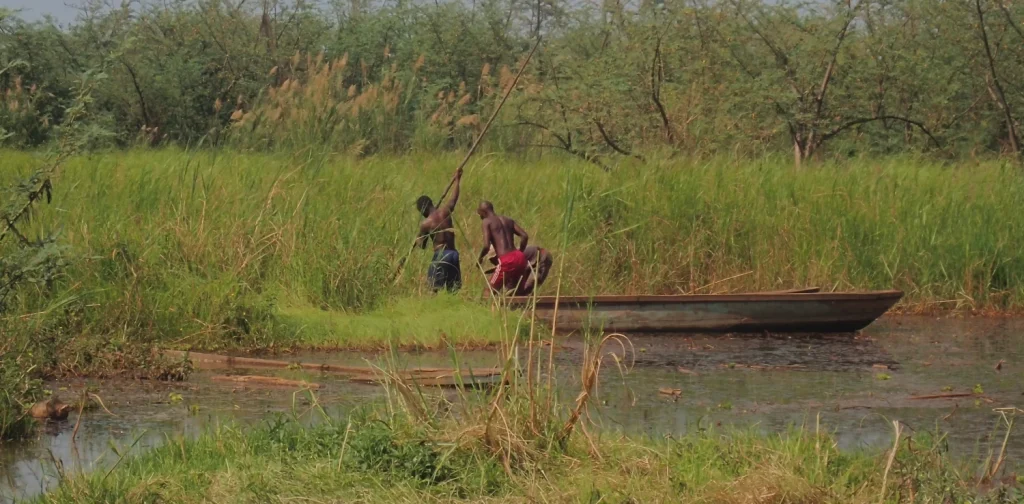
Photo: Cethuyghe on Wikimedia Commons.
At the heart of Africa lies one of the world’s largest tropical peatland complexes, the Congo Basin. Often described as the planet’s “second lung”, it is a crucial component of the global carbon cycle as its swamps and peatlands have long helped to regulate Earth’s climate. Yet emerging research suggests that this system may not be as stable as it once was, with parts of the Basin now acting as natural chimneys that release ancient carbon back into the atmosphere.
Congo Basin’s Role in the Ecosystem
The Congo Basin and its surrounding forests, covering approximately 500 million acres, form the second-largest network of tropical forests and rivers in the world. This region contains about 70% of Africa’s tropical forests and spans six countries: Cameroon, the Central African Republic, the Democratic Republic of the Congo, the Republic of the Congo, Equatorial Guinea, and Gabon. The sheer scale of the Congo Basin makes it a global hotspot for biodiversity and important ecosystems.
Although its peatlands and swamps cover only about 0.3% of the Earth’s land surface, the vast carbon reserves stored in the Congo Basin make it one of the world’s most significant carbon sink ecosystems. At the global scale, the Basin plays a crucial role in climate regulation, absorbing an estimated 1.5 billion tons of carbon dioxide annually. This figure is equivalent to roughly 4% of annual global emissions from the use of fossil fuels.
Furthermore, the ecological richness of the Congo Basin directly supports the livelihoods of approximately 80 million people. It is also home to around 900,000 Indigenous people with deep cultural and economic ties to the region’s forests.
Congo Basin as a Natural Chimney
Scientists had long assumed that the carbon preserved in the Congo Basin’s peatlands would remain locked away for a very long time, to be released only under specific conditions such as prolonged drought. However, a research team from ETH Zurich, Switzerland, has now identified evidence of carbon dioxide leakage from these natural carbon stores.
This research reveals that substantial amounts of carbon dioxide are being released from Africa’s largest blackwater lake, Lac Mai Ndombe, as well as from the smaller Lac Tumba. While some of these emissions originate from recently grown plant material, approximately 40% derive from peat that has accumulated over thousands of years.
Researchers identified this pattern by analyzing the released carbon dioxide using radiocarbon dating techniques. The radiocarbon age of dissolved inorganic carbon in Lac Mai Ndombe averages approximately 2,170 14C years, while measurements from Lac Tumba indicate an even older age of about 3,515 14C years. Although radiocarbon ages cannot be directly converted into calendar years, these results still indicate the release of carbon that has remained sequestered for millennia.
Addressing the Threats
This finding demonstrates that the vast carbon stocks of the Congo Basin are not entirely passive. Rather, previously unrecognized pathways appear to enable their mobilization. Although the precise mechanisms driving this underground carbon release remain unclear, the phenomenon reinforces concerns about the long-term stability of the Basin’s peatlands.
If ancient carbon is already being released through natural processes, climate change-induced drought may add to the pressure. It could lower water tables, enabling oxygen to penetrate deeper into peat layers and accelerating microbial decompositions. Incorporating this slow-cycle leakage into global climate models is, therefore, an essential step toward improving the accuracy of future projections of carbon emissions and global warming.
However, climate change is not the only factor that could accelerate this process. The change in land-use may pose an even greater threat. With the population of the Democratic Republic of the Congo projected to triple by 2050, pressures from deforestation and land degradation are likely to intensify. Given that many communities continue to rely on unsustainable land-use practices for their livelihoods, addressing the threats to the Congo Basin will require inclusive strategies that support socio-economic development while safeguarding the long-term sustainability of its ecosystem.
Editor:Nazalea Kusuma

Co-create positive impact for people and the planet.
Amidst today’s increasingly complex global challenges, equipping yourself, team, and communities with interdisciplinary and cross-sectoral insights on sustainability-related issues and sustainable development is no longer optional — it is a strategic necessity to stay ahead and stay relevant.
 Seeking Guidance from Karl Marx to Face the Climate Catastrophe
  Indonesia’s Greenwashing Diplomacy at COP31 and Beyond
  The Textile Industry Is Growing, and So Is Textile Wastewater
  EESG: We Need a New Economic Narrative for Sustainability in the Age of AI, Energy Crisis, and Geopolitical Divide
  The Continued Struggle for Equality and Dignity in Women’s Sportswear
  Behavior Change for the Planet: Is composting worth it?