

Health Challenges from Sea-Level Rise Demand Urgency and Accountability
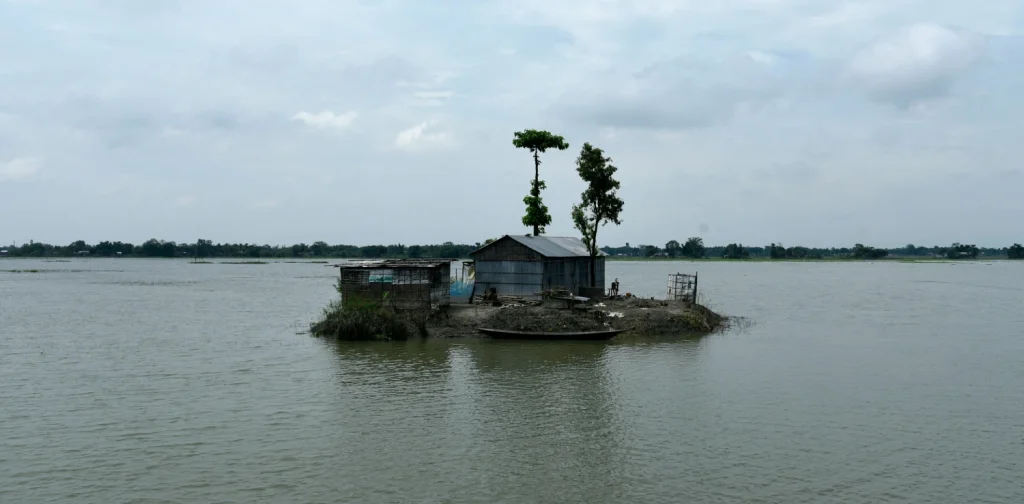
Photo: Vincenzo Cassano on Unsplash.
The Earth’s warming brings not only scorching days but also sea-level rise in many parts of the world. Waterlines are swallowing the shore millimeter by millimeter, presenting complex health challenges for people’s wellbeing.
Accelerating Sea-Level Rise
Just as popsicles melt under the sun, rising temperatures have been driving rapid glacier loss. Experts state that Earth’s glaciers lost 273 billion tonnes of ice annually between 2000 and 2023, equivalent to 30 years of water consumption by the global population.
Meanwhile, after 66 years of observational record, ocean heat set a new record in 2025, according to a report by the World Meteorological Organization (WMO). Together, the two factors drive sea-level rise.
Even though sea levels have always been rising, the concern now lies in the accelerating rate. WMO’s report further notes that the average rate for sea-level rise from 2012 to 2025 was 4.75 ± 0.3 mm per year, while the period 1993–2011 had an annual rate of 2.65 ± 0.3 mm. Alarmingly, the global mean sea level was about 11 cm higher at the end of 2025 than it was in 1993, when it was first observed via satellite.
Those numbers imply that the ocean is approaching us on land more quickly than ever. Rising sea levels bring a series of multiplying risks, including coastal flooding and erosion that can lead to loss of livelihoods and displacement. Moreover, it exacerbates challenges in the health sector by amplifying existing inequities, bringing new disease patterns, and disrupting critical infrastructures.
The Case of SIDS
The health impacts of sea-level rise vary and are disproportionate. Small Island Developing States (SIDS), which are mostly located in low-lying remote islands, are on the front lines of this crisis.
A 2024 report by the Lancet Countdown on Health and Climate Change notes that warming sea surface temperatures that drives sea-level rise can increase the potential for Vibrio transmission, which are commonly found in saltwater. Pathogenic Vibrio bacteria can cause serious gastrointestinal infections, including cholera, and can also infect open wounds. Between 2011 and 2022, the amount of the SIDS coastline suitable for pathogenic Vibrio transmission was 27% more than that in 1982–1990.
The complex interactions among climate-sensitive diseases can overwhelm healthcare systems, even those with high response capacity. For instance, the report notes increasing transmission potential for dengue and more frequent outbreaks.
Navigating the complex situation can also be mentally taxing, especially for women who often have to juggle it with caregiving responsibilities. The UNFCCC highlights that women experiencing coastal natural disasters are more prone to post-traumatic stress disorder, anxiety, and long-term psychological impacts. The absence of support when in displacement can trigger similar issues among children and other vulnerable groups.
Meanwhile, the physical infrastructure is not faring any better. A study examining healthcare facilities in 14 Pacific Island Countries found that 62% are located within 500 meters of the coast, making them highly vulnerable to sea-level rise and other extreme weather threats. Dr. Eileen Natuzzi, an expert at George Washington University, highlights that the hospitals there are vulnerable and need to be recognized as critical infrastructure. As such, it is important to direct more attention and funding to them as part of climate mitigation and adaptation efforts.
Demanding Urgency and Accountability
The risks and impacts of sea-level rise ring true across the world, as do the disparities. In the United States, for instance, researchers at UCLA found that more than 5,500 hazardous sites are projected to be at risk of coastal flooding by 2100. However, the impacts are still unequal even in this projection, with neighborhoods with impoverished households, racial minorities, and senior citizens likely to be more affected.
Thus, the issue’s severity demands urgency. Integrating health into climate and disaster management strategies is a critical step to building health system resiliency, as recommended in the Bangkok Principles. Enhancing cooperation between health authorities and stakeholders, incorporating health data into early warning systems, and encouraging transboundary information sharing on emerging hazards are some of the ways to do so.
Furthermore, with escalating greenhouse gas emissions as the main culprit behind global warming, it is crucial to demand accountability from the biggest offenders. The ICJ Advisory Opinion issued in 2025 has stated countries’ obligations to protect the environment from greenhouse gas emissions generated by human activities, thereby opening the door to greater international accountability for environmental offenses.
“That advisory opinion is the clearest legal affirmation to date that cooperation among states to address climate change—the main driver of sea-level rise—is a binding obligation. It was unanimous and stated clearly: expanding fossil fuels may constitute a wrongful act,” wrote Christiana Figueres, the Head of the UN Climate Change Convention (2010-2016).
Editor: Nazalea Kusuma

Co-create positive impact for people and the planet.
Amidst today’s increasingly complex global challenges, equipping yourself, team, and communities with interdisciplinary and cross-sectoral insights on sustainability-related issues and sustainable development is no longer optional — it is a strategic necessity to stay ahead and stay relevant.
 The Textile Industry Is Growing, and So Is Textile Wastewater
  EESG: We Need a New Economic Narrative for Sustainability in the Age of AI, Energy Crisis, and Geopolitical Divide
  The Continued Struggle for Equality and Dignity in Women’s Sportswear
  Behavior Change for the Planet: Is composting worth it?
  Building Bridges Between Environmental Policy and Mental Health
  We May Surpass 1.5°C Soon, But We Can Do Something About It