

Building Animal Crossing: Are wildlife crossings effective?
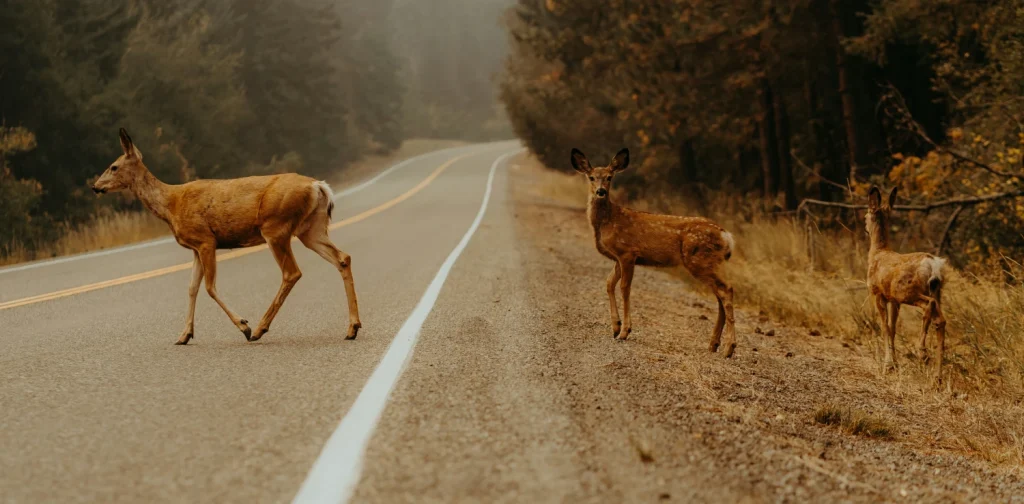
Photo: Emmanuel Munoz on Unsplash.
Humans are sharing the Earth with other species, and just like a good roommate, maintaining a respectful distance with occasional positive encounters seems appropriate for everyone. However, infrastructure development and resource-seeking activities have been encroaching on the habitats of wild animals . How can wildlife crossings be a solution?
Roadkill Prevalence
Long before cars were popular, animals had already been traversing the Earth looking for food, mates, and places to live. Today, transportation evolution has brought with it major infrastructures that inevitably cut through wildlife habitats and migration paths. The collisions are not pretty: millions of species are killed on the roads each year.
The Global Roadkill Data gathered roadkill records of terrestrial vertebrates between 1971 and 2024 from various published and unpublished sources. It estimates that 340 million birds were killed on the roads in the US alone during that time period. In Europe, roadkill has led to the loss of 194 million birds and 29 million mammals.
The Global Roadkill Data found around 126 threatened species that are frequent victims of roadkill. The giant anteater (Myrmecophaga tridactyla) has the highest number recorded in the database (1199 records), followed by the common fire salamander (Salamandra salamandra) with 1043 records. Both are already classified as vulnerable on the IUCN Red List.
Beside roadkills, roadways can directly destroy wildlife habitat by clearing areas to make room for lanes. It can also lead to declining habitat quality due to emissions and pollution, including noise, light, and runoff. Both are devastating for species with dwindling populations.
Moreover, the socio-economic impacts of these incidents cannot be overlooked. In the US, for instance, they have caused over 200 human fatalities and 29,000 injuries annually with billions of associated costs.
Building Wildlife Crossings
Wildlife crossings offer a way to address this human-wildlife conflict. They are built structures that allow animals to cross human-made barriers safely. Supposedly, the advantages go both ways: reconnecting habitats to address fragmentation and preventing collisions between vehicles and animals.
The concept of wildlife crossings first emerged in France in the 1950s and has taken off worldwide to this day. The infrastructure can take forms such as overpasses, underpasses, amphibian and reptile tunnels, fish ladders, canopy bridges, and culverts.
The Netherlands is said to have around 600 wildlife crossings, with the largest being the Natuurbrug Zanderij Crailoo—an overpass 800 meters long and 50 meters wide. In 2021, Swedish authorities announced the plan to build renoducts, viaducts for reindeers to help them cross streets to graze. Usually, authorities close Sweden’s main highway during the reindeer’s migration period to the mountains. The renoducts are hoped to allow the herds to find fresh grazing lands, as well as alleviate traffic jams.
Similar built also exists in Singapore. The Eco-Link bridge, established in 2012, is the first ecological bridge in the Asia-Pacific. It crosses over the Bukit Timah Expressway and is covered with trees and shrubs to replicate a native forest ecosystem and attract wildlife. Some species that have been recorded using the bridge are Sunda pangolins (Manis javanica), common palm civets (Paradoxurus hermaphroditus), and slender squirrels (Sundasciurus tenuis).
Effectiveness in Question
However, wildlife crossings have their limitations. For one, it is very expensive.
The construction of Singapore’s Eco-Link cost more than 10 million USD. In California, US, the ongoing construction of a wildlife crossing received criticism for its 114 million USD budget. The bridge is expected to operate by December 2, 2026, providing safe passage for mountain lions, bobcats, and lizards.
Furthermore, a study led by Soanes (2024) analyzing the literature on wildlife crossings finds that only 14% of 313 studies evaluated the infrastructure’s real impacts on changing animals’ movements on the road. Lack of benchmarks is identified as a critical issue. Most of the literature have yet to examine whether these ecological passages restore wildlife movements pre-construction or prevent the decline of movement post-construction.
Some evidence suggests improvements in wildlife movement due to wildlife crossings, though not to a full-fledged restoration. In cases where improvements are absent, the study suggests that roads are not an issue for animals’ travel to begin with.
Better Implementation
Finding ways for human-animal coexistence is a long, ongoing, yet highly necessary process. While infrastructure like wildlife crossings might help prevent accidents, implementation requires careful planning and stronger monitoring and evaluation mechanisms to assess effectiveness.
Additionally, as previously mentioned, adding new infrastructure to address human-wildlife contact in existing roads can be costly. So, conducting a proper assessment and integrating wildlife crossings into the planning at the beginning is crucial to minimize cost and potential issues along the way. Research and innovation in this area, including predictive maps of collision risk, are also required to identify the ideal solutions.
At the same time, conservation efforts must continue, and environmental destruction must be stopped. The fact that human and planetary health are deeply intertwined should be a sobering realization for governments, businesses, and people in power to put in place tangible measures to safeguard the health and wellbeing of all.
Editor: Nazalea Kusuma
Co-create positive impact for people and the planet.
Amidst today’s increasingly complex global challenges, equipping yourself, team, and communities with interdisciplinary and cross-sectoral insights on sustainability-related issues and sustainable development is no longer optional — it is a strategic necessity to stay ahead and stay relevant.
 Beyond Fashion: The Environmental Cost Behind Animal Leather
  Addressing the Hidden Risk of Microplastics from Offshore Infrastructures
  Addressing Antimicrobial Resistance as More Than a Medical Issue
  Holding Harmful Industries Liable for Harm to Human Life and the Environment
  Clearing the Air of Despair Surrounding the Climate Crisis with Data
  How Do Wild Animals Survive Wildfires?