

The Tangled Threads of Africa’s Blue Carbon
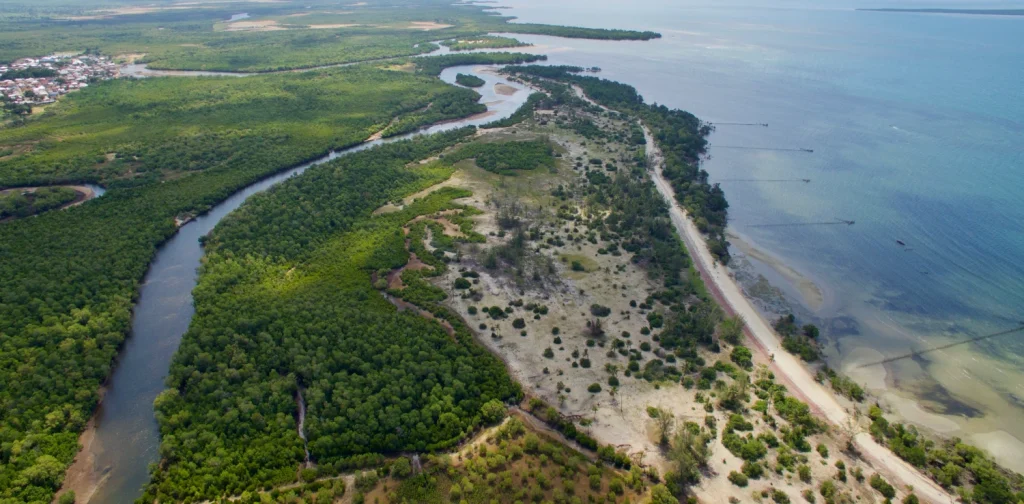
Gazi Bay, Kenya. | Photo: Rob Barnes for the GEF Blue Forest project.
Under the seas and along the coasts, nature is quietly performing one of nature’s most efficient climate services: carbon storage. Scientists call the carbon these ecosystems capture and store “Blue Carbon”, and Africa holds an outsized share of it. With it, comes an outsized share of disputes over who actually gets to claim the benefits.
What Is Blue Carbon?
Carbon dioxide is an essential part of the Earth’s atmosphere. But it is also a primary part of greenhouse gases that drive climate change. Today, the world is racing towards decarbonization. We attempt to greatly limit the emissions of human-induced carbon dioxide into the air to halt global warming. While modern technology and innovation is necessary in this effort, our planet also naturally provides the very service we need for that.
Blue carbon is carbon dioxide absorbed from the atmosphere and stored in coastal vegetation, ocean sediment, and marine life. Mangroves, tidal marshes, and seagrass beds sequester carbon per acre at rates far higher than tropical rainforests, according to findings from the Blue Carbon Initiative. With all of Earth’s oceans and coastlines, the potential is massive.
Africa holds roughly 19% of the world’s mangroves. West Africa alone contains an estimated 1.97 million hectares of mangroves storing 854 million metric tons of carbon, plus nearly 5 million hectares of seagrass and over a million hectares of salt marsh. That is a substantial climate asset sitting in soil most people never see. But under global carbon markets, it can, in theory, become tradable credits that benefit people and the planet alike
Who Owns Blue Carbon?
In theory, three parties have a claim: national governments, who typically hold formal legal title to coastal land; local communities, who have fished and managed these ecosystems for generations under customary rights that are rarely written into law; and private developers, who bring the financing and technical expertise to actually run a carbon project.
In practice, however, a horizon scan surveying 41 experts across 20 African countries found many barriers to scaling blue carbon in Africa and beyond. The most glaring issue is precisely that most national and international laws never specify how those three parties are supposed to share what a marine or coastal ecosystem is worth. So, the continent struggles with weak law enforcement, unresolved land tenure, and unclear carbon rights, among others.
Blue carbon is still a growing market in need of way more guidance than it has now. As of late 2025, the market was still small enough that ambiguity has not yet been forced to a reckoning. Only 81 blue carbon projects existed worldwide, and just 10 were actively issuing credits.
Bad Practices, Good Practices
Tanzania shows what happens when a foreign broker moves faster than local consent. In 2023, Dubai-based Blue Carbon LLC signed an agreement covering roughly 138,000 acres of mangroves as part of a broader forest concession. The Tanzanian government is set to retain 61% of carbon credit revenue. But beyond that, there is no clear framework spelling out what, if anything, reaches the coastal communities who have been living and depending on those coastlines for years and years, maybe even generations.
Madagascar shows a subtler failure: not a land grab, but a legal gap. The Tahiry Honko mangrove project in the Bay of Assassins is a result of co-designing with local communities. Yet, national policy directs 22% of carbon revenue straight to the government with no mechanism to transfer them to communities. Meanwhile, the project has struggled to issue any blue carbon credit certificates at all. Good intentions run straight into a wall of outdated legal framework.
On the other hand, Kenya shows what fixing that gap looks like. Kenya’s success stories are the Mikoko Pamoja project in Gazi Bay and its larger sister project, Vanga Blue Forest. Notably, they only became possible after Kenya amended its climate change act specifically to give coastal communities enforceable rights over mangrove carbon. Residents co-manage both projects, and credit revenue funds schools, clean water, and healthcare.
A Way Forward
The pattern across all three cases is the same. It highlights how projects succeed when carbon rights are written into law before a deal is signed, not negotiated after the fact. That means formally recognizing customary tenure, requiring certification against a recognized standard rather than a broker’s own terms, and mandating public disclosure of revenue splits. These are the same integrity questions Asia’s carbon markets are currently wrestling with.
International tools already exist to build from. Some key blueprints include the Voluntary Guidelines on the Responsible Governance of Tenure and the Core Carbon Principles from the Integrity Council for the Voluntary Carbon Market. Applied consistently, and modeled on what Kenya has already proven works, these safeguards could let Africa’s coastlines capture blue carbon’s real value, rather than becoming its latest cautionary tale. Ultimately, though, we must be careful not to turn this potential into yet another system that takes advantage of nature and the people for material profit that only benefits a handful of those already in power.
Editor: Nazalea Kusuma

Co-create positive impact for people and the planet.
Amidst today’s increasingly complex global challenges, equipping yourself, team, and communities with interdisciplinary and cross-sectoral insights on sustainability-related issues and sustainable development is no longer optional — it is a strategic necessity to stay ahead and stay relevant.
 Whimsymaxxing and Beyond: Rethinking the Waste Behind Viral Trends
  Seeking Guidance from Karl Marx to Face the Climate Catastrophe
  Indonesia’s Greenwashing Diplomacy at COP31 and Beyond
  The Textile Industry Is Growing, and So Is Textile Wastewater
  EESG: We Need a New Economic Narrative for Sustainability in the Age of AI, Energy Crisis, and Geopolitical Divide
  The Continued Struggle for Equality and Dignity in Women’s Sportswear