

The Existence of Civil Society Organizations in Indonesia Through A Data Lens
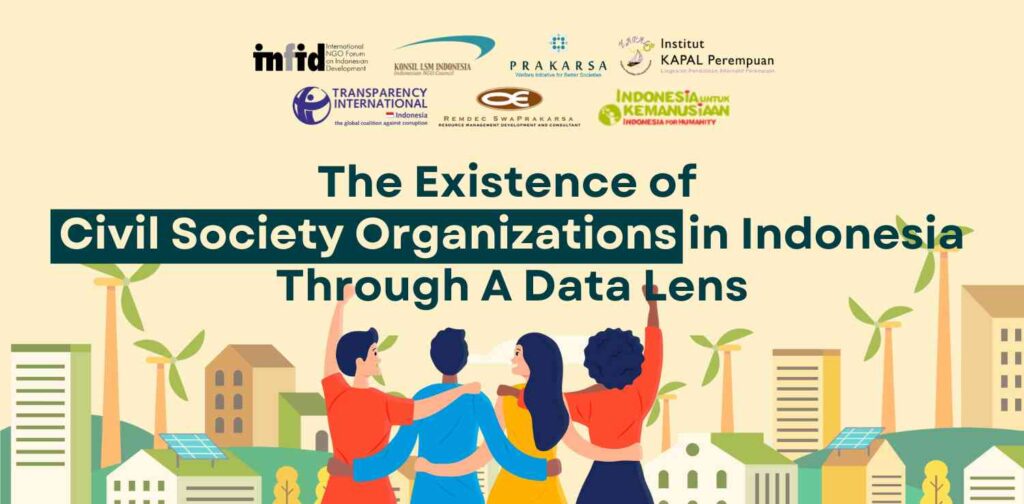

Civil Society Organizations (CSOs) in Indonesia have a crucial role as the bridge that connects the needs of citizens with the state. However, the survival and sustainability of CSOs are threatened due to the lack of financial support from international and national donors.
To overcome this problem, the CSO Endowment Fund Working Group was established in 2021 to work on an endowment fund policy for CSOs in Indonesia. This working group consists of INFID, KAPAL Perempuan, Perkumpulan Prakarsa, Konsil LSM, Penabulu, Transparency International Indonesia (TII), Remdec Swaprakarsa, and Indonesia for Humanity (IKa).
The Indonesian NGO Council, in collaboration with INFID, conducted a survey to determine existing conditions, institutional capacity, capacity-building models, and CSO empowerment models in Indonesia, which will be used as the basis for formulating and implementing the CSO Endowment Fund policy.
Based on the survey, what are the existing conditions and institutional capacity of CSOs in Indonesia?
Learn about the existing conditions and institutional capacity of CSOs in Indonesia by downloading the “Laporan Survei Kondisi Eksisting dan Kapasitas Kelembagaan OMS di Indonesia 2024” (available in Bahasa Indonesia) here.

Co-create positive impact for people and the planet.
Amidst today’s increasingly complex global challenges, equipping yourself, team, and communities with interdisciplinary and cross-sectoral insights on sustainability-related issues and sustainable development is no longer optional — it is a strategic necessity to stay ahead and stay relevant.
 We May Surpass 1.5°C Soon, But We Can Do Something About It
  From European Heat to the Himalayan Flood: The Transboundary Nature of Climate Risk
  Noise Pollution Is Making Us Sick, and Climate Change Is Making It Worse
  Beyond Fashion: The Environmental Cost Behind Animal Leather
  Addressing the Hidden Risk of Microplastics from Offshore Infrastructures
  Addressing Antimicrobial Resistance as More Than a Medical Issue