

Looking into the School Feeding Programs in Latin America and the Caribbean
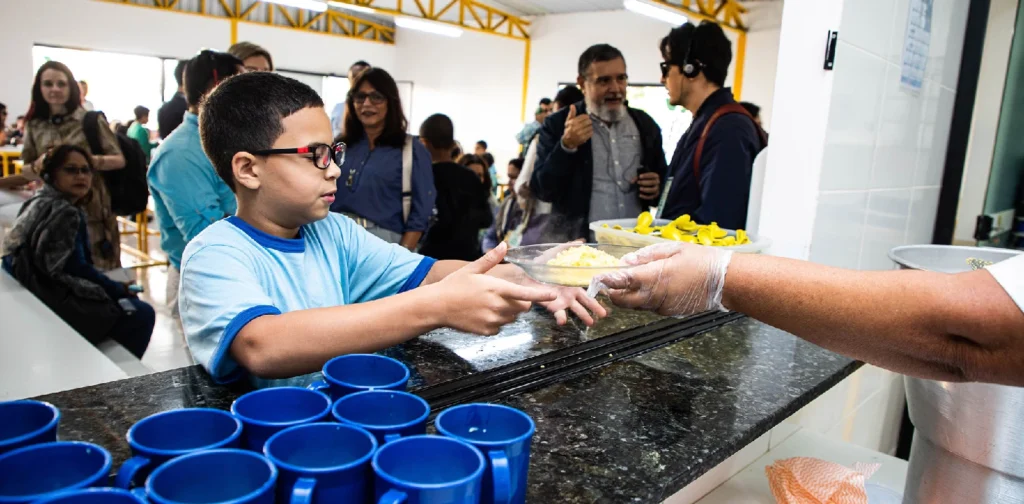
Photo: FAO
Adequate and balanced nutrition is essential for children’s physical and cognitive development, which directly affects concentration and academic performance. However, child malnutrition remains a global challenge. Thus, free school meal programs emerge around the world as an effort to tackle the issue. In Latin America and the Caribbean (LAC), the Regional Agenda for Sustainable School Feeding (RAES) aims to integrate school feeding programs into permanent national policies and strengthen existing ones.
Child Malnutrition and School Feeding Programs
In 2022, around 149 million children under five suffered from stunting due to chronic malnutrition, while 45 million experienced wasting or acute malnutrition. The LAC region is not an exception. A UN report reveals that around 131.3 million people there were unable to access a healthy diet in 2020 due to high cost. Furthermore, according to the report, children under five and women were more likely to be food insecure than men.
Child malnutrition is a structural issue, and tackling it requires more than one approach. Still, school feeding programs are increasingly recognized as an effective nutritional aid as well as a strategic investment in education, health, and sustainable development. Globally, more than 418 million children benefit from such programs. The impacts include improved learning outcomes and reduced school dropout rates. Moreover, when school feeding programs source from smallholder farmers, they also contribute to building stronger local economies.
RAES, National Ownerships, and Local Involvement
In Latin America and the Caribbean (LAC), this vision led to the Regional Agenda for Sustainable School Feeding (RAES). Developed by the Brazilian government with the support of the UN’s Food and Agriculture Organization (FAO), the Agenda aims to demonstrate how LAC countries can integrate school feeding programs into long-term national policy commitments. It emphasizes the importance of national ownership, localization, budget allocation, as well as regulation and monitoring.
RAES adopts a funding model inspired by Brazil’s National School Feeding Program (PNAE), which requires at least 30% of the budget to be spent on food from family farmers. RAES implements the Home-Grown School Feeding (HGSF) approach that connects schools with local farmers. This system helps create stable markets for smallholder farmers and reduce reliance on food imports, aligning child nutrition with education and community development.
Additionally, capacity building and proper monitoring are key components to the Agenda. At the regional level, RAES facilitates knowledge exchange through forums, certification programs, and online platforms with training and policy guidelines. Teachers receive training and regional study visits to support cross-country learning. RAES has also published an analytical study of ongoing school feeding programs to better inform policymakers of what works and what challenges remain. That way, governments can be effective in securing funding and strengthening local, regional, and international partnerships.
Toward Better Nutrition for All Children
The school feeding programs have obvious benefits, and RAES may offer a replicable model for other regions. Yet, it is far from enough.
It is crucial to treat child malnutrition as a complex issue with multiple interlinking factors, from poverty to pollution and climate change. All in all, governments, the private sector, and civil society must create a collaborative environment that enables intervention programs in health services, social protection, education, and agriculture and food systems.
Editor: Nazalea Kusuma

Co-create positive impact for people and the planet.
Amidst today’s increasingly complex global challenges, equipping yourself, team, and communities with interdisciplinary and cross-sectoral insights on sustainability-related issues and sustainable development is no longer optional — it is a strategic necessity to stay ahead and stay relevant.
 Whimsymaxxing and Beyond: Rethinking the Waste Behind Viral Trends
  Seeking Guidance from Karl Marx to Face the Climate Catastrophe
  Indonesia’s Greenwashing Diplomacy at COP31 and Beyond
  The Textile Industry Is Growing, and So Is Textile Wastewater
  EESG: We Need a New Economic Narrative for Sustainability in the Age of AI, Energy Crisis, and Geopolitical Divide
  The Continued Struggle for Equality and Dignity in Women’s Sportswear