

Exploring Seaweed Farming for Climate Action and Community Resilience
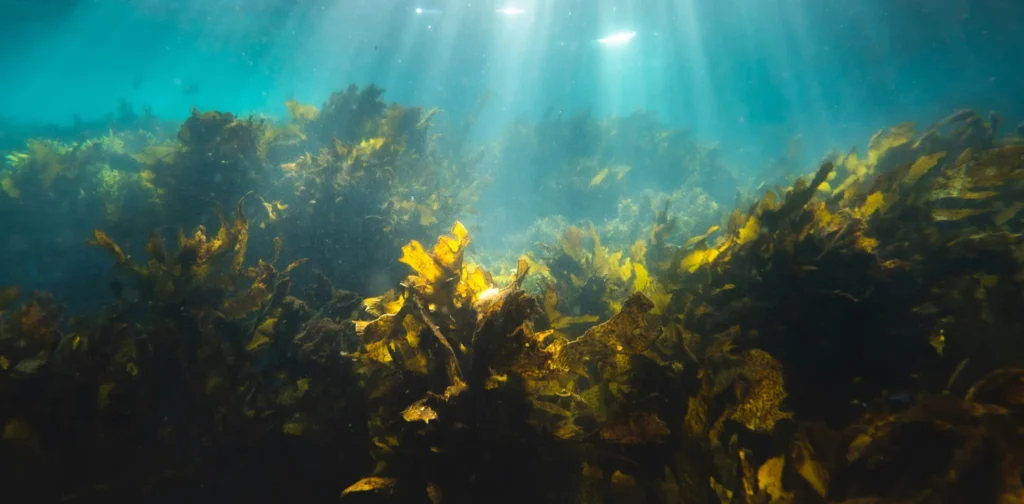
Photo: Silas Baisch on Unsplash.
Amid growing pressure from climate change and human activities, our oceans are under threat. In this light, seaweed offers potential as a nature-based solution due to its ecosystem services for humans and biodiversity alike. As such, expanding seaweed farming may become a key element in building healthy marine ecosystems and resilient coastal communities.
Nature-Based Solution for Climate and Ocean Health
Seaweed plays a strategic role in addressing the climate crisis and maintaining ocean health. Seaweed forests and kelp are known to absorb large amounts of carbon dioxide, produce oxygen, and help stabilize ocean pH levels.
A study estimates that global seaweed ecosystems can absorb up to 173 million tons of carbon annually, making them a natural solution for climate change mitigation. Other research has revealed that seaweed beds can store carbon in sediments at levels comparable to other coastal ecosystems such as mangroves, salt marshes, and seagrass meadows.
In this case, expanding seaweed farming globally could potentially remove up to 140 million tons of CO₂ per year by 2050. Older and larger seaweed farms also demonstrate greater carbon storage capacity. Seaweed farming also contributes to coastal protection by reducing erosion and absorbing excess nutrients that degrade water quality. The seaweed ecosystems cultivated in the farms can reduce up to 30% of wave energy during storms, while providing essential habitats for commercially valuable fish species.
Food Security and Community Resilience
From a socio-economic perspective, the ecological potentials mentioned above also form a strong foundation for coastal communities to adapt and build sustainable economic resilience. Moreover, the seaweed itself offers opportunities to strengthen food security. Seaweed can grow rapidly without requiring fertile land or freshwater, making it a nutritious food source that is rich in protein, fiber, and various micronutrients.
In 2021, the global seaweed production reached approximately 36.3 million tons, with 97% coming from aquaculturereflecting rapid growth and significant economic potential for coastal communities. The seaweed farming industry has empowered millions of people, with around 40% of enterprises in this sector led by women.
One of the initiatives that supports seaweed farming is the Blue Horizon: Ocean Relief through Seaweed Aquaculture program initiated by the World Wildlife Fund (WWF). The program aims to build a sustainable seaweed value chain in Southeast Asia, while delivering ecological benefits such as mitigating eutrophication and ocean acidification, as well as socio-economic benefits through improved income and resilience of coastal communities.
Building a Sustainable Future for Seaweed Farming
Despite global demand growth, several challenges remain in ensuring sustainable seaweed farming practices.
A report by the UNEP mentioned several environmental risks, such as entanglement of marine megafauna from seaweed farming infrastructure, competition with wild habitats for nutrients and light, and pollution. Additionally, climate change impacts on ocean temperature and acidity, ecosystem disruptions caused by extreme weather, and the spread of diseases and pests can disrupt the productivity of seaweed farming.
To address these challenges, advancements in farming technology, genetic research, and adaptive risk management are essential to ensure that the seaweed industry not only survives but thrives in a way that benefits people and the planet. Cross-sector collaboration among governments, researchers, private actors, the youth, and coastal communities is crucial to developing policies that support environmentally responsible and inclusive aquaculture practices.
Editor: Nazalea Kusuma & Kresentia Madina

Co-create positive impact for people and the planet.
Amidst today’s increasingly complex global challenges, equipping yourself, team, and communities with interdisciplinary and cross-sectoral insights on sustainability-related issues and sustainable development is no longer optional — it is a strategic necessity to stay ahead and stay relevant.
 Seeking Guidance from Karl Marx to Face the Climate Catastrophe
  Indonesia’s Greenwashing Diplomacy at COP31 and Beyond
  The Textile Industry Is Growing, and So Is Textile Wastewater
  EESG: We Need a New Economic Narrative for Sustainability in the Age of AI, Energy Crisis, and Geopolitical Divide
  The Continued Struggle for Equality and Dignity in Women’s Sportswear
  Behavior Change for the Planet: Is composting worth it?