

Natural Regeneration for a More Cost-Effective Forest Restoration
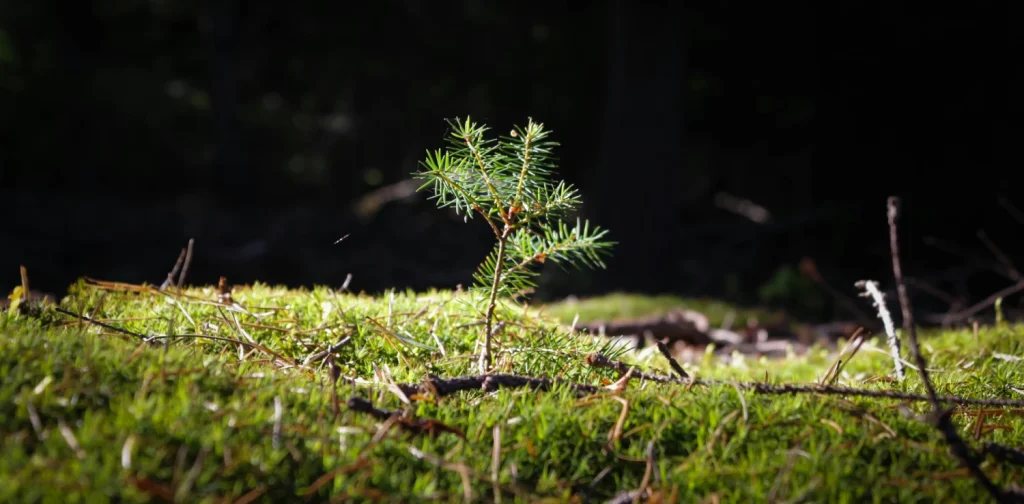
Photo: Thomas Konings on Unsplash.
Much of life on Earth relies on the presence of healthy natural forests. Unfortunately, these pillars of life are dwindling, primarily due to land conversion for economic and development purposes. Amidst forest restoration efforts, natural regeneration, which allows forests to recover on their own, emerges as a more cost-effective approach.
The High Cost of Forest Restoration
The Kunming-Montreal Global Biodiversity Framework, signed by 196 countries, mandates the conservation of 30% of land, sea, and inland waters and restoration of 30% of degraded ecosystems by 2030. These targets, of course, include forests. More specifically, the Framework’s Target 10 mentions the sustainable management of areas for forestry.
Forest restoration efforts have so far focused on planting trees in degraded or cleared forest areas. Unfortunately, these projects are expensive. According to a study which analyzed data from 243 restoration projects, restoring degraded land worldwide will cost around US$311 billion to US$2.1 trillion. Another study suggests that these costs will continue to rise, reaching US$393 billion annually by 2055. The cost would depend on climate targets and the combination of policies.
Natural Regeneration for Forests
With the high cost of forest restoration, an alternative method has emerged: natural regeneration. Essentially, the natural regeneration approach is about allowing forests to recover on their own. It has potential as a more cost-effective and sustainable solution than tree planting.
A study published in Nature estimates that approximately 215 million hectares of tropical forest land could potentially recover on their own. This much forest restoration would sequester approximately 23.4 billion tons of carbon from the atmosphere over a 30-year period. The study has identified Brazil, China, Indonesia, Mexico, and Colombia as countries that could contribute 52% of this potential.
“Tree planting in degraded landscapes can be costly. By leveraging natural regeneration techniques, nations can meet their restoration goals cost effectively. Our model can guide where these savings can best be taken advantage of,” said Brooke Williams, the study’s co-lead author and a researcher at the Queensland University of Technology, Australia.
The study used satellite data to identify areas where forests had regenerated. The researchers utilized machine learning to exclude areas restored through tree planting and only included areas of natural regeneration as input to their model. They also incorporated various biophysical variables that support forest regrowth, such as soil chemistry, proximity to other forests, and wildfire frequency between 2001 and 2017, to identify areas with the highest chance of regeneration.
“Here’s areas that, if you just let them go, will pop back into rainforests quickly,” explained Matthew Fagan, the study’s co-lead author. “It’s incredibly impressive. [At] 3 years old, it’s over your head; 5 years, you’re under shade.”
Robust Policy Support and Community Engagement
The natural regeneration of forests is an implementation of ecosystem-based adaptation. Besides contributing to emissions reduction, forest restoration also means restoring clean water sources, maintaining soil health and stability, and restoring the natural habitats of various wildlife species. So, countries with tropical rainforests can and should use the study’s findings to inform their policy-making regarding forest restoration.
However, the natural regeneration of forests is not as simple as letting grass and shrubs grow wild in our yard. This approach requires the meaningful involvement of Indigenous Peoples and Local Communities as key actors in forest restoration. This is crucial, given that maintaining young forests is far more difficult than simply allowing them to grow. The threats of land clearing for agriculture and forest fires, among others, remain as challenges to anticipate. Therefore, natural regeneration still requires robust long-term protection mechanisms.
“This [study] just shows possibility. Persistence is the other half of it, and persistence is through policy. It’s through working with people. It’s through building partnerships and finding ways for people to extract money out of young forests and make them a good financial investment,” added Fagan. “They’re cheap to establish. They’re not necessarily cheap to keep around.”
Translator: Nazalea Kusuma
The original version of this article is published in Indonesian at Green Network Asia – Indonesia.

Co-create positive impact for people and the planet.
Amidst today’s increasingly complex global challenges, equipping yourself, team, and communities with interdisciplinary and cross-sectoral insights on sustainability-related issues and sustainable development is no longer optional — it is a strategic necessity to stay ahead and stay relevant.
 Behavior Change for the Planet: Is composting worth it?
  Building Bridges Between Environmental Policy and Mental Health
  We May Surpass 1.5°C Soon, But We Can Do Something About It
  From European Heat to the Himalayan Flood: The Transboundary Nature of Climate Risk
  Noise Pollution Is Making Us Sick, and Climate Change Is Making It Worse
  Beyond Fashion: The Environmental Cost Behind Animal Leather