

What Australia Can Do to Help Prevent the Next Fire Crisis in Indonesia
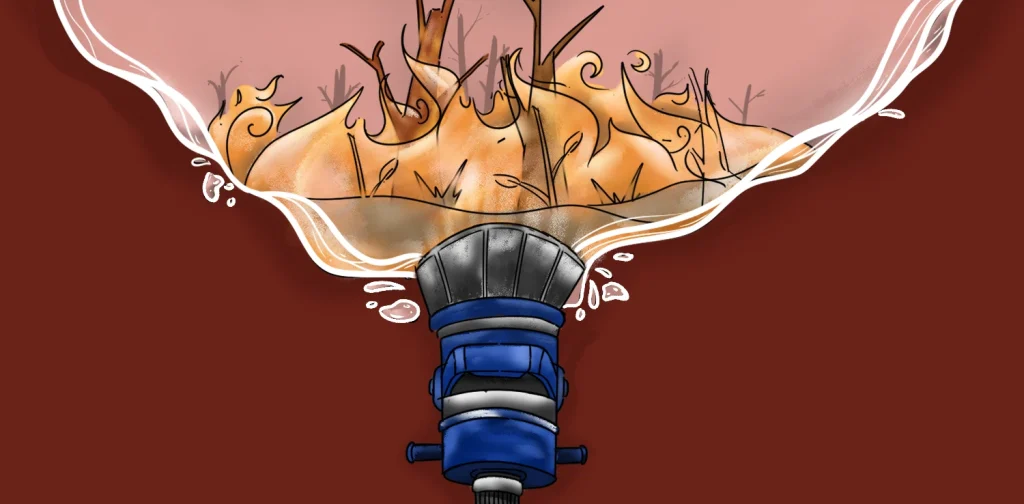
Illustration by Irhan Prabasukma.
As days get warmer, the urgency to mitigate the possibility of a fire crisis in Indonesia gets more real. The country’s past experience of major fire disasters of 1997, 2006, and 2015 all coincided with El Niño-driven droughts. Then, in 2026, the government itself has warned that a so-called “Godzilla El Niño”, combining extreme Pacific sea surface warming with a positive Indian Ocean Dipole, is intensifying drought risks across much of the archipelago through April to October. And this time, Indonesia is “welcoming” El Niño without a dedicated peat governance body, with responsibilities fragmented across ministries, and with fire data already showing increasing even under relatively benign conditions.
The Fire Crisis in Indonesia
A significant institutional change occurred in Indonesia at the end of 2024. The Peat and Mangrove Restoration Agency, created after the catastrophic 2015 fire season to coordinate peatland rewetting and protection, reached the end of its mandate and was not renewed. No equivalent successor body was established. Instead, its responsibilities were spread across multiple ministries, including environment, forestry, and marine affairs, raising concerns about fragmented oversight and the absence of a clear coordinating authority.
The consequences are already visible in satellite data. In January 2026, at the height of the rainy season when fire activity is typically low, Indonesia’s monitoring systems recorded 110 hotspots nationwide, up from 29 in the same month a year earlier. By late March, fires had already burned more than 2,700 hectares of land in Riau, one of Indonesia’s provinces that is often hit by fires every year.
Furthermore, beyond the changing climate, various other challenges contribute to the recurring fires in Indonesia. Issues such as tenure conflicts, economic dependence on land clearing, and the scale of restoration required means Indonesia must build robust governance frameworks that address all causes and risks. To do so, the country cannot walk alone.
Australia-Indonesia Partnerships
This is where the regional partnership becomes critical. Australia and Indonesia have built strong technical cooperation, but durable governance has been harder to sustain. This matters enormously for a bilateral relationship that is now in one of its most productive phases. The 2024 Defence Cooperation Agreement, the SIAP SIAGA disaster resilience program, and expanding climate and infrastructure partnerships all reflect genuine depth.
Yet, experience over two decades of collaboration suggests a persistent gap. The two countries have been effective at launching programs, but less consistent in embedding the kind of institutions that endure beyond them.
A cautionary example is the Kalimantan Forests and Climate Partnership (KFCP), which spent around A$40 million between 2007 and mid-2014 on a REDD+ demonstration activity in Central Kalimantan. Although it delivered valuable research, it failed to trial performance-based payments for emission reductions. Major constraints included an uncertainty of purpose, unrealistically expansive, unresolved land tenure, and insufficient sub-national government engagement.
Furthermore, initiatives such as Gambut Kita (Our Peatlands) is producing research that operates alongside, rather than being fully integrated into, the policy frameworks and local institutional arrangements that govern land clearing and burning. The diagnosis of what drives peatland forest fire has been made many times. However, translating research findings into durable policy and institutional solutions in Indonesia has proven far more difficult.
Building Frameworks
In practice, targeted Australian technical and financial assistance could support Indonesia in establishing a credible cross-sectoral fire governance body. Indonesia already has the National Agency for Disaster Countermeasure. However, the fire crisis in Indonesia requires institutional design focused on prevention coordination and incentive alignment.
Australia’s National Emergency Management Agency provides lessons as a federal coordinating agency that facilitates collaboration across government and non-government actors. It emphasizes situational awareness, flexible coordination, information sharing, and networked decision making. Australia’s support could help establish a backed body linking ministries, provinces, and regencies, ensuring continuity.
At the same time, institutional redesign alone will not be sufficient. Indonesia’s fire problem is deeply rooted in land tenure ambiguity and in the economic logic that continues to reward land clearing. Australia’s experience offers relevant lessons. The Native Title Act 1993 demonstrates how formal recognition of community land rights can strengthen tenure security. With this reference, Australia could help Indonesia accelerate cadastral mapping of Indigenous and local community forest boundaries in peat-prone districts.
Meanwhile, the Carbon Farming Initiative shows how payments linked to verified emissions reductions, supported by robust measurement and mapping systems, can create financial incentives for improved land management. Thus, with Australia’s support, Indonesia can also capitalize on a results-based payment facility that rewards verified zero-burning outcomes through national satellite monitoring systems. The Indonesian government can also embed fire-free compliance as a soft conditionality within government-backed smallholder credit programs, working through institutional channels that farmers and plantation managers already engage with.
From Reactionary to Endurance
Alongside these longer-term reforms, the fire crisis in Indonesia faces an immediate risk window. Forecasts of a potential El Niño-driven drought in 2026 highlight the need for short-term preparedness. This includes pre-positioning firefighting resources, strengthening early warning systems, and establishing clear interagency response protocols ahead of the peak fire season. High-tech monitoring platforms, such as Geoscience Australia’s Digital Earth and emerging IoT-based fire detection networks, can significantly improve situational awareness. However, their value depends on whether district-level authorities are equipped to respond quickly.
Within this broader framework, Australia’s role is best understood as supporting Indonesian-led reform rather than designing institutions from the outside. Its comparative advantage lies in sharing experience on interagency coordination, risk-based planning, and multi-level governance, while helping to test adaptable approaches that fit Indonesia’s political and administrative context. Past initiatives have shown that technical solutions alone are not enough. The priority now is to ensure that international cooperation strengthens institutions that endure, instead of projects that conclude.
Editor: Nazalea Kusuma

Co-create positive impact for people and the planet.
Amidst today’s increasingly complex global challenges, equipping yourself, team, and communities with interdisciplinary and cross-sectoral insights on sustainability-related issues and sustainable development is no longer optional — it is a strategic necessity to stay ahead and stay relevant.

Mohd. Yunus
Mohd. Yunus is a researcher from Indonesia. He holds a master’s degree in biological sciences from Khon Kaen University, Thailand. His expertise includes ecology, environmental economics, conservation, and sustainability.
 The Continued Struggle for Equality and Dignity in Women’s Sportswear
  Behavior Change for the Planet: Is composting worth it?
  Building Bridges Between Environmental Policy and Mental Health
  We May Surpass 1.5°C Soon, But We Can Do Something About It
  From European Heat to the Himalayan Flood: The Transboundary Nature of Climate Risk
  Noise Pollution Is Making Us Sick, and Climate Change Is Making It Worse