

By Design, not Destiny: Escaping from Capitalism with Clara Mattei Amidst Collective Fatigue
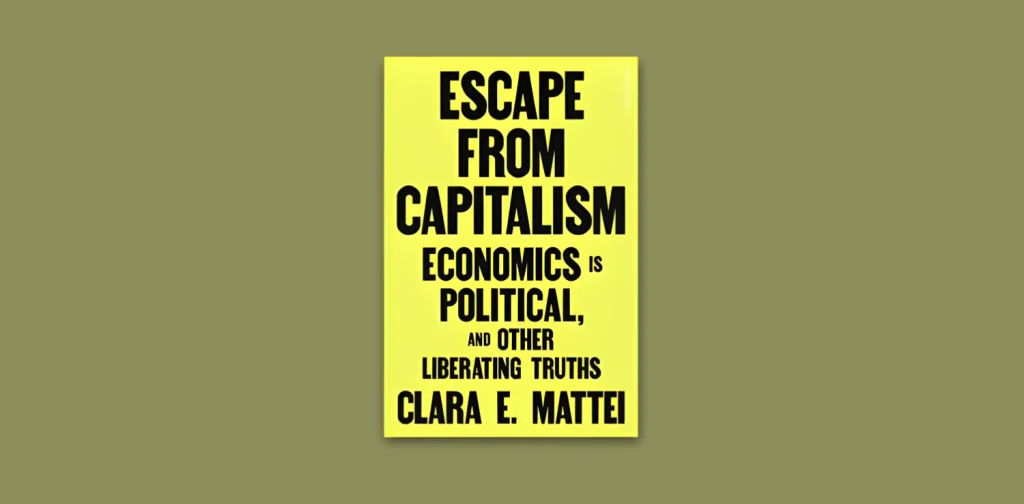
Book Cover “Escape from Capitalism: Economics is Political, and Other Liberating Truths” by Clara Mattei. | Publisher: Penguin Books Ltd (2026).
A collective fatigue seems to be haunting our generation. It’s not just physical and mental fatigue, but epistemic fatigue. It’s the fatigue that comes from being constantly told there’s no other way. We are supposed to believe that unemployment is the price to pay for price stability; that budget cuts on public services are a bitter but necessary medicine; that the free market, however painfully throbbing, is humanity’s best devised mechanism for allocating resources. Amidst this exhaustion, Clara Mattei, a professor of economics at the University of Tulsa and founder of the Forum for Real Economic Emancipation (FREE), has released a short but powerful book titled “Escape from Capitalism: Economics is Political, and Other Liberating Truths”. Its main message can be summed up in one sentence: the fatigue we feel is not by destiny, but by design.
Clara Mattei is by no means a newcomer to the table. Her previous book, The Capital Order (2022), placed her at the forefront of intellectual exploration of the historical roots of government austerity and its surprising connection to the rise of fascism in early 20th-century Europe. The Capital Order was praised by the Financial Times as one of the best economics books of the year and translated into more than a dozen languages. Now, with Escape from Capitalism, Clara Mattei has streamlined her argument, amplified her critiques, and addressed them directly to the general public. She is talking not to academics, but to the millions of people around the world struggling with bills, wages, and the unnamed despair and hopelessness. I may be hard-pressed to find a more insightful economics book this year.
The Apolitical Mask
The book’s most fundamental argument is a claim that feels provocative. But once Mattei lays out the evidence, it’s hard to refute: mainstream economics has never been neutral. It has never truly stood outside the political arena as an objective referee. It is part of that arena, or rather, it is a tool used by one side to win the game before the whistle even blows.
Clara Mattei brilliantly traces the genealogy of this claim to “neutrality” back to the aftermath of World War I, when a shattered world needed a new authority. Amidst the chaos, economics was elevated to the status of a science, equipped with mathematical formulas, new institutions, and technical language deliberately too complex for ordinary people to understand. This move, Mattei argues, was not merely an intellectual advancement. It was a political maneuver. By wrapping decisions about the distribution of power in differential equations, economists have succeeded in moving the debate about who gets what—a question that should be decided democratically—into spaces closed off from the reach of ordinary citizens.
The result is what Mattei calls the greatest ideological trap of the modern age: capitalism presented as a natural law instead of a political choice. Just as gravity cannot be lobbied against, the free market seems non-negotiable. Anyone who questions it is dismissed as naive, sentimental, or—in the words most often used to end the debate—“unrealistic”.
The Four Lenses of Understanding
This book utilizes four analytical lenses to examine the architecture of capitalism: austerity, unemployment, Western domination, and democracy. Each chapter deconstructs a concept long accepted as economic fact and reveals behind it political choices that benefit only a select few. For me, each chapter is like a mind-boggling semester of college classes.
The first lens is austerity, and Clara Mattei writes about it in controlled anger. She exposes the dominant narrative about austerity, that governments should “tighten their belts” like a sensible household, as a misleading analogy. States are not households. And public service budget cuts are not simply neutral austerity; they are a redistribution away from the healthcare, education, and social security benefits enjoyed by the many toward the tax incentives and asset protection benefits enjoyed by the super-rich few. Austerity, in Mattei’s framework, is not an unpleasant side effect of capitalism. As she puts it, it is a feature, not a bug.
The second lens is unemployment, and it is here that Mattei makes her most compelling argument. Unemployment, she asserts, is not a systemic failure but a systemic necessity in capitalism. Those with capital power fear a situation where every worker is fully absorbed into the labor market, because under such conditions, workers have bargaining power. They can demand higher wages, shorter working hours, and more humane working conditions. This situation is understood to inevitably reduce profits. Therefore, a certain level of unemployment must be maintained. The real reason is not because the economy is incapable of creating jobs, but because this supposed incapability is profitable. The phrase “natural rate of unemployment”, which has long been ubiquitous in economics textbooks, is, according to Mattei, a euphemism for a level of job insecurity necessary to keep workers subservient to the ones with capitals.
Western dominance, the third lens, extends the critique to the global level. Clara Mattei portrays international financial institutions such as the IMF and the World Bank, often praised as pillars of global stability, as exporters of the logic of capitalism to countries in the Global South. They do this through structural adjustment programs that force privatization, subsidy cuts, and market liberalization as conditions for loans. As a result, poor countries are forced to sacrifice their economic sovereignty in the name of “reforms”, which actually make them more dependent on Western capital. Mattei does not speak in abstractions; she presents data and analysis. She talks about education that is not accessible to everyone, clean water that is privatized, and farmers who are marginalized by subsidized imports.
The fourth lens, and perhaps the most disturbing, is democracy. Clara Mattei proposes a bold thesis: capitalism and true democracy cannot coexist. She’s not talking about how capitalism always coexists with dictatorship—it clearly does not. She explains her reasoning that capitalism systematically moves the most crucial economic decisions out of the reach of democratic processes. Central banks set interest rates, rating agencies assess sovereign debt, international forums negotiate trade rules. These all operate outside the control of ordinary citizen voters. We may elect members of parliament, but parliaments do not choose who heads the central bank. We may elect presidents, but presidents cannot order the IMF, while the reverse continues to be true. Real economic power, Mattei argues, has been locked behind a door labeled “technical expertise”, and the key to unlocking that door has never been given to the people.
Pondering Clara Mattei’s Work
Escape from Capitalism’s greatest strength lies in its uncompromising moral clarity. In an era where intellectuals often retreat into seemingly endless uncertainty—every claim tempered with exceptions, every criticism tempered with praise—Clara Mattei chooses to speak bluntly. She doesn’t hide her biases. She stands with workers, neglected communities, and countries dictated by outside forces. And she does so with solid intellectual ammunition: history, data, and institutional analysis that cannot be easily refuted.
This book is also remarkably accessible for a text devoted to political economic theory. Mattei has a rare ability to explain technical mechanisms, like how interest rates work and why inflation is driven by corporate greed and not simply by money supply (greedflation), with simplicity without sacrificing depth. Her writing style makes me feel like I’m talking to a very intelligent friend explaining something in a cafe, rather than a professor lecturing from a university podium.
The personal dimension is also a strength. Clara Mattei opens the book with her family story: how she is the great-granddaughter of two Italian communist resistance fighters, Gianfranco and Teresa Mattei, who fought against the ideology of Fascism. This biographical setting is not merely an emotional ornament. From it, she is able to demonstrate that questions about economics are questions about human life: about who survives and who doesn’t, about what systems we pass on to the next generation.
Though, of course, the book is not without its flaws. At 224 pages, Escape from Capitalism feels like a manifesto that ends just as it should have begun. The section on alternatives, on what Mattei means by “economic democracy” in concrete terms, feels too brief or even vague. She cites the Mississippi barter community as an example of the seeds of an alternative economy. While that example is touching, readers like me who already agree with her diagnosis will be left intellectually hungry for more insight into how the transition from community-level barter to national or even international monetary reform works. How, for example, does economic democracy operate in Indonesia, with its 287 million people and economy integrated into global supply chains?
Clara Mattei also doesn’t adequately address the most serious criticism of her argument: that capitalism, however flawed and unjust, has lifted hundreds of millions of people out of extreme poverty. This is a debatable claim, but it can’t be dismissed. Defenders of capitalism will ask: what guarantee is there that an alternative system wouldn’t produce even more extreme poverty? Mattei is right to be skeptical of these statistics (and there’s a strong argument that the definition and boundaries of “extreme poverty” used are deliberately chosen to make capitalism look good), but I think she needs to address the question more directly.
Moreover, the book’s strong focus on the West—on the Federal Reserve, the IMF, and European history—sometimes makes the experiences of developing countries seem more like footnotes than the main subject. For readers in Southeast Asia, Africa, or Latin America, local voices of resistance to capitalism would have greatly enriched Mattei’s argument. Furthermore, capitalism has had a variety of negative impacts across all countries, on various scales; so, any analysis of its economic, social, and environmental impacts needs to begin with the many countries Mattei does not mention.
Choices Amidst Collective Fatigue
For those who long for economic and social justice and environmental sustainability, Escape from Capitalism is a nearly essential read. It may not provide all the answers, but it offers something even more valuable: a new perspective, particularly through these four lenses. After reading the book, we will no longer be able to hear the phrase “there is no alternative” without hearing the accompanying question: an alternative for whom?
Those interested can continue this intellectual journey with a number of complementary works. Clara Mattei’s The Capital Order (2022) provides a deeper historical foundation. Mariana Mazzucato’s The Value of Everything (2018) debunks the myth that economic value is created solely by the private sector. Kate Raworth’s Doughnut Economics (2017) offers a more concrete and environmentally friendly alternative framework, positing planetary boundaries as an indispensable economic parameter. And David Graeber’s Debt: The First 5,000 Years (2011) offers an anthropological perspective, demonstrating that money, debt, and markets are social constructs, not natural facts.
For activists and practitioners seeking concrete action, solidarity-based economy movements, worker cooperatives, and circular economy initiatives offer a pathway into the world Mattei is trying to imagine. In small pockets around the world, cooperatives and various community-based mutual assistance systems are evidence that economic logic beyond the free market is not just wishful thinking. It already exists, on various scales, among us.
Ultimately, this book is an invitation. Clara Mattei is inviting readers to stop accepting injustice as a “law of nature” and to start seeing it as the product of choices that, once made, can also be changed. Clara Mattei doesn’t promise utopia. She doesn’t offer a complete roadmap. What she offers is something rarer and more valuable in our time: a grounded belief that another world is not merely possible, but absolutely necessary.
And, perhaps, amidst our collective fatigue, that’s enough to begin again.
Editor: Abul Muamar
Translator: Nazalea Kusuma

Co-create positive impact for people and the planet.
Amidst today’s increasingly complex global challenges, equipping yourself, team, and communities with interdisciplinary and cross-sectoral insights on sustainability-related issues and sustainable development is no longer optional — it is a strategic necessity to stay ahead and stay relevant.

Jalal
Jalal is a Senior Advisor at Green Network Asia. He is a sustainability consultant, advisor, and provocateur with over 25 years of professional experience. He has worked for several multilateral organizations and national and multinational companies as a subject matter expert, advisor, and board committee member in CSR, sustainability, and ESG. He has founded and become a principal consultant in several sustainability consultancies as well as served as a board committee member and volunteer at various social organizations that promote sustainability.
 Building Bridges Between Environmental Policy and Mental Health
  We May Surpass 1.5°C Soon, But We Can Do Something About It
  From European Heat to the Himalayan Flood: The Transboundary Nature of Climate Risk
  Noise Pollution Is Making Us Sick, and Climate Change Is Making It Worse
  Beyond Fashion: The Environmental Cost Behind Animal Leather
  Addressing the Hidden Risk of Microplastics from Offshore Infrastructures