

The Battery Belt on Women’s Bodies: Looking into the Gendered Impacts of Cobalt Mining in Congo
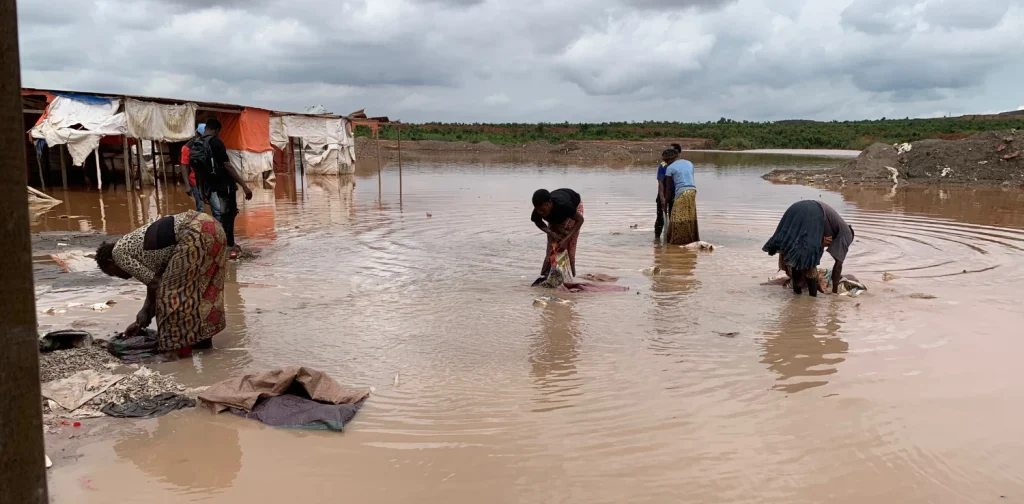
Photo: Afrewatch on Flickr.
The road to digitalization and decarbonization is not-so-easy. Concerningly, it is also not-so-ethical. The story is particularly grim for the women of Congo. Congo’s cobalt mining industry is booming, but the scene reveals who bears the cost of technological advancement and the global transition to clean energy.
The Cobalt Capital
Every smartphone, electric vehicle, or renewable energy battery in the world depends, in some part, on critical minerals like cobalt and nickel. And chances are, the cobalt comes from Kolwezi, a city in the southern Democratic Republic of Congo known as the world’s cobalt capital.
The Democratic Republic of Congo (DRC) yields approximately 70% of all the cobalt used in the world. With such a share of the supply chain, Congo may as well be the backbone of the global technology sector. Cobalt is also a vital component of lithium-ion batteries, aero-space alloys, and several renewable energy systems, making it key in the low-carbon transition.
A substantial amount of cobalt extraction occurs through artisanal or wildcat mining. These systems use miners that extract minerals without official permits or regulation. They exist with no labor laws, no safety regulations, and abundant reports of child labor. Many major Western- and Chinese-owned companies run cobalt mining groups in the country and often perpetuate the wildcat mining industry. Government officials, mining authorities, and manufacturing companies often turn a blind eye to these situations in the pursuit of profit.
Unsurprisingly, this practice is rapidly draining DRC of its resources and destroying the environment. But more than that, it comes at the cost of the lives of individuals working in the mines, as well as the people living in surrounding areas.
The Gendered Impacts
The numbers are difficult to read past. In 2024, the U.S. Department of Labor confirmed that more than three-quarters of cobalt miners in the DRC may be in modern slavery. This means they are working under conditions involving coercion or debt bondage.
Moreover, the exposure to risk is deeply gendered. An investigation by RAID and AFREWATCH looked into more than 22 scientific studies and community testimonies in the DRC. It found that 56% of residents interviewed near cobalt and copper mines reported a sharp rise in gynecological and reproductive problems among women and girls since industrial mining began. Women and girls in Congo are struggling with irregular menstruation, urogenital infections, and increasingly frequent miscarriages and birth defects.
Mongabay’s on-the-ground reporting echoes a similar story. Health workers in Kolwezi are seeing a steady stream of women arriving with threatened miscarriages, stillbirths, and infants born with severe congenital malformations. They link those to the use of contaminated water for washing, drinking, and daily hygiene near the mines.
Furthermore, this reproductive harm does not happen in isolation. In an investigation, Amnesty International interviewed more than 130 people across six cobalt and copper mining sites in and around Kolwezi. Evidently, the expansion of industrial-scale mining has led to forced evictions and human rights abuses, including sexual assault. One NGO study cited by the World Economic Forum found that 80% of women interviewed near cobalt mining sites had been physically forced into sexual relations in the prior year, often by the same police and security forces overseeing the mines.
A System of Injustice
All of those are interconnected outcomes of the same underlying conditions: poverty, weak regulation, and a justice system with little capacity to respond.
Artisanal miners in Congo lack clarity on the legal frameworks that guide their operations. And while officials and authorities have greater awareness, they, too, find it difficult to interpret and implement laws effectively. These existing legal frameworks often favor the interests of the government and foreign companies. Meanwhile, artisanal miners and Indigenous communities get sidelined. Strain between district interests and national policies further highlights the disjointed nature of Congo’s mining governance. Because of this perfect storm, legislative bodies can find legal loopholes and use them as opportunities for exploitation.
A major part of what allows this to continue is the near-total absence of accountability. World Economic Forum reports that despite extensive documentation of abuse, prosecutions for rape in cobalt mining areas remain exceedingly rare. They are hampered by chronic shortages of police, prosecutors, and even the basic resources needed to investigate. For women in mining communities, this means that violence and exploitation often come with no real avenue for justice or protection.
From Cobalt Mining to Just Transition
Ongoing analysis of due diligence laws now facing EV makers shows that the social and environmental costs of mining are increasingly recognized as material business risks, not peripheral ones. It is a critical, fundamental step.
Yet peer-reviewed research evaluating the EU corporate due diligence found that such legislation is unlikely to meaningfully improve conditions on its own. There must also be context-specific reforms shaped by the people at the heart of the operations. From stricter legislative laws to on-the-ground support , any rights-based development must center the communities most affected.
After all, a truly sustainable green technology supply chain is more than about the carbon emissions avoided. It must also account for the women whose reproductive health, safety, and bodily autonomy are currently treated as an acceptable cost.
Editor: Nazalea Kusuma
Co-create positive impact for people and the planet.
Amidst today’s increasingly complex global challenges, equipping yourself, team, and communities with interdisciplinary and cross-sectoral insights on sustainability-related issues and sustainable development is no longer optional — it is a strategic necessity to stay ahead and stay relevant.
 EESG: We Need a New Economic Narrative for Sustainability in the Age of AI, Energy Crisis, and Geopolitical Divide
  The Continued Struggle for Equality and Dignity in Women’s Sportswear
  Behavior Change for the Planet: Is composting worth it?
  Building Bridges Between Environmental Policy and Mental Health
  We May Surpass 1.5°C Soon, But We Can Do Something About It
  From European Heat to the Himalayan Flood: The Transboundary Nature of Climate Risk