

The Shrinking Safety Net: Inside the Global Collapse of Refugee Aid
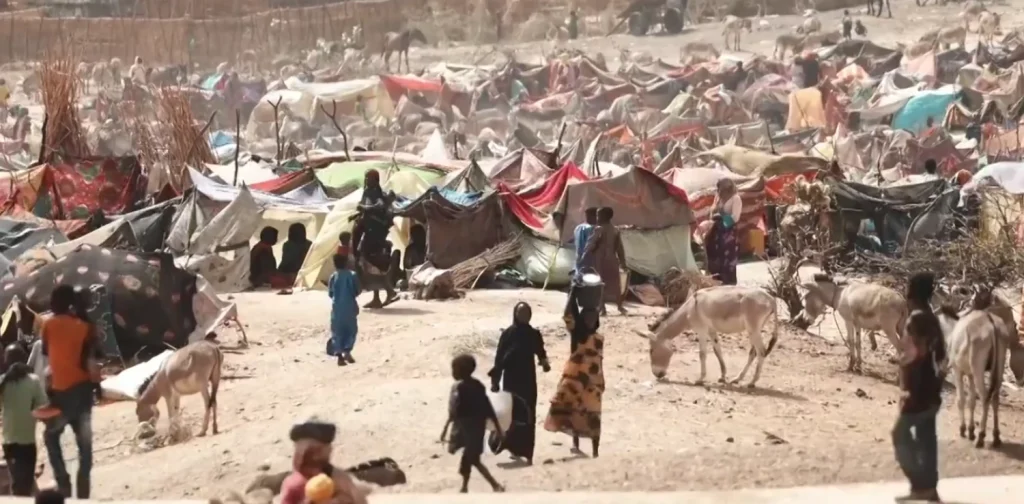
Sudanese refugee camp in Chad, May 2023 | Photo: Henry Wilkins/VOA.
One in every 70 people is now forcibly displaced. They flee wars, persecution, climate disasters, and collapsing states. And when they arrive at wherever it is they’ve run to, a safety net is supposed to catch them. Unfortunately, the refugee aid that should be funding the whole process is dwindling, exposing how fragile the web is now that it’s fraying faster than it has in decades.
A Crisis Bigger Than Any One Agency
Refugee aid is not a single system with a single budget. It spans governments, UN agencies, international NGOs, local civil society organizations, and private donors. They all operate under different mandates and funding models.
State governments are responsible for handling the refugees in and of their own countries. Globally, though, the Office of the United Nations High Commissioner for Refugees (UNHCR) coordinates efforts for most stateless and displaced people. There is also the UN Relief and Works Agency for Palestine Refugees in the Near East (UNRWA), with its own mandate to serve Palestinian refugees across its focus areas. On the ground, organizations like the International Rescue Committee, Médecins Sans Frontières, and thousands of local groups further fill the gaps.
Evidently, the system is as fragmented as the crises it responds to. And right now, nearly every part of it is under strain.
A Growing Need for Refugee Aid
There have never been more people forced from their homes than there are right now. According to the UNHCR, there were 41.6 million refugees around the world as of the end of 2025. Beyond that number, 68.7 million people were displaced within their own country due to conflict or violence.
The disarrays that create refugees seem to be persistent or even escalating. Conflicts in Sudan, Myanmar, the Democratic Republic of Congo, and Palestine, for instance, show no signs of resolution. Meanwhile, climate shocks are pushing people to move and fall into a legal grey zone. Displacement linked to climate hazards alone drove 26.4 million movements in 2023. The result is a record 136 million forcibly displaced and stateless people worldwide, a number that existing funding was never designed to support.
The Collapse
The UN’s overall global humanitarian appeal was already cut to $46 billion in 2024. This total amounted to what donors covered: barely a third of what was asked the year before. Since then, the pullback has deepened.
UNHCR’s 2026 budget sits at $8.5 billion, about 20% less than the year before. The shrinking fund manifests across the board, impacting workers and refugees alike. Nearly 5,000 staff, almost a quarter of the agency’s workforce, have lost their jobs. Around 12 million refugees are expected to lose direct assistance altogether.
The impacts on the ground are real. In South Sudan, 75% of safe spaces for women and girls have closed. Meanwhile, monthly funding per refugee has fallen from $11 to $4 in Sudan. This has forced the closure of two of three registration centers and left more than 71,000 refugee families in eastern Chad without shelter assistance. In Egypt, funding cuts have suspended medical treatment for thousands of refugees, including one man who lost access to the cardiac care keeping him alive.
For Palestinian refugees, the situation carries additional layers of political complexity. UNRWA, which operates schools, health clinics, and food programs for 2.4 million people across Gaza and the West Bank, is facing a compounding crisis: a US funding ban, Israeli legislation restricting its operations in areas considered Israeli sovereign territory, and a $220 million budget shortfall in 2026 that forced a 20% salary cut for local staff and the suspension of essential programs.
Why Refugee Aid Is Running Dry
Theoretically, refugee aid is meant to be neutral and impartial. But, as experts Nicholas R. Micinski and Kelsey Norman put plainly, in practice, funding is routinely used as a foreign policy tool, rewarding allies and punishing enemies. The currently dwindling global refugee aid reflects that pattern.
Much of the immediate damage traces back to the US pulling out of major humanitarian funding commitments in 2025. However, the deeper problem is structural.
Refugee crises are no longer short emergencies with a defined end date; they are protracted, decades-long situations. Moreover, climate change now adds to the muddling of the landscape, and the worst is yet to come. The donor-dependent, year-by-year refugee aid funding model was never built for that reality. Promises made in frameworks like the Rabat Declaration, which committed governments to extending health coverage to refugees and migrants, get harder to keep.
Ways Forward
The most urgent—and feasible—structural change is diversifying funding away from a small number of government donors. Tapping into the private sector, for example, is an opportunity. UNHCR’s national partner organizations, which raise money directly from the private sector, channeled $350 million into 2026 operations. This might be a model worth scaling significantly, given how exposed government budgets have proven to political shifts.
Furthermore, multi-year funding commitments, rather than annual pledges, would let agencies plan and staff properly instead of constantly triaging. Investing in host countries’ own inclusive health, education, and social infrastructure is also crucial. That way, refugees can integrate into robust, established systems rather than relying on parallel aid structures. These strategies tend to hold up better when international funding wavers.
Community-led responses also fill gaps where formal systems fall short. Organizations like the Sanad Initiative, run by displaced Palestinians in Cairo to support other Palestinian refugees in Egypt, show what locally-rooted, peer-led aid looks like in practice. Allocating support to those organizations can only help. Then, on an individual level, finding ways to support refugees in your own community will not close an $8.5 billion gap on its own, but it keeps pressure on the system to stay accountable to the people it exists to protect.
Safety Nets for All
The world needs refugee aid now more than ever; a retreat is not an option.
What’s clear is that a reactive, donor-dependent model that is always one political decision away from collapse is not enough. It simply cannot keep up with a world where displacement looms over every single person on the planet as the Earth heats up and divides widen.
Ultimately, a shift toward forward looking, diverse, and collaborative strategies in refugee aid is fundamental to weave safety nets that can protect all people amidst increasingly volatile realities.
Editor: Nazalea Kusuma

Co-create positive impact for people and the planet.
Amidst today’s increasingly complex global challenges, equipping yourself, team, and communities with interdisciplinary and cross-sectoral insights on sustainability-related issues and sustainable development is no longer optional — it is a strategic necessity to stay ahead and stay relevant.
 We May Surpass 1.5°C Soon, But We Can Do Something About It
  From European Heat to the Himalayan Flood: The Transboundary Nature of Climate Risk
  Noise Pollution Is Making Us Sick, and Climate Change Is Making It Worse
  Beyond Fashion: The Environmental Cost Behind Animal Leather
  Addressing the Hidden Risk of Microplastics from Offshore Infrastructures
  Addressing Antimicrobial Resistance as More Than a Medical Issue