

Seeking Guidance from Karl Marx to Face the Climate Catastrophe
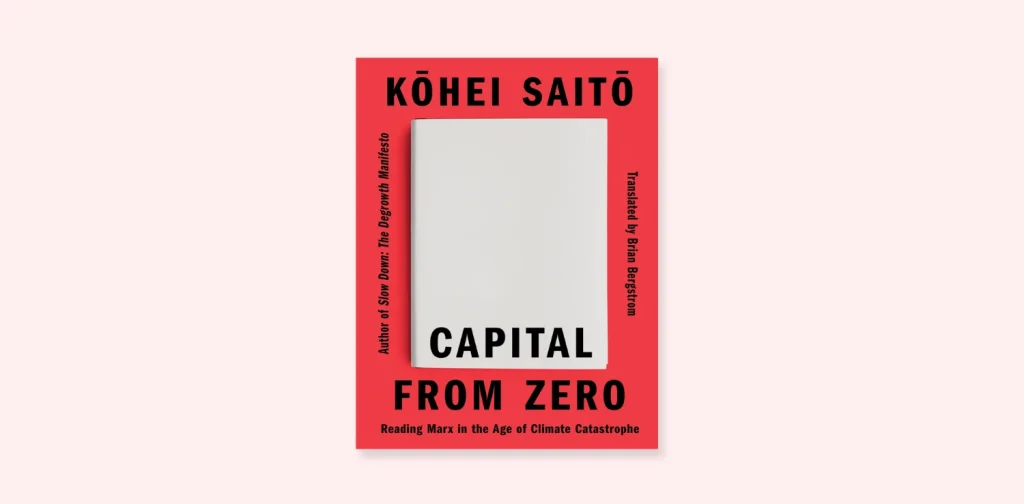
Book cover of “Capital From Zero: Reading Marx in the Age of Climate Catastrophe” by Kohei Saito. | Publisher: Astra Publishing House (2026).
There is an old anecdote about a city worker who chides a fisherman on a tropical island for spending his day lounging on the beach. He tells the fisherman to work harder so that one day he can retire and spend his days fishing. The fisherman replies without a moment’s hesitation, “Isn’t that exactly what I’m doing right now?”
Kohei Saito opens his new book, Capital From Zero: Reading Marx in the Age of Climate Catastrophe, with this well-worn joke precisely because he understands why we, urban workers who keep telling ourselves we are saving for the future, rarely find it truly funny. There is something about it that hits a little too close to home, leaving us with nothing more than a wry, uncomfortable smile.
Capital From Zero: Reading Marx in the Age of Climate Catastrophe
Saito is a young Japanese philosopher—who will turn only 40 next January—who has risen to prominence thanks to his bestselling books. His academic credentials are formidable. He teaches at the University of Tokyo and holds a doctorate in philosophy from Humboldt University of Berlin. He was the youngest recipient of the Isaac Deutscher Prize, the most prestigious award in Marxist studies, in 2018. Saito also serves as one of the editors for the monumental Marx-Engels-Gesamtausgabe (MEGA) project, which, over the past few decades, has been unearthing and re-examining the entirety of Marx’s previously unpublished research notes.
Saito has now returned with a project that is simultaneously more ambitious and more humble. Rather than offering a critical commentary on Marx’s work, he guides the regular-Joe-readers into the heart of Capital.
The copy I read was translated from Japanese by Brian Bergstrom and published by Astra House in July 2026. It felt like an accelerated course for anyone curious as to why—amid an intensifying climate crisis—a philosopher would stubbornly insist that we revisit a 19th-century German thinker who never even managed to complete his own magnum opus.
Overview: Change and Transformation
The preface to this book, Capital and Red Ink, opens with a Cold War-era joke. It tells the story of a prisoner in Siberia who wrote to his family claiming that his life was perfect—except for the fact that he could not buy any “red ink”. This was a pre-arranged code between them, signaling that everything he had written was a complete lie. Saito uses this analogy to describe our current situation: surrounded by the comforts of Netflix, Uber Eats, and Roombas, we have lost the “red ink” needed to recognize just how unequal and fragile the lives we are actually living truly are. For Saito, Marx was the red ink that we discarded far too quickly.
The first chapter, Manipulated by Commodities, examines the foundation of the entire book. It goes into the distinction between the use-value and the exchange-value of a commodity, and how capitalism inverts the two—leaving humans enslaved by the very objects they have created, a concept Marx termed “reification”.
Saito draws upon a curious and witty image from Marx. It is about how once a piece of wood is transformed into a table and sold as a commodity, it is as if it stands on its own and dances among other commodities, dragging humans into a dance of value that we never fully comprehend. Bottled water, urban parks that became shopping malls, and even the ancient forest of Jingū Gaien in Tokyo that was nearly razed for a retail complex serve as contemporary examples that render Marx’s abstractions strikingly literal.
Overview: Extracting Values
The next two chapters explore how surplus value is extracted from the bodies of workers. The second chapter uses the simple example of a shoemaker with a daily wage whose creation value consistently exceeds the value of that wage. The story explains why Marx insisted that the struggle to shorten working hours is far more fundamental than merely pushing for higher pay. Raising wages without reducing working hours, Saito writes, only makes workers more “willing” to enslave themselves.
The third chapter then unpacks why Keynes’s 1930 optimistic prediction—that by 2030 humans would work only fifteen hours a week—missed the mark so drastically. He writes about technological innovation driven by Taylorism and the separation of conception from execution, a concept Saito draws from sociologist Harry Braverman. Under capitalism, technological innovation has been designed not to lighten the worker’s burden, but to strip craft knowledge from the workers’ hands and transfer it to management and machinery. This chapter concludes with a discussion of what anthropologist David Graeber calls “bullshit jobs”, alongside a brief account of an initiative to revive school kitchens in Japan as an example of how reintegrating conception and execution can restore the meaning lost from work.
Overview: Punch in the Gut
The fourth chapter, Green Capitalism: A Fairy Tale, serves as the ecological heart of the book. It is also, perhaps, the most piercing section for anyone, like myself, who grapples with sustainability issues on a daily basis.
Saito traces the agricultural research of Justus von Liebig, which influenced the young Marx. The book then demonstrates that long before the term “Anthropocene” gained popularity, Marx was already concerned about the metabolic rift between humanity and nature: a one-way process of relentless exploitation with no replenishment, standing in stark contrast to the closed-loop cycles of an ecosystem. The core argument of this chapter is one of the most incisive points in the entire book. It is simple: Capitalism cannot be recycled into something green, because the fundamental problem is not the fuel being used, but the very logic of endless growth itself.
The final two chapters are the boldest and most contentious parts of the book. The fifth chapter, Goodbye Lenin!, offers a sharp dissection of the failure of state socialism in the Soviet Union and China—which Saito calls state capitalism—given how workers remained powerless to determine the nature of production. At the same time, he critiques reformist proposals such as Universal Basic Income, Modern Monetary Theory, and Thomas Piketty’s wealth tax. Saito dismisses them as mere juridical illusions that fail to account for the possibility of the capital itself “going on strike”.
The sixth chapter, Who Said Communism’s Impossible?, concludes the book with Saito’s most significant thesis. It argues that the later Marx—inspired by the 1871 Paris Commune and his research into the Russian agrarian commune (mir)—was, in fact, moving toward a vision of Degrowth Communism, a society liberated from the drive for infinite growth, grounded in worker cooperatives and collective ownership. It is, unfortunately, a vision far removed from the image of the Soviet bureaucracy that has long been associated with the term communism.
My Strongest Impression
I finished this book in the middle of Bangkok Climate Action Week 2026, and was struck by its profound relevance and powerful resonance. The book’s conclusion carries a deeply personal tone. Saito situates himself within a decade defined by waves of protest that, while often ending in defeat, are never truly in vain. The anti-nuclear movement following the Fukushima disaster—which sparked his initial interest in Marxism and ecology—Occupy Wall Street, the Arab Spring, the Mahsa Amini protests in Iran, and the electoral victory of socialist youth candidate Zohran Mamdani in New York; they were not for nothing.
Saito reminds us that Capital is not a ready-made blueprint. Rather, it is a set of tools that readers must continuously sharpen and wield for themselves in the context of their own era’s struggles. I find myself in complete agreement with this perspective.
Criticisms
To begin with, this book is truly good—perhaps even too good. In its review, Publishers Weekly notes that Saito’s arguments carry a power and urgency that make Capital more relevant than ever in this era of climate catastrophe. Meanwhile, writing for the Los Angeles Review of Books, Ashley Dawson praises the way Saito skillfully weaves his own interpretations of Marx with direct quotations from Capital. Although, he also points out two significant gaps in the argument: The book barely touches upon the concept of Racial Capitalism as articulated by Cedric Robinson, and it fails to integrate the ideas of social reproduction and ecofeminism, perspectives championed by thinkers like Silvia Federici. He argues that they are essential, as they sustain and often safeguard the foundations of society.
Even harsher criticism has come from those who should be Saito’s natural allies: fellow left-wing thinkers. Reviews in Chatham House and Jacobin of Saito’s previous works have long questioned whether Degrowth Communism can truly be distinguished from zero-growth prescriptions, proposals that never quite explain how the transition of political power is actually supposed to take place.
In my opinion, this criticism remains relevant to the present book. To me, Saito is far more compelling when dissecting the maladies of capitalism than when prescribing a cure. Once his argument shifts toward worker cooperatives and the municipalist movement in Barcelona as blueprints for the future, the incisiveness that was previously so captivating suddenly feels like nothing more than a set of aspirations—ones that might be realizable only in very specific, isolated places.
Food for Thought amid the Impending Climate Catastrophe
For anyone working in the field of corporate sustainability—as I do—this book should not be a casual read. Rather, it comes as a direct challenge to the very core of the profession. The fourth and fifth chapters essentially accuse the entire architecture of “green transformation”—from carbon trading to the just transition advocated by international labor unions—as a mere diversion, one that makes capitalism appear as though it can be deconstructed without ever being truly dismantled.
This is an indictment that we cannot dismiss simply by pointing to emission-reduction figures in a corporate sustainability report. It demands an answer to the question of who, in reality, holds the power to decide where financing and investment flow. This is a question that, whether we like it or not, will continue to haunt every attempt to reconcile economic growth with the finite carrying capacity and limits of our planet.
At the end of the book, Saito writes that he holds no magic key to unlock the door to the future. And perhaps, that is where the book’s greatest honesty lies. I am reminded of the image of a wooden table suddenly beginning to dance. Saito makes no promise that he can bring this dance to a halt. Instead, he offers an invitation: to pause for a moment and to look down at one’s own feet, which apparently have been moving to the rhythm of commodities. He invites us to ask a question that perhaps deserves to be written in red ink: are we truly choosing to dance, or have we simply forgotten that we still have the choice to stop?
Editor: Abul Muamar
Translator: Nazalea Kusuma
The original version of this article is published in Indonesian at Green Network Asia – Indonesia.

Co-create positive impact for people and the planet.
Amidst today’s increasingly complex global challenges, equipping yourself, team, and communities with interdisciplinary and cross-sectoral insights on sustainability-related issues and sustainable development is no longer optional — it is a strategic necessity to stay ahead and stay relevant.

Jalal
Jalal is a Senior Advisor at Green Network Asia. He is a sustainability consultant, advisor, and provocateur with over 25 years of professional experience. He has worked for several multilateral organizations and national and multinational companies as a subject matter expert, advisor, and board committee member in CSR, sustainability, and ESG. He has founded and become a principal consultant in several sustainability consultancies as well as served as a board committee member and volunteer at various social organizations that promote sustainability.
 Indonesia’s Greenwashing Diplomacy at COP31 and Beyond
 The Textile Industry Is Growing, and So Is Textile Wastewater
 EESG: We Need a New Economic Narrative for Sustainability in the Age of AI, Energy Crisis, and Geopolitical Divide
 The Continued Struggle for Equality and Dignity in Women’s Sportswear
 Behavior Change for the Planet: Is composting worth it?
 Building Bridges Between Environmental Policy and Mental Health