

Earth Overshoot Day 2026: A Growing Debt to Future Generations and a Call to the Business World
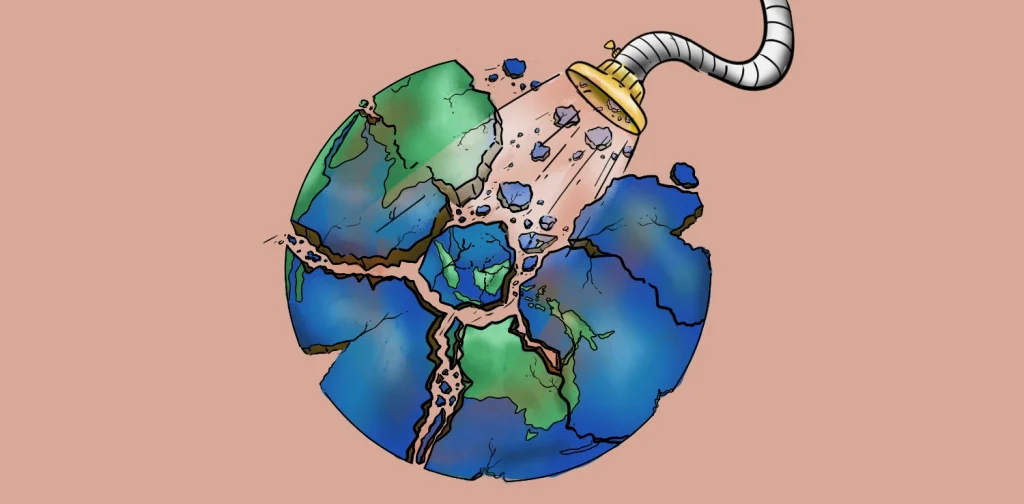
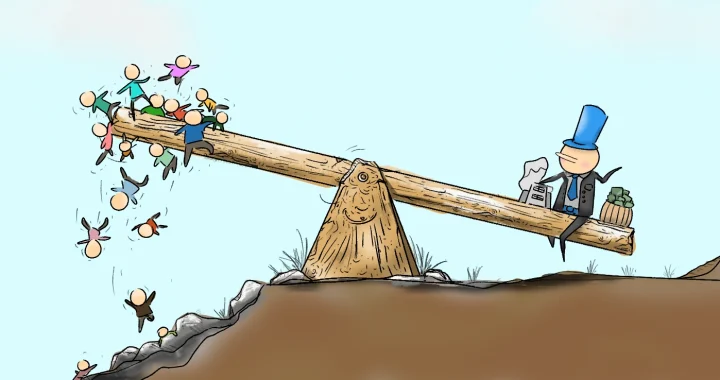
Illustration by Irhan Prabasukma.
On June 5, 2026—coinciding with World Environment Day—the Global Footprint Network announced a date that revealed a fundamental condition of our civilization today. It was July 30, the Earth Overshoot Day (EOD). This is the day humanity exhausts the entire budget of ecological resources that the Earth is capable of regenerating over the course of a full year. From that day until the end of December, the world lives on credit. Yet, we still cut down more trees than can regrow, catch more fish than can reproduce, and release more carbon into the atmosphere than the oceans and forests can absorb.
Earth Overshoot Day 2026
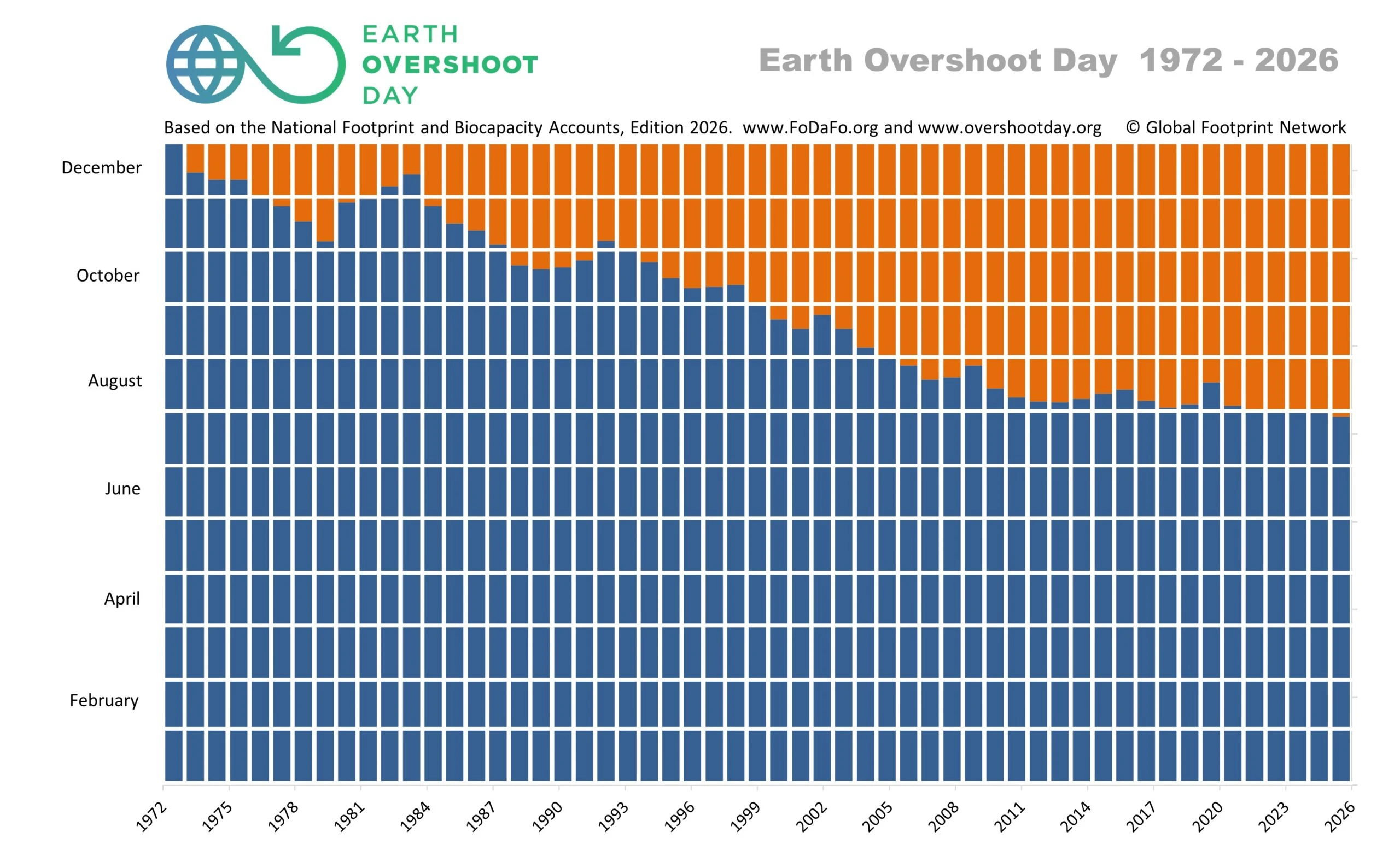
The Global Footprint Network is an international research organization that has spent over two decades calculating the planet’s ecological balance sheet. The 2026 update is here. And to me, the accompanying figures are both simple and alarming.
Humans are currently consuming natural resources 73% faster than Earth’s ecosystems can regenerate them. At this point, it would take 1.73 planets to sustain our collective lifestyle. This represents the highest level of overshoot ever recorded in the history of such measurements.
Interestingly, this year’s date was actually six days later than in 2025. But it is now something to be proud of. That shift is almost entirely due to a revision in data regarding the ocean’s carbon-absorption capacity, rather than any genuine improvement in human behavior. In reality, our actual ecological footprint continues to expand.
History of Earth Overshoot Day
The concept of Earth Overshoot Day (EOD) originated with Andrew Simms, a researcher at the New Economics Foundation in the UK. In the mid-2000s, he proposed a way to translate complex ecological data into a single date that the public could easily grasp.
The scientific foundation was already well-established. The stepping stone was the Ecological Footprint methodology developed by William Rees and his student, Mathis Wackernagel, during their doctoral studies at the University of British Columbia. They measured the area of biologically productive land and sea—expressed in global hectares (gha)—required to sustain human consumption, and then compared this figure against Earth’s available biocapacity.
The formula is straightforward. It’s global biocapacity divided by the global ecological footprint, multiplied by 365 days. When Wackernagel founded the Global Footprint Network in 2003, the organization began publishing annual National Footprint and Biocapacity Accounts. Then, in 2006, it launched the first global EOD campaign in collaboration with the New Economics Foundation.
Alarming Trends
Historical data shows that this critical threshold was first crossed in late 1970. At that time, EOD fell on December 29 or 30, almost at the very end of the year. Since then, the date has been relentlessly shifting earlier and earlier. It moved into August during the 1990s and into July during the 2000s. The only pause occurred in 2020, when the pandemic suppressed global economic activity, pushing EOD back to August 22. However, Wackernagel was quick to point out that this was no cause for celebration. A disaster-induced improvement, he noted, was not planned progress. Indeed, as the economy recovered in 2021, the date jumped back to July 29.
Since overshoot first occurred five decades ago, the accumulated ecological debt has reached the equivalent of 20.6 years of Earth’s biological capacity. Atmospheric greenhouse gas concentrations surged from 367 ppm (CO2 equivalent) in 1972 to 547 ppm in 2026. Carbon emissions now account for approximately 60% of humanity’s collective ecological footprint, making energy transition the single most influential lever for pushing back this date. These are burdens we are passing on to future generations.
Methodological Discussion
It is important to note that this methodology is not without criticism. The Global Footprint Network itself acknowledges that its calculations tend to be conservative. Many forms of environmental degradation—such as groundwater depletion, agricultural soil erosion, or biodiversity loss—are difficult to quantify due to limitations in the global data available from UN agencies. In other words, the actual damage the planet is sustaining is likely more severe. Still, this is no reason to doubt the methodology. Rather, it serves as a reminder that the official EOD figure represents a lower bound, not a worst-case scenario.
My suggestion is to view the Earth Overshoot Day not in isolation, but alongside another scientific framework that also maps the planet’s safety limits: the Planetary Boundaries framework, pioneered by Johan Rockström and his team at the Stockholm Resilience Centre in 2009. While the EOD measures flows—specifically, the rate at which humanity consumes its annual resource budget relative to Earth’s regenerative capacity—the Planetary Boundaries framework assesses the condition of nine Earth systems that sustain life. These range from climate change and biosphere integrity to nitrogen-phosphorus cycles and ocean acidification, Each system has a threshold that, if crossed, risks triggering irreversible changes.
The latest update is the Planetary Health Check 2025, conducted in collaboration with the Potsdam Institute for Climate Impact Research. It confirms that seven of the nine planetary boundaries have now been crossed. Ocean acidification has newly joined the list of breached boundaries, with mounting pressure across nearly all processes—with the exception of ozone depletion.
While these two frameworks differ in their scientific origins and units of measurement, they converge on a single conclusion. They agree that modern industrial civilization has systematically exceeded Earth’s carrying capacity, and not merely at a single point.
What It Means for Businesses
For corporations, this means that sustainability strategies focused solely on carbon footprints are no longer enough. Nature-related risks, such as biodiversity, water, and synthetic chemicals, now demand equally urgent management. If the task of reducing emissions already feels burdensome, we face an even greater struggle ahead as a consequence of our long-term collective negligence.
The Global Footprint Network itself asserts that the solutions to pushing back this date are no fantasy. They are already available and, more importantly, commercially viable. Under their Power of Possibility framework, the Network estimates that halving carbon emissions from fossil fuels alone can push back the Earth Overshoot Day by up to three months. This is clearly not a task for governments alone. It is, above all, a strategic agenda for any company wishing to remain relevant in a decade defined by resource constraints and climate disruption.
What Businesses Can Do
One of the most concrete steps companies can take is to transition to a circular economy. This must go beyond mere jargon at the project level. It must entail developing business models that decouple economic growth from the rate of resource exploitation.
Last November in Belém—as part of the lead-up to COP30—the World Business Council for Sustainable Development and the UNEP-hosted One Planet Network launched the Global Circularity Protocol for Business. This is the first global framework providing companies with a measurable way to manage and disclose their circularity performance. If followed, their analysis projects 100–120 billion tonnes of material savings and the avoidance of 67–76 gigatonnes of CO2-equivalent emissions between 2026 and 2050.
For companies reliant on resource extraction—such as mining, forestry, plantations, and fisheries—this kind of protocol should serve as an essential reference. Concrete actions would vary depending on sectors. For instance, the mining industry needs post-mining landscape restoration that is truly regenerative, rather than mere minimal reclamation. Meanwhile, the plantation and forestry sectors require supply chains that are genuinely deforestation-free, with auditable traceability, going beyond simple regulatory compliance. Manufacturing and retail need product designs that extend lifespans and facilitate recycling. The financial sector needs to integrate “overshoot” risks into financing criteria, and so on.
From Earth Overshoot Day to Real Change
However, there is one crucial warning that corporate leaders should heed. Claims of being “circular”—or, increasingly, “regenerative”—without verifiable evidence amount to nothing more than greenwashing with new terminology. Any business adopting the “regenerative” label must demonstrate that its operations genuinely reduce overshoot. Otherwise, the label is misleading. This underscores the importance of credible substantiation for sustainability claims, disclosures based on recognized frameworks—such as the TNFD—and independently verified science-based targets, rather than merely empty claims in sustainability reports.
Furthermore, global inequality is also worth noting. It is estimated that the world’s wealthiest one percent exhaust their share of the annual carbon budget within just the first ten days of January. This underscores the fact that our crisis is also a matter of consumption patterns and business models, not merely population size.
The Earth Overshoot Day is not at all a doomsday prediction. It is a balance sheet. And just like a financial balance sheet, it can be corrected. Certainly not by delaying the accounting, but by changing the way we do business, produce, and consume before we pass this ecological debt on to generations that do not yet have a voice to accept or reject that legacy.
Editor: Abul Muamar & Nazalea Kusuma
Translator: Nazalea Kusuma
The original version of this article is published in Indonesian at Green Network Asia – Indonesia.

Co-create positive impact for people and the planet.
Amidst today’s increasingly complex global challenges, equipping yourself, team, and communities with interdisciplinary and cross-sectoral insights on sustainability-related issues and sustainable development is no longer optional — it is a strategic necessity to stay ahead and stay relevant.

Jalal
Jalal is a Senior Advisor at Green Network Asia. He is a sustainability consultant, advisor, and provocateur with over 25 years of professional experience. He has worked for several multilateral organizations and national and multinational companies as a subject matter expert, advisor, and board committee member in CSR, sustainability, and ESG. He has founded and become a principal consultant in several sustainability consultancies as well as served as a board committee member and volunteer at various social organizations that promote sustainability.
 Noise Pollution Is Making Us Sick, and Climate Change Is Making It Worse
  Beyond Fashion: The Environmental Cost Behind Animal Leather
  Addressing the Hidden Risk of Microplastics from Offshore Infrastructures
  Addressing Antimicrobial Resistance as More Than a Medical Issue
  Holding Harmful Industries Liable for Harm to Human Life and the Environment
  Clearing the Air of Despair Surrounding the Climate Crisis with Data