

Strengthening Resilience amid Growing Dependence on Space Infrastructure
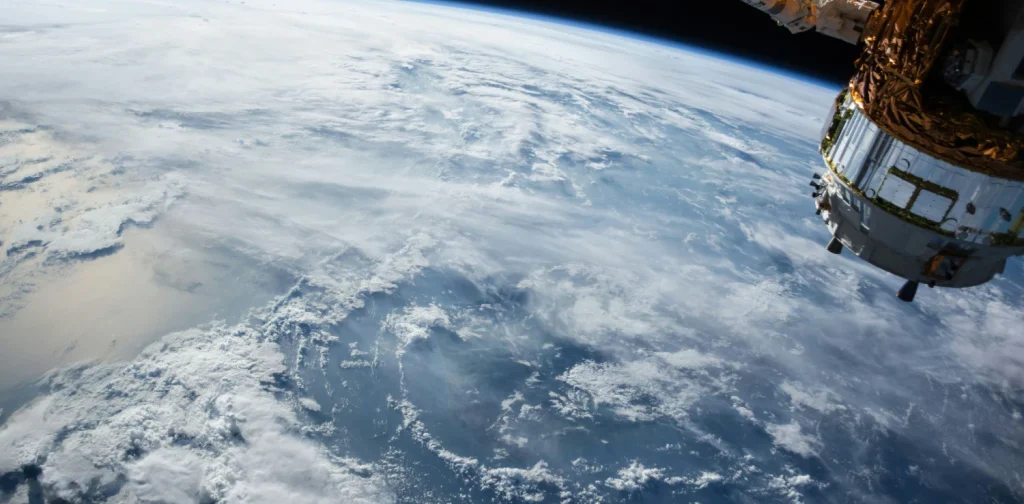
Photo: NASA on Unsplash.
Green and digital transformation is often presented as the pathway to a safer, cleaner, and more prosperous future. However, above this optimistic vision hovers a less visible reality: space infrastructure. As satellites quietly become essential to how energy flows, cities function, and economies operate, a challenge arises: can we ensure resilience amidst uncertainties that come with growing dependence on space?
The Hidden Role of Space
Our growing dependence on space mostly goes unnoticed. Yet, in reality, many of the technologies that support a greener and more digital society rely on space infrastructure, like satellites. These satellites orbit the planet and operate in what is known as near-earth space. Near-earth space is the region of space surrounding Earth where its gravity, magnetic field, and upper atmosphere still have a strong influence.
There, most communication, navigation, and Earth-observation satellites travel. They are essential for managing renewable energy grids, coordinating transportation, and synchronizing financial and communication networks. They are also in use in precision agriculture, conservation, disaster preparedness, and climate monitoring.
Space Infrastructure, Threats, and Risks
As green and digital systems expand, so does our reliance on space-based technologies. At this point, space is no longer just a distant environment. It has become an operational extension of everyday systems on the ground. Therefore, what happens in space increasingly shapes how vital systems perform on Earth.
In this light, new risks emerge. While current space policy tends to focus on visible threats like space debris, an invisible threat remains under-addressed.
Near-earth space is affected by space weather, the changing physical conditions in space caused mainly by the sun. Space weather events include solar storms, bursts of radiation, and disturbances in Earth’s magnetic field. While many of these events are mild, some are extreme. Scientists refer to these as High-Impact, Low-Frequency (HILF) events. They can disrupt satellite electronics, degrade communication signals, and interfere with the precise timing services that many Earth-based systems depend on.
When satellites are affected, the consequences can cascade across multiple sectors. Because these systems are increasingly interconnected and optimized for efficiency, failures can spread quickly and are difficult to manage. As a result, the very technologies designed to make life easier may also introduce new vulnerabilities.
When Efficiency Creates Fragility
With its current systems, the world demands efficiency and optimization. From communication and travel to production and consumption, there is an expectation for everything to run smoothly in the shortest time possible. Even “sustainability policies” tend to emphasize only the reduced use of resources.
These highly optimized systems may perform well under normal conditions, but they often have little room to adapt when unexpected events occur. A clear example of this tension is how green and digital systems rely heavily on space infrastructure.
Yet to build systems and societies that prosper long into the future, resilience matters. Resilience focuses on a system’s ability to withstand shocks and recover from disruptions. Beyond just efficiency, this requires diversity, redundancy, and spare capacity. After all, sustainability and resilience are complementary goals.
Strengthening Resilience amid Transitions
Addressing the risks created by the growing dependence on space infrastructure requires shifting how green and digital systems are designed and governed. Instead of prioritizing efficiency alone, critical infrastructures must be planned with resilience as a core objective.
This means preserving redundancy, such as backup communication and timing systems. It also requires identifying shared control points across interconnected infrastructures and planning for cascading failures, where disruption in one system triggers problems in others. Preparing for these scenarios in advance can prevent isolated disruptions from escalating into large-scale societal crises.
At the same time, reducing uncertainty in the space environment itself is essential. Although scientists are beginning to understand space weather, the timing and intensity remain difficult to predict. Closing this gap requires sustained investment in space research and exploration designed to observe the physical conditions of near-earth space in greater detail. More observations lead to better models and forecasts, improving the ability to protect satellites and the Earth-based systems that depend on them.
The Expanding Frontier
Our growing dependence on space effectively integrates near-earth space into Earth’s socio-ecological systems. Therefore, near-earth space must be treated as part of Earth’s broader environment rather than a separate domain. This means establishing continuous monitoring of space conditions. It also includes integrating space weather risks into sustainability planning, infrastructure regulation, and policymaking.
Ultimately, by aligning green and digital transition goals with resilience-based strategies for our expanded domain—space, societies can ensure that efforts to build a sustainable future do not inadvertently create new vulnerabilities. The challenge is not choosing between efficiency and resilience, but designing sustainable systems that can deliver both.
Editor:Nazalea Kusuma

Co-create positive impact for people and the planet.
Amidst today’s increasingly complex global challenges, equipping yourself, team, and communities with interdisciplinary and cross-sectoral insights on sustainability-related issues and sustainable development is no longer optional — it is a strategic necessity to stay ahead and stay relevant.
 The Invisible Infrastructure: What ASEAN’s Carbon Market Needs Most
  Indonesia Ruled to Recognize Chronic Illness as a Disability
  Clean Cooking as a Developmental Multiplier in Africa
  Congo Basin Peatlands Are Releasing Ancient Carbon
  From Anxiety to Action: How Youth Climate Activism Is Evolving
  India’s Supreme Court Declared Menstrual Health and Hygiene as Fundamental Rights