

The Role of Trade Unions in Peacebuilding
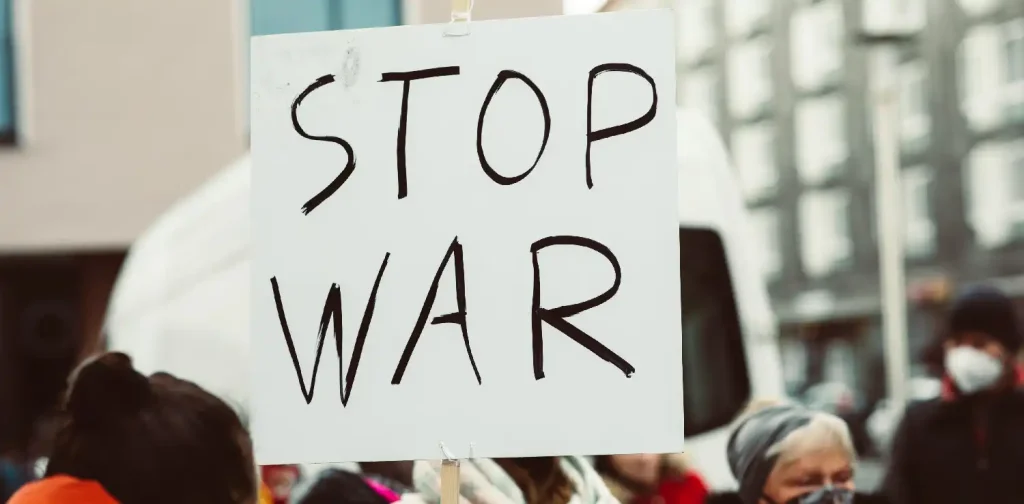
Photo: Markus Spiske on Unsplash.
For centuries, the presence of trade unions, also called labor unions, has been essential in promoting labor rights and social justice. At times of rising geopolitical tensions, trade unions can become powerful and influential agents of peacebuilding.
Conflicts & Workers
In recent years, news coming from the international scene has been brimming with anxiety over geopolitical tensions, which seem to be one step away from snapping. The beginning of March 2026 saw this tension escalating into full-blown armed conflicts between Iran and Israel-US, all while the genocide against the people of Palestine by Israel has not stopped.
The consequences are dire. Workers have lost their lives and livelihoods, and continue to be at risk of further devastation if conflicts continue.
For instance, many sailors are stranded at sea on oil tankers and freight ships following the closure of the Strait of Hormuz. The failure to comply results in immediate attacks on the vessels by drones or missiles. Workers on land are nowhere near safe, too. A total of 31 medical workers in Lebanon have been killed by the Israeli military since early March 2026.
Additionally, these attacks do not spare journalists across the globe. Over 200 journalists have been killed since Israel’s escalated aggression on Gaza in October 2023, for instance.
Strikes in the Arms Industry
The escalation of conflicts and genocide actively goes against peacebuilding efforts, which is an integral part of sustainable development. In this case, the role of trade unions is vital in contributing to peacebuilding and resilience. After all, they are workers’ organizations moving collectively to demand changes in employment, human rights, and beyond.
One example is in the arms industry. Weapons do not spawn on their own. They are mass-produced by the arms industry and transported by the shipping companies using the labor of workers. Many of these military pieces of equipment are imported from Western countries, such as the United States, Germany, and Italy. According to a report published by Stockholm International Peace Research Institute (SIPRI) in 2024, the United States accounted for 69% of Israel’s arms imports.
Against this backdrop, trade unions, particularly in Europe, have attempted to intervene in the supply chains of weapons through strikes. In October 2025, workers from Leonardo, an Italian arms manufacturer, published a petition demanding that the company sever its connection with Israel, which was signed by over 20,000 people.
Mediterranean dockworkers also mobilized masses to obstruct arms shipments in February 2026. Demonstrations were held across different ports in Greece, Spain, Türkiye, France, Germany, and Italy. As a result, five ships belonging to ZIM, an Israeli company, and Mediterranean Shipping Company (MSC) were blocked. These types of industrial protests are capable of disrupting the economy, which in turn pressure governments and businesses to take action.
Protests, Throughout History
Trade unions’ efforts to promote peacebuilding are not a new thing. Historically, workers have organized to support human rights causes.
From 1984 to 1987, Dunnes Stores workers went on strike on Henry Street in Dublin, Ireland. They refused to handle imported goods from South Africa due to the country’s apartheid policy. This strike led to the Irish government eventually banning the importation of South African goods.
Fighting for the same cause in 1984, dockworkers of the International Longshore and Warehouse Union (ILWU) Local 10 in San Francisco refused to unload the cargo full of goods from South Africa. ILWU has also been actively protesting against the United States’ occupation in Iraq and Afghanistan and racial discrimination against African-American descendants.
These strikes were not without a cost. During two years and nine months of strike, the Dunnes Stores workers only earned £21 a week in strike pay, while longshoremen from the ILWU had to make economic sacrifices by not getting paid during the 11-day boycott.
Strengthening Peacebuilding for All
Armed conflicts add to the threats to workers’ wellbeing globally, including unemployment, diminishing rights, and weakening trade unions. Therefore, unions’ crucial roles in enabling changes underscore the urgency for legal protection of unions and their workers. Such collective bargaining can be powerful and hard to ignore when there is a certain demand from the workers’ side.
Additionally, initiating alliances with other labor unions, promoting boycotts, and garnering public support through education are a few examples unions can do to develop campaigns for peacebuilding.
Still, the responsibility of ending armed conflicts ultimately rests in the hands of world leaders to prevent atrocities and respect international humanitarian law.
Editor: Nazalea Kusuma & Kresentia Madina

Co-create positive impact for people and the planet.
Amidst today’s increasingly complex global challenges, equipping yourself, team, and communities with interdisciplinary and cross-sectoral insights on sustainability-related issues and sustainable development is no longer optional — it is a strategic necessity to stay ahead and stay relevant.
 Red Flags in the EU’s Industrial Accelerator Act (IAA)
  Untangling the Root Causes Underneath Lesotho’s Suicide Crisis
  Looking into the Inadequate Legal Recognition for Women’s Tenure Rights Across the Global South
  The Disproportionate Cost of Data Centers for Local Communities
  Will the EU Ban on Destroying Unsold Clothes Reduce Textile Waste?
  How Extreme Heat Affects Human Livability