

Looking into Australia’s Community Battery Program
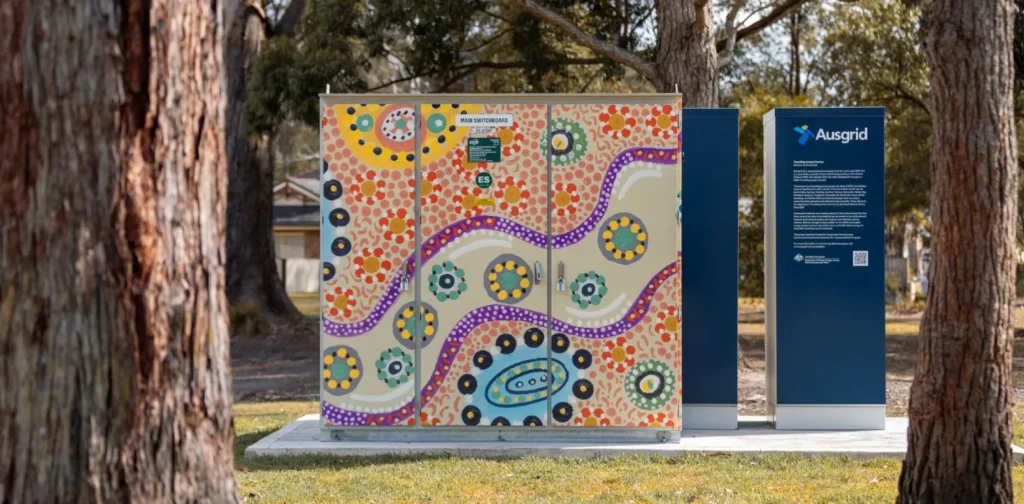
Community Battery at Mitchell Park, Narara, Australia. Artwork titled Travelling across Country by Emma Peel.
The transition toward clean, renewable energy is a priority agenda in many national climate action plans worldwide. As the renewable energy sector grows more promising, making it available at scale and affordable for all is essential. One way to do this is by utilizing BESS, the battery energy storage system. In Australia, community battery installations seek to strengthen the country’s energy security and accelerate clean energy transition for all levels of society.
Community Battery
Australia’s community battery program is a combination of renewable energy generation (primarily solar) with BESS, the battery energy storage system. BESS stores excess electricity generated when the sun is out and strong and discharges it when needed. So, during the cold winters when everyone needs heating or the summer heat when people liberally use air conditioners, the grids remain ready and stable.
The capacity of one community battery installation may range from 30 kW to 1 MW. The Australian government’s Community Batteries for Household Solar program aims to install more than 420 batteries across the country. In total, they shall provide electricity storage for up to 100,000 households.
Reportedly, this program will expand renewable energy generation throughout the country. It will improve electricity grids’ reliability, reduce emissions, and reduce the cost of electricity for consumers. Therefore, once established, the community battery program will benefit all levels of citizens, from households to schools to shopping centers to remote communities.
Funding and Installation
In October 2022, the Federal Budget provided $200 million for the community battery program. Of this, $171 million was allocated to the Australian Renewable Energy Agency (ARENA), and the rest went to the Department of Climate Change, Energy, the Environment and Water (DCCEEW).
For the first round of grants, ARENA conditionally approved up to $143 million in June 2024 for the roll out of up to 370 community batteries. This round should have a total storage capacity of up to 281 MWh. One of the first-round awardees is the City of Melbourne, with $500k grant to support the community battery installation at the Boyd Community Hub in Southbank. In November 2024, ARENA launched the second round of grants to be distributed in 2025, with at least $28 million.
Community batteries are visible installations, so some community batteries use artworks to liven them up. For example, Melbourne’s community batteries are set to works by local artists Mysterious Al, Michael Fikaris, and Amina Briggs.
Toward Just Energy Transition
A vital part of energy transition is ensuring everyone from the present and future generations can experience the benefits of clean, renewable energy. In this light, efforts to establish sustainable energy systems at scale that can be replicated within local contexts are important. More accessible renewable energy supply means more affordable electricity costs for all.However, safeguarding the entire energy value chain to avoid the harmful exploitation of source materials and the labor force is also a priority. Ultimately, a just energy transition requires careful consideration throughout the process, from planning to disposal, to ensure a better future for all people and the planet.
Nazalea Kusuma
Naz is the Manager of International Digital Publications at Green Network Asia. She is an experienced and passionate writer, editor, proofreader, translator, and creative designer with over a decade of portfolio. Her history of living in multiple areas across Southeast Asia and studying Urban and Regional Planning exposed her to diverse peoples and cultures, enriching her perspectives and sharpening her intersectionality mindset in her storytelling and advocacy on sustainability-related issues and sustainable development.
 The Invisible Infrastructure: What ASEAN’s Carbon Market Needs Most
  Indonesia Ruled to Recognize Chronic Illness as a Disability
  Clean Cooking as a Developmental Multiplier in Africa
  Congo Basin Peatlands Are Releasing Ancient Carbon
  From Anxiety to Action: How Youth Climate Activism Is Evolving
  India’s Supreme Court Declared Menstrual Health and Hygiene as Fundamental Rights