

GEF Approves Funding for Biodiversity Conservation Projects in Indonesia
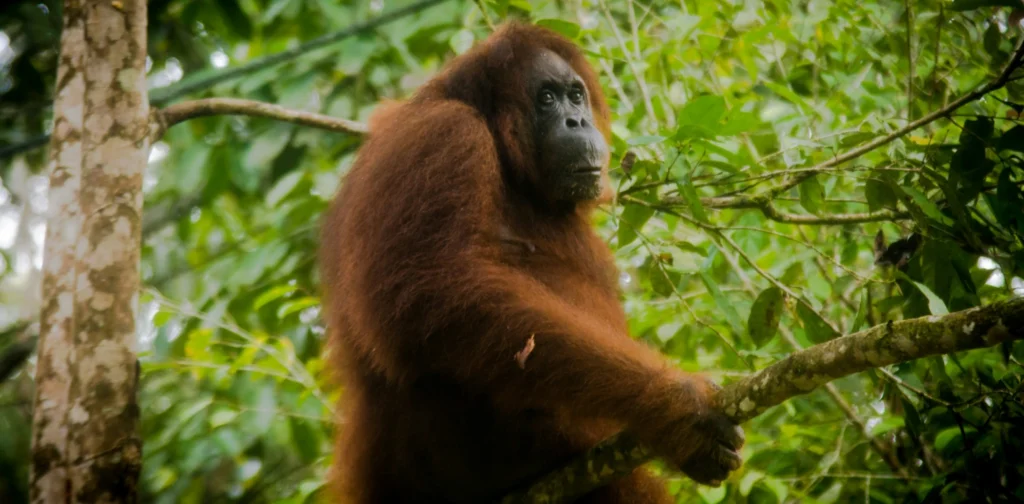
Orangutan in Kalimantan. | Photo: Felix Serre on Unsplash.
Beyond just the existence of a group of different and unique wild animals and plants, biodiversity is a pillar that supports life on Earth. Therefore, preserving biodiversity and its habitat is essential for our collective survival. In this light, the Global Environment Facility (GEF) has agreed to fund two biodiversity conservation projects in Indonesia.
Biodiversity Decline and Ecosystem Destruction
Biodiversity decline and ecosystem degradation have become increasingly urgent issues, especially in light of massive development and irresponsible business expansion. These issues are prominent in Indonesia, where many endemic species and natural ecosystems are facing serious threats due to deforestation, land conversion, and infrastructure development. This leads to habitat fragmentation, which isolates various species populations and accelerates the rate of extinction. For example, the population of Sumatran and Bornean orangutans has declined due to the shrinking tropical rainforests, their main habitat.
Moreover, hunting and wildlife trade have exacerbated the situation. More than 95% of animals sold in the market are wild-caught, and more than 60% of protected rare mammals are being traded. Climate change also contributes to the crisis, where rising temperatures, changing rainfall patterns, and extreme weather events have changed habitat conditions, threatened food security, and affected the life cycles of many species. Therefore, ramping up efforts on biodiversity conservation and ecosystem preservation are urgent to maintain ecosystem balance.
Biodiversity Conservation Projects in Indonesia
The biennial GEF Board meeting in June 2025 approved funding for two conservation projects in Indonesia, namely “Excelling Protected Area Management Effectiveness for Biodiversity Conservation through Landscape-Based Approach (ENABLE)” and “Spatial-based Natural Forest Planning and Governance for Robust Ecosystems (SPARE)”.
The projects, initiated by the Ministry of Forestry (MoF) with support from UNDP and the GEF, aim to preserve high conservation value landscapes in and around protected areas. These landscapes have biological, ecological, social, or cultural values that are considered critically important. Additionally, the projects also plan to address the threats to Indonesia’s species, including the Sumatran tiger, Sumatran rhinoceros, and Bornean orangutan, as well as protect remaining natural forests.
The ENABLE project will implement a pilot model for landscape-based management in three national parks: Gunung Leuser, Sebangau, and Bogani Nani Wartabone National Parks. This model aims to transform the parks into Centers of Excellence to foster inclusive innovation and capacity building. With a total grant of 6.6 million USD over six years, the ENABLE project is also expected to benefit local communities through sustainable livelihood initiatives and participatory conservation agreements.
Meanwhile, the SPARE project will support the MoF with forestry spatial planning and information to improve governance, decision-making, and protection of natural forests outside protected areas, with a 6.1 million USD funding. In addition to environmental benefits, SPARE is expected to generate socio-economic benefits for around 10,000 people, restore over 4,000 hectares of land, and strengthen the management of over 1.6 million hectares of landscape.
Strengthening Shared Commitment
Ultimately, the success of biodiversity conservation projects depends heavily on strong political commitment and collaboration among stakeholders. Addressing challenges such as weak cross-sector coordination and ignorance of local contexts, as well as ensuring lasting positive impacts post-project are crucial.
Therefore, it is important for all parties to ensure meaningful local community involvement, strengthen the capacity of local communities, and build transparent and adaptive monitoring and evaluation systems. With an inclusive, long-term approach, and based on local and scientific knowledge, biodiversity conservation projects can become catalysts for change towards fair, sustainable, and crisis-resilient natural resource governance.
Translator: Kresentia Madina
Editor: Nazalea Kusuma
The original version of this article is published in Indonesian at Green Network Asia – Indonesia.

Abul Muamar
Amar is the Manager of Indonesian Digital Publications at Green Network Asia. He holds a Master’s degree in Philosophy from Universitas Gadjah Mada and a Bachelor’s degree in Communication Studies from Universitas Sumatera Utara. He has over ten years of professional experience in journalism as a reporter and editor for several national-level media companies in Indonesia. He is also a writer, editor, and translator with a particular interest in socio-economic and environmental issues.
 The Invisible Infrastructure: What ASEAN’s Carbon Market Needs Most
  Indonesia Ruled to Recognize Chronic Illness as a Disability
  Clean Cooking as a Developmental Multiplier in Africa
  Congo Basin Peatlands Are Releasing Ancient Carbon
  From Anxiety to Action: How Youth Climate Activism Is Evolving
  India’s Supreme Court Declared Menstrual Health and Hygiene as Fundamental Rights