

UKRI’s £12 Million Funding for Sustainable Aquaculture in Southeast Asia
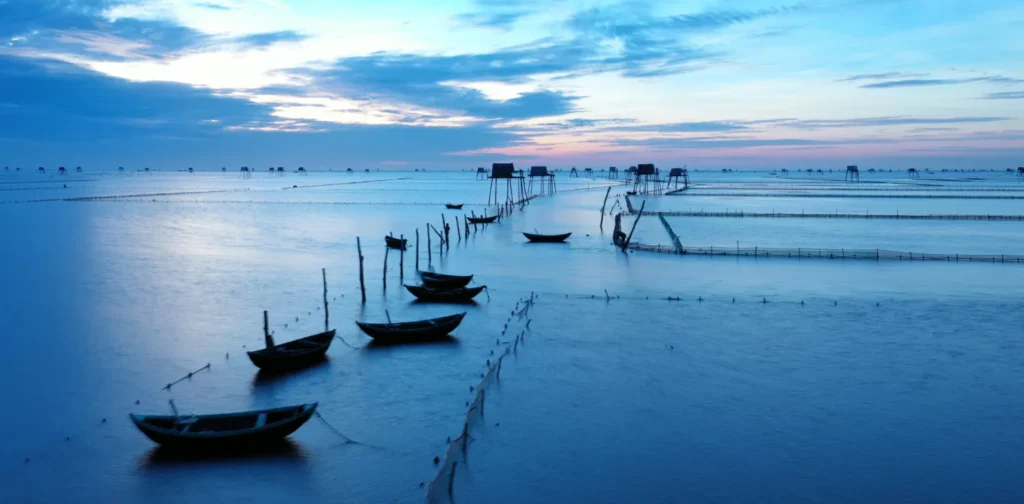
Photo: Quyển Phạm Xuân on Pexels.
Aquaculture produces a significant portion of the global food supply, and its role in supporting global economies cannot be overlooked. To maximize the implementation of sustainable aquaculture, the United Kingdom Research and Innovation (UKRI) launched a funding initiative for Southeast Asian countries.
Aquaculture in Southeast Asia
Aquaculture refers to the practice of cultivating fish, shellfish, aquatic plants, and other organisms in semi-natural or controlled environments such as ponds, fish tanks, and inshore areas.
In 2022, global aquaculture production reached a record high of 130.9 million tonnes, valued at USD 313 billion. FAO’s report states that this growth signifies the potential of aquaculture to address hunger, malnutrition, and poverty, as well as boost economies. Another analysis by a researcher at the ISEAS Yusof Ishak Institute highlighted Southeast Asia’s aquaculture production, which contributed 22% (46.2 million tonnes) of global aquaculture products in 2020.
While growth is on the horizon, the region still faces challenges such as overfishing, harmful chemical use, and water contamination. These issues are also exacerbated by the impacts of climate change, such as sea level rise, ocean acidification, and changing sea patterns. Therefore, accelerating efforts to support resilient and sustainable aquaculture is important.
UKRI’s Funding
In March 2025, the United Kingdom Research and Innovation (UKRI) launched a £12 million funding initiative to improve sustainable aquaculture in Southeast Asia. The initiative aims to enhance the sustainability, resilience, and productivity of the region’s aquaculture system while also empowering local communities and gender equity in science and research.
The funding will support interdisciplinary research projects surrounding climate change, disease management, and food security across Southeast Asian countries, including Vietnam, Malaysia, Indonesia, Thailand, and the Philippines. Several key projects include:
- AquaSoS project, which aims to develop a digital tool by combining data from satellites, sensors, and labs, to address issues in Vietnam’s Mekong Delta.
- WAVES Consortium, which aims to improve mollusk farming in Vietnam, Malaysia, and Indonesia.
- GLOBALSEAWEED-PROTECT, which aims to support the seaweed industry in Southeast Asia through the One Health approach.
“Our shared intention is to deliver a more productive, healthy, resilient, and sustainable food system and this interdisciplinary programme on aquaculture systems take us a step closer to realising this ambition,” said Dr. Amanda Collis, Executive Director, Research Strategy and Programmes at the Biotechnology and Biological Sciences Research Council (BBSRC).
Towards Sustainable Aquaculture
Developing a sustainable aquaculture sector involves practices and strategies that are not only economically viable but also environmentally and socially responsible. The UKRI funding seeks to contribute to putting research and innovation as a central part of this effort, which is hoped to improve the sector’s sustainability and resiliency in Southeast Asia.
Editor: Nazalea Kusuma
Kresentia Madina
Madina is the Assistant Manager of Stakeholder Engagement at Green Network Asia. She holds a bachelor’s degree in English Studies from Universitas Indonesia. As part of the GNA In-House Team, she supports the organization's multi-stakeholder engagement across international organizations, governments, businesses, civil society, and grassroots communities through digital publications, events, capacity building, and research.
 The Widespread Impacts of Severe Drought in Somalia
  Ensuring Access to Justice for Women and Girls
  The Invisible Infrastructure: What ASEAN’s Carbon Market Needs Most
  Indonesia Ruled to Recognize Chronic Illness as a Disability
  Clean Cooking as a Developmental Multiplier in Africa
  Congo Basin Peatlands Are Releasing Ancient Carbon