

Weaving the Thread Between the Last Elephant and the Floods in Sumatra
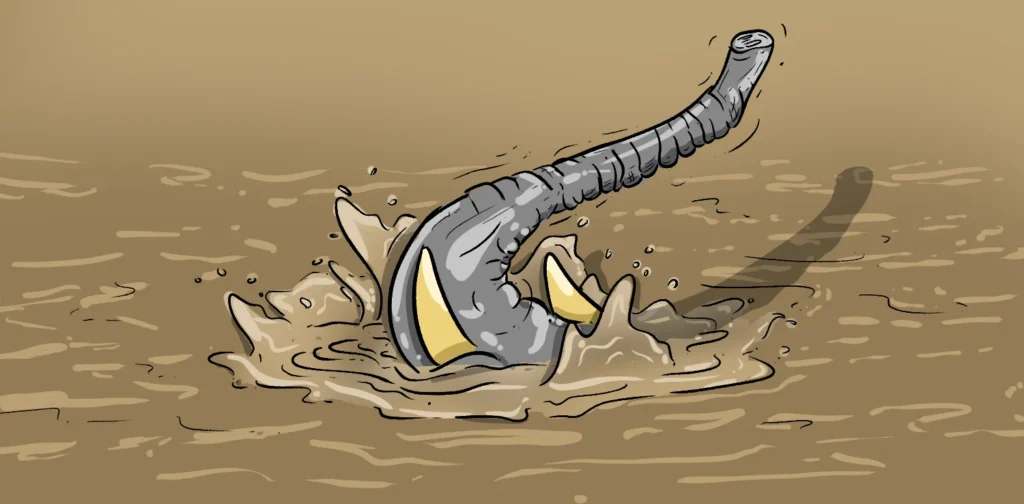
Illustration: Irhan Prabasukma.
Ecological systems of the Earth are connected—this is a fact. We have seen countless evidence of how intertwined the fates of wildlife, humans, and the entire planet are. Around the world, our biodiversity and ecosystems are declining at a dangerous rate. And at the same time, we are experiencing extreme weather events and disasters like never before. Sadly, that is also what’s happening in Sumatra, Indonesia, home for endangered elephants, tigers, and many other species. It is time to boldly draw the line between the wildlife population decline and the devastating floods in Sumatra.
Wildlife Population Decline and Deforestation in Sumatra
Today’s reality of Sumatran elephants should be seen as an ecological alarm, not just a number in a conservation report. Ecologically, they are keystone species that spread seeds and maintain forest dynamics.
Alarmingly, its population in the wild is down to 2,400-2,800 individuals. Much of the habitat of this Critically Endangered species has been cut into small patches, leaving many local elephant groups isolated and increasingly vulnerable.
One of the clearest examples is in Tesso Nilo National Park (TNTN) in Pelalawan, Riau. It is the last stronghold of Sumatra’s lowland rainforest and an essential home for elephants and tigers. Originally, the designated area was around 81,000 hectares. Yet analysis of satellite imagery by Nusantara Atlas shows that about 80% of its forest cover has been lost. This is mainly due to the expansion of oil palm plantations, many of which are illegal, and other human activities.
However, the deforestation that occurs is not just a story of “illegal palm oil” with vague, nameless perpetrators. Since 2013, tens of thousands of hectares of protected forest in the Tesso Nilo complex have become oil palm plantations to supply large palm oil groups. Environmental Justice Atlas recorded more than 36,000 hectares of the National Park area under the control of oil palm plantation owners.
Big corporations are not the end of it. Mongabay’s investigation also revealed that many of the orchards within Tesso Nilo were managed by smallholders, local entrepreneurs, and land brokers. Meanwhile, law enforcement has remained weak for years, and local and central governments have been, at the very least, absent, and at worst, corrupt. In the midst of it all, one of the last homes of the Sumatran elephant was slowly being gnawed from the bottom and the top at once.
Connection to the 2025 Floods in Sumatra
Rarely discussed is the direct link between the “last elephant” and the recent devastating floods in Sumatra. Forest exploitation and upstream oil palm expansion not only drive away wildlife, but also damage the landscape’s ability to absorb and manage water. A healthy forest serves as a giant sponge: the canopy slows down the fall of rainwater, while the roots hold the soil in place and store water in the soil profile. When forests are cleared and replaced by monocultures, this system collapses. Heavy rain turns into rapid runoff, carrying soil and wood into rivers already narrowed by sedimentation and buildings on their banks. Rivers overflow more easily, and villages downstream become targets.
Similar things happen worldwide. In Indonesia, we see the impact of all this brutally at the end of November 2025. Extreme rains triggered by storms and monsoons hit Aceh, North Sumatra, and West Sumatra. About 800 people died, and hundreds more went missing, with more than 3.1 million people affected. Almost 600 thousand people had to evacuate. Since 2001, Sumatra has lost about 4.4 million hectares of forest—an area larger than Switzerland. So, when extreme rains meet bald slopes and damaged watersheds, what happens then is no longer a “natural disaster”, but a disaster caused by human action.
At this point, the green theory in international relations offers a relevant lens. The theory critiques mainstream viewpoints that measure a country’s success solely by economic growth and political stability while overlooking ecological limits. From this perspective, deforestation and the 2025 floods in Sumatra represent a form of environmental insecurity, characterized by the collapse of life support systems.
Humans destroy forests for the sake of export commodities. Elephants lose their habitats. Downstream communities lose their ecological safety nets.
Causes and Accountability
However, the cause is not merely a “lack of environmental awareness”. The approaches of critical political economy and political ecology help us understand who benefits and who becomes sacrifices. Profits from logs, CPO, and mining flow to large corporations, investors, and the political elite who control the permits. Meanwhile, villagers on riverbanks are enduring floods, small farmers are losing land, and Sumatran elephants are left in ever-narrowing pockets of forests. Reports on Tesso Nilo and cases in Sumatra reveal a similar pattern: governments are slow to crack down on forest encroachers, but quick to roll out the red carpet for extractive investments.
The country’s response to the 2025 floods in Sumatra has also been a nightmare. Prior to these disasters, disaster management bodies underwent massive budget cuts. Afterward, the official statement is that the condition “has improved,” and does not require a national disaster status. That is in stark contrast to the reality of residents who are still trapped in refugee camps, running out of supplies, and waiting for inadequate assistance. In this empty space, what moves fast are the citizens themselves. There have been networks of volunteers, communities, and small donors who raise funds, open kitchens, and even save pets and wildlife, as noted in several citizen journalism reports across Sumatra.
The Thread
If we put all the above pieces together, the thread between the last elephant and the floods in Sumatra is clear: both are born from the same pattern. What I call “the last elephant” does not literally mean the only elephant left, but the critical conditions of the wildlife population and habitat in Sumatra. Elephants displaced from Tesso Nilo and people whose homes were washed away by the 2025 floods are victims of the same system: a development logic that treats forests as commodity reserves, rather than as shared homes.
Editor: Nazalea Kusuma
Co-create positive impact for people and the planet.
Amidst today’s increasingly complex global challenges, equipping yourself, team, and communities with interdisciplinary and cross-sectoral insights on sustainability-related issues and sustainable development is no longer optional — it is a strategic necessity to stay ahead and stay relevant.

Charisya
Charisya is a Master’s student of International Relations at Gadjah Mada University, Indonesia, focusing on climate justice, children’s rights, and post-conflict issues. She has experience in research and advocacy writing across the humanitarian and environmental sectors.
 Looking into Green Ramadan Initiatives Worldwide
  The Widespread Impacts of Severe Drought in Somalia
  Ensuring Access to Justice for Women and Girls
  The Invisible Infrastructure: What ASEAN’s Carbon Market Needs Most
  Indonesia Ruled to Recognize Chronic Illness as a Disability
  Clean Cooking as a Developmental Multiplier in Africa