

Environmental and Geopolitical Risks in the Development of Medog Hydropower Station
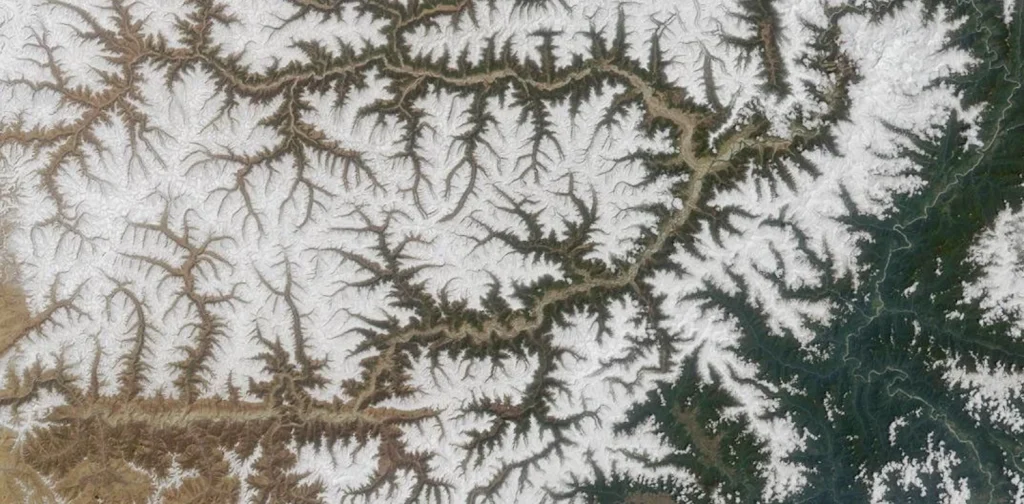
Photo: NASA/GSFC/LaRC/JPL, MISR Team.
Hydroelectric power, or hydropower, utilizes the flow of water to produce electricity. This renewable energy source has been used since ancient times. Back then, people were using watermills to harness the energy from water and turn it into a mechanical process. In China, the Medog Hydropower Station project is underway. Claimed to be the world’s largest hydroelectric initiative, the impacts on its surrounding environment and communities are significant.
The Development of Medog Hydropower Station
The Medog Hydropower Station is an integral part of China’s 14th Five-Year Plan (2021–25) and 2060 carbon neutrality goal. As a flagship project, its development is estimated to cost over USD 120 billion with a state-owned enterprise having the full rights of its construction. Capable of generating power up to 60 gigawatt, Medog Hydropower Station is predicted to surpass that of the Three Gorges Dam.
The dam will be constructed on the Yarlung Tsangpo river, in the Tibet Autonomous Region (TAR), China. It will sit on the “great bend” of the river where water plunges approximately 2,700 meters through a gorge, a conducive spot to build a hydroelectric power station.
Environmental Risks
In 1985, the Chinese Government established the Yarlung Tsangpo Grand Canyon as a national nature reserve. According to Article 32 of Regulations of the People’s Republic of China on Nature Reserves, no production installations shall be built in the core area and buffer zone of nature reserves.
In contrast, the construction of the Medog hydropower dam is an act of violation against their own efforts to protect the area. This project may unfortunately cause damages to the ecosystem at the expense of net-zero targets.
The Tibet plateau has undergone significant change since the 1980s because of climate change. The air temperature in this region is warming up twice faster than the rest of the globe. Moreover, permafrost is on the brink of thawing faster due to the drilling that permeates through its layers, releasing methane that speeds up global warming.
Additionally, this mega project is extremely risky due to the geological volatility of the Indus-Tsangpo Suture Zone. The location is seismically active, thus prone to extreme landslides and earthquakes. The building process of the dam might exacerbate the consequences when they happen.
Cascading Effects
Previous dam constructions have caused displacements among the surrounding communities, such as the cases of Shuangjiangkou Dam and Gangtuo/Kamtok Dam. It is likely that in this case for the Medog Hydropower Station, the local Tibetan communities will not be exempt from such a ramification.
This construction will not only impact Tibet, but also its neighboring countries. Yarlung Tsangpo flows south into India and Bangladesh and turns into the Siang, Brahmaputra, and Jamuna rivers.
China’s geographical condition makes it an upper riparian state with upstream control over these transboundary water resources. This hydro-hegemony practice is a threat to China’s international relations.
People in the downstream India and Bangladesh will feel the disruptions. These countries will suffer from water shortages, and eventually food scarcity with the loss of resources necessary for agriculture activities.
Toward Better Transboundary Water Governance
Despite being a primary water source, China has limited engagement with global water governance. For example, the Chinese government did not ratify the 1997 UN Watercourses Convention (UNWC). With China’s position of power, pressuring the country’s water management to be in consideration of the downstream states is vital.
This complication calls for a better approach to diplomacy and cooperation. Water-sharing treaties and collaborative frameworks are imperative to address the complexities of transboundary water governance. With the mutual goal of sustainable water management, China and downstream countries must work on basin-wide agreements and ecosystem monitoring together.
Editor: Nazalea Kusuma

Co-create positive impact for people and the planet.
Amidst today’s increasingly complex global challenges, equipping yourself, team, and communities with interdisciplinary and cross-sectoral insights on sustainability-related issues and sustainable development is no longer optional — it is a strategic necessity to stay ahead and stay relevant.
 What Australia Can Do to Help Prevent the Next Fire Crisis in Indonesia
  Looking into Gender Inequality in the Water Domain
  How the Earth’s Energy Imbalance Affects the Climate
  When Distant Conflict Ripples: How Global Supply Disruptions Find Africa
  Urgency to Protect Migratory Species as Extinction List Expands
  How Spogomi Addresses Waste Through Competitive Sport