

Looking into the Government Regulation on the Protection and Management of Mangrove Ecosystems in Indonesia
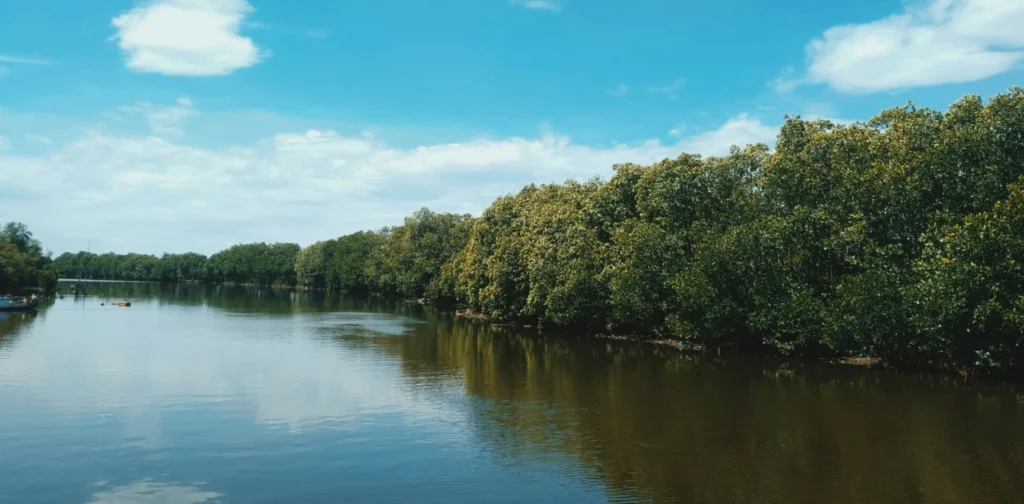
Mangrove Forest in Makassar, Indonesia. | Photo: Bayu Setiawan on Unsplash.
Undeniably, mangrove ecosystems play a crucial role in maintaining the ecological balance of coastal areas. Healthy mangrove forests can dampen ocean waves and abrasion, absorb and store significant amounts of carbon, provide habitat for various species, and support the livelihoods of coastal communities. Therefore, the robust protection and management of mangrove ecosystems is crucial to ensure the sustainability of the ecological, social, and economic functions that depend on them. In Indonesia, the Government Regulation 27/2025 covers the protection and management of mangrove ecosystems. Is it good enough?
Mangrove Ecosystems in Indonesia
Indonesia has the largest mangrove forests in the world, making up about 20–23% of the total global mangrove area. According to the 2024 National Mangrove Map, the total area of mangrove forests in Indonesia is 3,440,464 hectares. Papua (45.7%) and Kalimantan (21%) are the islands with the largest mangrove forest cover. Meanwhile, the potential area of mangrove ecosystems that can be rehabilitated reaches 769,824 hectares.
Unfortunately, mangrove forests in Indonesia are under various pressures, particularly from human activities and global warming. For example, between 2009 and 2019, the total area of mangrove forest lost was 182,091 hectares. In 2024, the loss reached approximately 261,575 hectares, over 4,000 hectares more compared to the previous year.
Spatial analysis shows that the main drivers of mangrove deforestation and degradation are land conversion to low vegetation areas, aquacultures, and agricultural practices. Besides the loss of their functions as coastal protectors and natural habitats, mangrove deforestation has the potential to emit 182.6 million tons of CO2e into the atmosphere within 10 years. If the loss continues, the impacts will put coastal communities and beyond at risk.
2025 Government Regulation
In 2025, the Indonesian government issued a set of new regulations on the protection and management of mangrove ecosystems. It is described as an effort to strengthen evidence-based and sustainability-oriented environmental governance. Government Regulation (PP) No. 27 of 2025 covers planning, utilization, control, maintenance, supervision, and enforcement of sanctions.
Key points of the Regulation include the obligation of businesses to prevent, mitigate, and restore mangrove forests if they damage them; the rights and opportunities for community participation, such as empowerment, incentives, and active involvement in planning and implementation; the use of mangroves to support a circular economy through mangrove-derived products; and strengthening the function of mangroves as a carbon sink crucial for national climate targets.
Loopholes and Blind Spots
Unfortunately, Government Regulation 27/2025 leaves loopholes that allow the threat of mangrove forest damage and shrinkage to continue. For one, this regulation only imposes administrative sanctions for mangrove ecosystem destruction, rather than treating it as an ecological crime. Furthermore, the standard criteria for damage stipulated in this regulation are also considered lax, requiring a decrease of at least 25% in mangrove canopy cover and the density of living trees with a diameter of ≥4 cm.
Furthermore, the Regulation also fails to acknowledge extractive industry activities and reclamation projects as contributing factors to the high rate of mangrove deforestation and degradation, which have been rampant, particularly in small island regions. The explanation only mentions aquaculture, agriculture, plantations, settlements, infrastructure development, solid waste disposal, and climate change as serious threats.
Strict Regulations and Robust Participation
Mangrove ecosystems are natural coastal barriers that support the resilience and sustainability of coastal communities—human and biodiversity alike. Therefore, mangrove ecosystem management must be cross-sectoral, with the implementation of strict sanctions, fair incentives, and transparent oversight. Halting land conversion and destructive land use as well as implementing restoration schemes with multi-stakeholder participation are crucial steps. In this regard, the role of local coastal communities is vital, and so is recognizing and realizing their potential. After all, a healthy mangrove ecosystem will support a healthy environment for all of us.
Editor and Translator: Nazalea Kusuma
The original version of this article is published in Indonesian at Green Network Asia – Indonesia.

Co-create positive impact for people and the planet.
Amidst today’s increasingly complex global challenges, equipping yourself, team, and communities with interdisciplinary and cross-sectoral insights on sustainability-related issues and sustainable development is no longer optional — it is a strategic necessity to stay ahead and stay relevant.
 Women in Waste Management: Asia’s Circularity Runs on Women. Its Policies Still Don’t
  Embracing the Business Value of Sustainability
  American Farmers Call for Government Support Amidst PFAS Contamination
  Asia Pacific’s SDG Progress Faces Major Setbacks
  Exploring the Bidirectional Relationship Between Olympic Games and the Environment
  The Hidden Threat of Tire Pollution to Salmon Populations