

Strengthening Religious Moderation to Support Global Peacebuilding
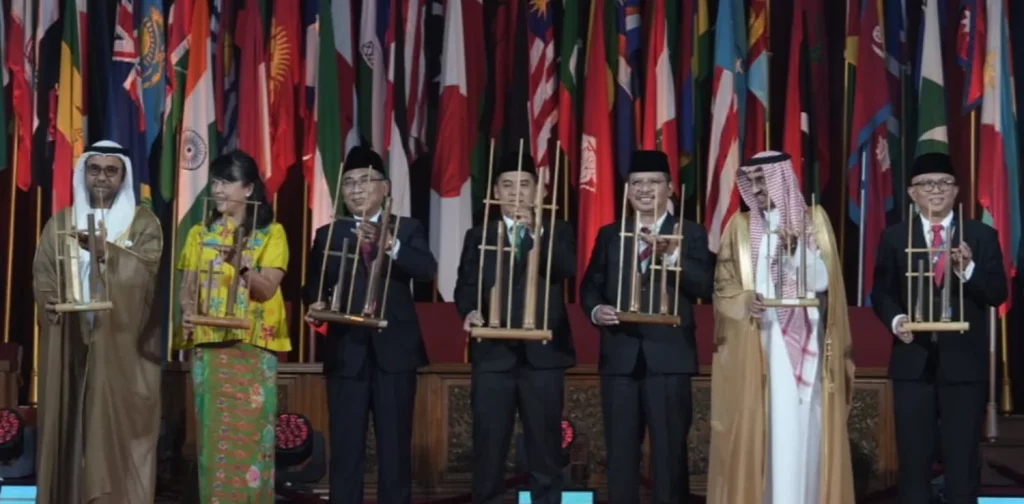
The Asian-African and Latin American Conference on Religious Moderation in Bandung, West Java, Indonesia. | Photo: Ministry of Religious Affairs of Indonesia.
Religion is an integral part of society. For many people, it is the foundation of and guidance in conducting their daily lives. Unfortunately, religion is often used to justify actions that are against human rights, such as violence and extremism. In this light, the Asian-African and Latin American Conference on Religious Moderation held by the Ministry of Religious Affairs of Indonesia became a momentum to strengthen religious moderation to support the achievement of world peace.
Religious Moderation
More than 85% of the global population adheres to a certain religion. This shows that religious people have huge opportunities to address some of the world’s most pressing matters, including climate crisis, poverty and inequality, hunger and food crisis, and ecosystem degradation. However, addressing those issues would be nearly impossible without maintaining peace. Therefore, religious moderation is crucial to support peacebuilding in a society with pluralistic beliefs.
The Ministry of Religious Affairs of Indonesia defines religious moderation as a process of understanding and practicing religious teachings justly and equally, and avoiding extreme behaviors in the implementation. Religious moderation emphasizes the importance of mutual respect between diverse religious groups and faith communities.
The Asian-African and Latin American Conference on Religious Moderation
Held in Bandung, West Java, Indonesia, on 20–22 December 2023, the Asian-African and Latin American Conference on Religious Moderation brought the theme of “Religion and Humanity.” The conference aimed to be a strategic forum for Asian-African and Latin American leaders to work together to stop the escalation of conflicts and achieve global peace.
Beyond religious moderation, the conference also discussed the most effective way to end the conflicts that are still happening in several countries, including Palestine and Ukraine. Country leaders, academics, researchers, religious figures, and practitioners from diverse cultural, political, and religious backgrounds convened to discuss and present the research results about religious moderation.
The conference seeked to achieve several goals:
- Ignite the spirit of the 1955 Bandung Asian-African Conference and Indonesia’s diplomacy in Latin America on peace and unity for global citizens.
- Develop international public diplomatic roles through strengthening religious moderation.
- Encourage peace and harmony among religious people in the world.
- Participate and contribute to the achievement of Sustainable Development Goals.
- Make recommendations on the mechanism for protocol and policy-making in mitigating and resolving problems of intolerance, violence, and religious extremism.
“The conference serves as the Ministry of Religious Affairs’ effort to strengthen religious moderation at the global level while also contributing to world peace amid conflicts that continue to occur in several countries,” said Saiful Rahmat Dasuki, the Deputy Minister of Religious Affairs of Indonesia.
Towards the World Peace
In Indonesia, religious moderation has been established as a part of the country’s policy to build character. The implementation and success measurement should follow four indicators: commitment to nationality, tolerance, anti-violence, and tradition acceptance.
Globally, interfaith dialogues and collaborations are crucial to build mutual understanding and tolerance between religious leaders and faith communities. As conflicts, disasters, and crises are getting more unpredictable and severe, building unity and peace among global citizens is one of the key drivers in mitigation and adaptation efforts where no one is left behind.
Translator: Kresentia Madina
Editor: Nazalea Kusuma
The original version of this article is published in Indonesian at Green Network Asia – Indonesia.

Abul Muamar
Amar is the Manager of Indonesian Digital Publications at Green Network Asia. He holds a Master’s degree in Philosophy from Universitas Gadjah Mada and a Bachelor’s degree in Communication Studies from Universitas Sumatera Utara. He has over ten years of professional experience in journalism as a reporter and editor for several national-level media companies in Indonesia. He is also a writer, editor, and translator with a particular interest in socio-economic and environmental issues.
 Risk of Transboundary Air Pollution Increases as Extreme Heat Continues
  Whimsymaxxing and Beyond: Rethinking the Waste Behind Viral Trends
  Seeking Guidance from Karl Marx to Face the Climate Catastrophe
  Indonesia’s Greenwashing Diplomacy at COP31 and Beyond
  The Textile Industry Is Growing, and So Is Textile Wastewater
  EESG: We Need a New Economic Narrative for Sustainability in the Age of AI, Energy Crisis, and Geopolitical Divide