

The Monsoon Wind Power Project Supports Energy Transition Across Borders in Southeast Asia
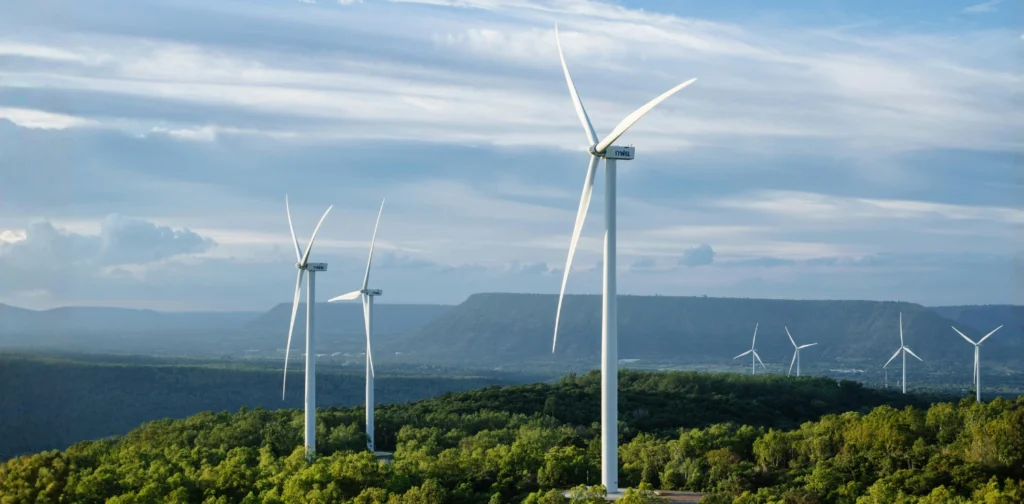
Photo: Taweesak Jang on Unsplash.
Southeast Asian countries are blessed with an abundance of renewable energy potential. However, most of it remains as potential without significant progress. The region still has plenty of room to grow in solving the energy trilemma of energy security, affordability, and sustainability. In this light, Lao PDR developed the Monsoon Wind Power Project to facilitate cross-border trade and collaboration on renewable energy.
Renewable Energy Opportunity
A report published by Ember reveals that renewables overtook coal as a source of electricity in the first half of 2025. The UN’s report on energy transition cites policy support and cost reduction as key drivers, especially for solar PV and wind power generation.
Lao PDR is taking advantage of this development to realize its vision of becoming the “Battery of Southeast Asia” by exporting electricity to neighboring countries. So far, Laos has become the largest electricity exporter in ASEAN, exporting 21.3 TWh in 2017. However, the majority of it comes from hydropower generated across the Mekong River basin, which faces criticisms for its impacts on the ecology and local communities.
The government of Laos started an ambitious renewable energy project in 2011. They collaborated with the International Energy Agency (IEA) to study the potential of harnessing strong, consistent winds in southern Laos. In 2016, Lao PDR and Vietnam signed the first MoU for Lao to supply 5,000 MW of renewable energy to Vietnam. Later in 2021, a 25-year Power Purchase Agreement (PPA) was signed with Vietnam’s state-owned electricity company, and then construction began in 2023. In August 2025, The Monsoon Wind Power Project officially reached its commercial operation date.
The Monsoon Wind Power Project
The Monsoon Wind Power Project is Asia’s first cross-border renewable energy project. As of 2025, it is Southeast Asia’s largest onshore wind farm. With approximately US$950 million investment, this project aims to be the most cost-effective renewable energy model in the region. It is expected to avoid more than 32.5 million tonnes of CO2 emissions over its 25-year operating life.
The wind farm is located in two southern provinces in Laos, Dak Cheung District in Sekong and Sanxay District in Attapeu. Spanning across 68,000 hectares, there are 133 turbines along mountain ridgelines. Each turbine generates about 4.51 megawatts of electricity, which could power as many as 4,000 households.
Besides for domestic use, electricity produced by Monsoon will be exported to Vietnam per the agreement. It will be transmitted through a 27 km transmission line on the Lao-Vietnam border, then to the EVN’s Thanh My substation.
Connecting Electricity in ASEAN
As the climate crisis worsens, transitioning to clean, renewable energy becomes an inevitable urgency. ASEAN should ideally pursue ambitious targets in reducing GHG emissions and investing in cleaner energy for both domestic and cross-border applications.
ASEAN has been working towards regional electricity interconnectivity through an ASEAN Power Grid (APG) since 1997. Yet, most cross-border electricity trade in ASEAN has been based on bilateral contracts, like the Monsoon Wind Farm Project. ASEAN has yet to have an integrated regional power market or synchronised electrical grid.
This lack of institutional support is the most challenging aspect in realizing cross-border collaborations. When building the Monsoon Wind Farm, for instance, developers had to navigate varying technical specifications and local political hurdles or complex bureaucracies alone.
Developing an integrated regional energy market in ASEAN is not an easy task. Challenges range from bureaucracy and political mistrust between the member states to costs and cost sharing. Overcoming environmental impacts and differing sociocultural contexts is also vital. Ultimately, ASEAN should focus on developing the market and its systems in a just and sustainable manner.
Editor: Nazalea Kusuma
 EESG: We Need a New Economic Narrative for Sustainability in the Age of AI, Energy Crisis, and Geopolitical Divide
  The Continued Struggle for Equality and Dignity in Women’s Sportswear
  Behavior Change for the Planet: Is composting worth it?
  Building Bridges Between Environmental Policy and Mental Health
  We May Surpass 1.5°C Soon, But We Can Do Something About It
  From European Heat to the Himalayan Flood: The Transboundary Nature of Climate Risk