

All Pain, No Gain for Women from the Tobacco Industry’s So-Called Generosity
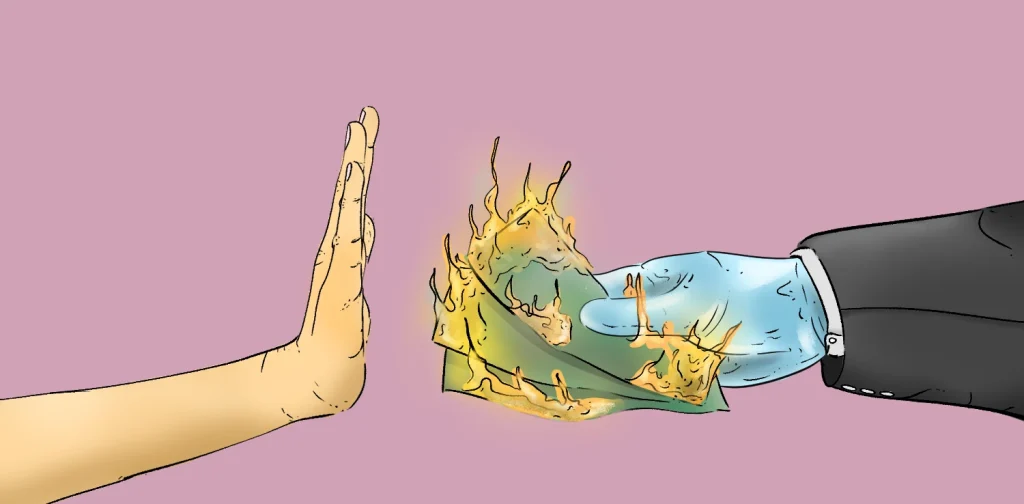
Illustration by Irhan Prabasukma.
When tobacco companies fund programs for women’s empowerment, entrepreneurship, or community development, they often frame these efforts as corporate generosity. But this raises a critical question: can an industry that profits from harm genuinely advance women’s wellbeing?
Southeast Asia, Women, and the Tobacco Industry
Southeast Asia offers a critical lens to understand this dynamic. The region is home to one of the world’s largest and fastest-growing tobacco markets, making it a key battleground for industry expansion, including among women and girls.
In 2023, the ASEAN tobacco market sold 474.7 billion cigarettes, with highest consumption in Indonesia, the Philippines, Thailand, and Vietnam. This number is the result of the 129 million adults who smoke across the region (19.1% of the population), with over half (63.1 million) residing in Indonesia alone.
Although women generally smoke at lower rates than men in ASEAN, the absolute numbers still amount to millions of women using tobacco. This “gender gap” is not a sign of protection, but a commercial opportunity actively exploited by the industry. Thus, the tobacco industry deploys targeted marketing to position tobacco and nicotine products as symbols of independence, sophistication, and empowerment.
Additionally, in the region, adolescent girls smoke at rates higher than adult women: 9.1% vs 5.8% in the Philippines, 5.2% vs 1.7% in Thailand, and 2.4% vs 1.4% in Malaysia. This is a clear sign that the tobacco industry is recruiting young girls to be its future market.
The Tobacco Industry and CSR
Within this strategy, corporate social responsibility (CSR) plays a pivotal role. The ISO 26000 Guidance on Social Responsibility provides seven principles and standards. But there is one industry, among others, that is fundamentally incapable of fulfilling these principles and, hence, cannot ever be considered as socially responsible: the tobacco industry. This is consistent with the World Health Organization in 2004 referring to tobacco industry’s CSR as “an inherent contradiction”.
Corporate social responsibility is, at its essence, about doing business responsibly. The concept involves the entire business operation, from day-to-day processes to strategic decisions. But the term CSR is often (mis)understood as only one aspect of it, which is corporate philanthropy. Even then, the tobacco industry’s use of CSR functions less as philanthropy and more as a strategy to get around bans on tobacco advertising, gain the attention of senior public officials, and obtain endorsement of vulnerable communities.
It’s a well-known tactic: tobacco companies often use CSR activities to detract attention away from the harm they cause. Globally, at least 74 countries have banned this strategy. Under the WHO Framework Convention on Tobacco Control, such activities are recognized as a form of promotion, and the framework calls on governments to ban them. Yet, the tobacco industry continues to adapt—rebranding CSR as “social contributions” or “sustainability initiatives” to circumvent regulation while maintaining influence. These tactics have been carefully designed to sanitize an industry profiting from addiction, illness, and death.
Case Study: Indonesia
As the largest tobacco market in the region and the only ASEAN country not party to the WHO Framework Convention on Tobacco Control, Indonesia represents both the scale of the crisis and the regulatory gaps the industry exploits.
Indonesia remains vulnerable to tobacco industry influence and weak regulation. With no total ban on tobacco advertising, promotions, and sponsorships (TAPS), including CSR activities, the country continues to serve as a major profit center for the industry. In 2024, Indonesia sold an estimated 320 billion cigarettes, the most in the region. Similarly, e-cigarettes profited USD 400 million and HTPs (heated tobacco products) USD 120 million in 2024.
Despite these grim figures, tobacco companies are still allowed to cloak themselves in the language of women’s empowerment through CSR programs. A USD100,000 here for “capacity building for women” and USD 100,000 there to “support women entrepreneurs” are chicken feed for a rich and powerful industry that made billions in profits in 2025.
Disproportionate Benefits and Costs on Women
The sums tobacco companies spend on CSR may not be insignificant, but they are miniscule in comparison to the economic and human toll of tobacco and nicotine. More importantly, these initiatives create a misleading narrative: that the industry is part of the solution, rather than the source of the problem.
Meanwhile, women bear the real costs. They spend billions of dollars annually on tobacco products, fueling an industry that causes nearly one in six deaths in Indonesia and imposes hundreds of trillions of rupiah in direct and indirect economic costs from healthcare and lost productivity. Women are also disproportionately exposed to secondhand smoke. Meanwhile, they often shoulder the burden of healthcare and caregiving for family members who fall ill because of tobacco use.
Beyond consumption, women are deeply embedded in the tobacco industry’s labor chain. Women make up 94% of workers in Indonesia’s kretek hand-rolling factories, often under low wages and poor working conditions. In tobacco farms, many suffer from “green tobacco sickness”, a form of nicotine poisoning from handling raw tobacco leaves. This reveals a full-cycle exploitation: women are targeted as consumers, relied upon as labor, and burdened as caregivers.
No to Bluewashing
Governments, particularly in ASEAN, can take concrete steps to prevent tobacco industry’s bluewashing and protect women’s health:
- Enact and enforce comprehensive bans on tobacco advertising, promotion, and sponsorship (TAPS), explicitly including CSR, “social contributions,” and other indirect promotional activities.
- Adopt and implement policies that protect public health policies from tobacco industry interference, including partnerships framed as corporate responsibility.
- Mandate transparency and disclosure of all corporate donations and partnerships involving tobacco companies, particularly those targeting women’s groups and community organizations.
- Make smoking cessation programs accessible, affordable, and widely available, especially for women, young people, and communities disproportionately harmed by tobacco use.
- Invest in alternative and sustainable livelihood programs that enable women working in tobacco factories and supply chains to transition to safe, dignified, and non-exploitative work.
Fundamentally, reframing the issue is essential: tobacco industry CSR is not about social responsibility, but a strategic tool to sustain its business model. No woman truly gains from the tobacco industry’s so-called support. When a business profits from a product that kills hundreds of thousands each year and harms even more, what it gives back cannot undo the lives it takes and the damage it deals. Thus, the path to genuine women’s empowerment lies not among such “gifts”, but in reforming the systems that make them possible.
Editor: Nazalea Kusuma

Co-create positive impact for people and the planet.
Amidst today’s increasingly complex global challenges, equipping yourself, team, and communities with interdisciplinary and cross-sectoral insights on sustainability-related issues and sustainable development is no longer optional — it is a strategic necessity to stay ahead and stay relevant.

Mary Assunta
Mary Assunta is the Senior Policy Advisor of the Southeast Asia Tobacco Control Alliance (SEATCA). She is an international tobacco control advocate with over 30 years of experience in policy development, research, consultancy, and capacity development. Mary obtained her PhD at the University of Sydney where her research involved reviewing the internal documents of the global tobacco industry.

Mouhamad Bigwanto
Mouhamad Bigwanto is a tobacco control researcher and advocate based in Indonesia, and the Founder and Executive Director of the Indonesia Health Policy Forum (RUKKI). Since 2015, he has collaborated with the Southeast Asia Tobacco Control Alliance (SEATCA) and is the lead author of Indonesia’s Tobacco Industry Interference Index. His work focuses on industry interference, e-cigarette use among youth, and research-to-policy analysis.
 From European Heat to the Himalayan Flood: The Transboundary Nature of Climate Risk
  Noise Pollution Is Making Us Sick, and Climate Change Is Making It Worse
  Beyond Fashion: The Environmental Cost Behind Animal Leather
  Addressing the Hidden Risk of Microplastics from Offshore Infrastructures
  Addressing Antimicrobial Resistance as More Than a Medical Issue
  Holding Harmful Industries Liable for Harm to Human Life and the Environment