

How Land Use and Climate Change Shape the Increasingly Precarious Balance of Global Deadwood Stocks
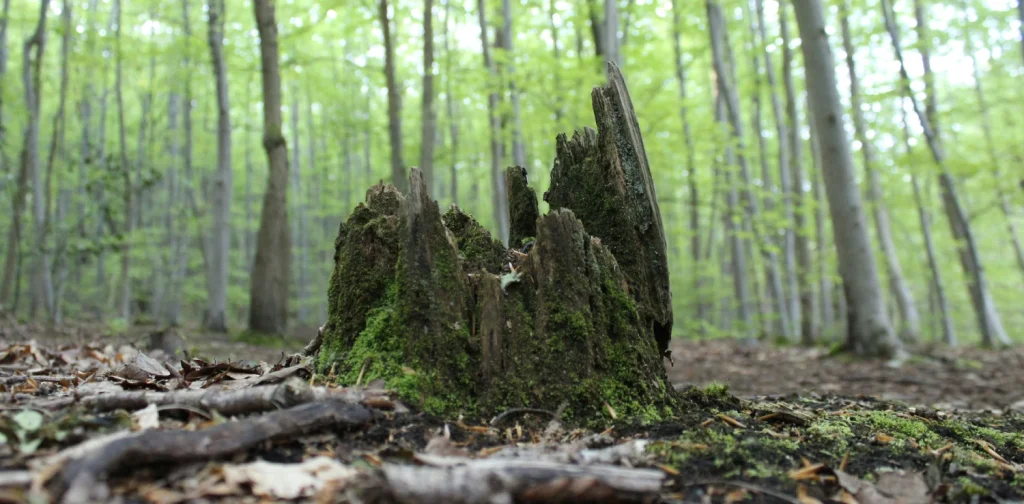
Photo: George Martin on Unsplash.
Forests are the lungs of the Earth, and, even more amazingly, their trees’ ecological functions last past their deaths. Trees store carbon, preventing it from going into the atmosphere, not only when they are alive. Dead trees in the forest, or deadwood, can also serve as carbon sinks for a while. Besides that, deadwood plays a vital role in maintaining forest productivity, supporting natural regeneration, and conserving biodiversity. However, its presence is increasingly vulnerable to climate change and human activities.
What Is Deadwood?
During its lifespan, a tree absorbs carbon dioxide from the atmosphere and stores it within its woody tissue. Upon the tree’s death, this accumulated carbon is not immediately released back into the environment. Instead, it remains sequestered within the structural logs, stumps, and branches. These dead parts of the tree are known as deadwood. It functions as a critical buffer and carbon pool, preventing immediate release of carbon into the atmosphere for decades.
Globally, deadwood holds approximately 73 billion tonnes of all forest-stored carbon. However, 15% of this pool, which is about 10.9 billion tonnes, is released back into the atmosphere each year. This figure is slightly higher than global emissions from fossil fuel combustion.
The total stock of deadwood in a forest relies on two opposing and climate-sensitive processes. The first is deadwood formation, which is driven by tree mortality and the carbon left behind in woody structures. The second is decomposition, where heterotrophic organisms break down matter and release its carbon back into the atmosphere.
Climate Change as a Catalyst
Climate change is rapidly reshaping the dynamics of the world’s forests. Increasingly severe threats, such as intensifying wildfires, extreme droughts, pest infestations, and diseases, are fundamentally altering forest structures by driving up tree mortality rates. As tree mortality climbs alongside forest productivity, the volume of fallen timber is growing. Simultaneously, warmer temperature allows decomposing fungi and insects to break down this material faster.
A recent study highlights how these shifting dynamics will reshape global deadwood stocks under various climate scenarios. According to the research, the generation of new deadwood from dying trees is now outpacing decomposition by 5%. Therefore, the temporary deadwood carbon pool is actually growing.
Because both processes are still happening at nearly the same rates, the overall ratio between them remains largely unchanged. However, the study findings also indicate that both deadwood formation and decomposition will accelerate past current levels. This surge in activity is highly dangerous because the total volume of carbon moving through the system has skyrocketed. The precarious situation creates a growing but unstable reservoir of carbon, one which will release massive unprecedented amounts of carbon into the atmosphere as the Earth warms and decay speeds up.
Anthropogenic Drivers of Deadwood Decline
More than climate change, the study warns that future global stocks depend much more heavily on human land-use decisions. In fact, global deadwood stocks have experienced a slight net decline since 1990.
This reduction is most prevalent in tropical forests, where losses have completely overwhelmed regional increases elsewhere. Human activities remain the primary driver of this decline. Industrial logging directly eliminates the living trees that would naturally become woody debris, while intensive management practices often sweep away existing deadwood from the forest floor.
Balancing Conservation and Utility
Given its critical functions as a carbon pool and vital biodiversity habitat, deadwood conservation must become a prioritized but flexible part of forest management. This will require close collaboration across sectors and stakeholders, but it is far from impossible. Leaving the vast majority of dead trees intact must remain the ecological baseline to nourish the soil, secure the underground carbon vault, and maintain forest resilience. However, highly targeted removal of debris can safely coexist with conservation when used for necessary wildfire mitigation. Moreover, as the world is looking into renewable energy sources, this excess residue becomes a sought-after source of biofuel. This conversion must be strictly managed so it does not prematurely spike atmospheric emissions.
Ultimately, the key lies in striking a careful balance between ecosystem protection and human utility rather than abandoning either practice.
Editor:Nazalea Kusuma

Co-create positive impact for people and the planet.
Amidst today’s increasingly complex global challenges, equipping yourself, team, and communities with interdisciplinary and cross-sectoral insights on sustainability-related issues and sustainable development is no longer optional — it is a strategic necessity to stay ahead and stay relevant.
 Noise Pollution Is Making Us Sick, and Climate Change Is Making It Worse
  Beyond Fashion: The Environmental Cost Behind Animal Leather
  Addressing the Hidden Risk of Microplastics from Offshore Infrastructures
  Addressing Antimicrobial Resistance as More Than a Medical Issue
  Holding Harmful Industries Liable for Harm to Human Life and the Environment
  Clearing the Air of Despair Surrounding the Climate Crisis with Data