

Insurers Are Retreating from Climate Risk, How Does It Matter?
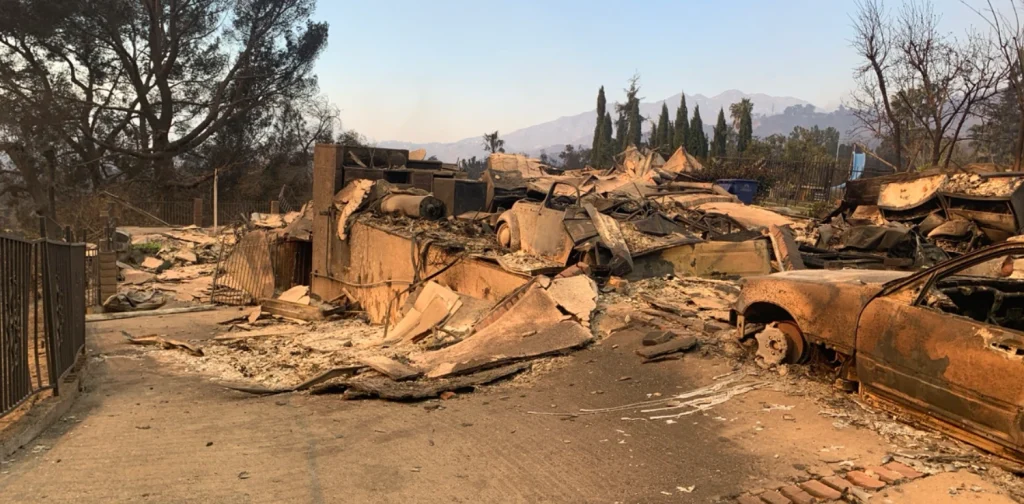
The aftermath of the Eaton Fire in northern Altadena, California, USA. | Photo: Wikimedia Commons.
As climate change escalates, extreme weather events and natural hazards are becoming the new reality for all lives on Earth. And having this constant, unpredictable threat over our heads is neither easy nor cheap. In this light, having a safety net is prudent. Yet key players, like private insurance providers, seem to be retreating in the face of heightened climate risk.
Climate Risk and Insurance
Disasters used to be predictable enough for insurers to price. That’s no longer true. The scale, the landscape, the frequency—they all present a new reality.This phenomenon is a manifestation of climate risk.
Climate risk is the growing likelihood that rising global temperatures make extreme weather and natural hazards like floods, storms, and wildfires more frequent and more destructive. The data is clear: global temperatures are now 1.4°C above pre-industrial levels, and recorded climate disasters worldwide have climbed nearly sixfold since the 1960s. In 2025 alone, natural disasters caused an estimated $224 billion in damage worldwide. It was the fourth straight year insured losses topped $100 billion globally.
Moreover, it is not just about the number of events. The unpredictability and severity also make climate risk hard to keep up with. For insurers, whose business depends on predicting how often disasters strike, that shifting baseline is the core problem.
As climate risk drives losses higher, private insurers are pulling back rather than absorbing the cost. Consequently, the global natural catastrophe protection gap has been widening. The difference between what disasters cost and what insurance actually covers hit a record $424 billion in 2025.
What the Retreat Looks Like
The pull-back from insurers occurs, just like climate risk, globally. However, what actually happens on the ground varies.
In the United States, insured losses reached $112.7 billion in 2024, a 36%jump from the year before. Several major carriers have simply stopped writing new policies in California and Florida altogether. Since 2022, seven of California’s top twelve insurers have paused or restricted new business. This pushed more homeowners onto the state’s FAIR Plan, a last resort that needed a $1 billion bailout after the 2025 Los Angeles fires.
The changes also occur internally. Insurance companies have reinsurance, the coverage insurers themselves buy to stay solvent. At a single 2023 renewal point, reinsurance rose as much as 50% in California. This extra cost ultimately lands on homeowners’ premiums.
Losing What Never Was
Meanwhile, the retreat looks different across emerging markets, mostly because meaningful coverage never fully arrived in the first place.
Take Myanmar, for example. A magnitude 7.7 earthquake in Myanmar caused an estimated $11 billion in damage. However, insurance claims covered barely $200 million of it. It is just one of many recent examples of the same pattern repeating from Manila to Maputo. In these regions, it is not just that insurers are retreating. It is that in most of the developing world, that market was never built.
In Emerging Asia, Swiss Re’s resilience index sits at just 5%, meaning nearly all new economic exposure goes uninsured. Latin America and emerging EMEA are not far behind. Their numbers hover around 8–9%, with almost all catastrophe exposure left unprotected. Africa’s numbers are starker still. Only about 0.5% of the continent’s economic losses from climate disasters were insured, compared to roughly half in high-income countries.
Exposed Fault Lines
When private insurers pull back, the bill does not disappear; it just changes hands. People either pay sharply higher premiums or shift into smaller, lower-rated regional insurers. Or, they go without coverage entirely and absorb the next disaster themselves.
Governments increasingly become the backstop of last resort. This may happen whether through state-run plans like California’s FAIR Plan or through emergency disaster relief after the fact, which is a far more expensive way to manage climate risk than insuring against it upfront. Thus, the holes in the safety nets governments should have provided become clearer. When private coverage retreats and public systems are not ready to fill the gap, the most exposed households end up carrying risk that neither the market nor the state has priced correctly.
Climate Risk Finance Adaptation
Without bold and prompt actions, climate risk is only going to keep rising. Therefore, strengthening resilience in the face of climate change is vital. Financial readiness is a key aspect of that. At the same, it is one of the most persistent barriers to disaster risk reduction and climate adaptation measures.
Still, closing this gap does not require reinventing insurance. Several tools already exist and simply need wider adoption. Among them is parametric insurance, which pays out automatically based on a disaster’s measured intensity rather than a lengthy damage assessment. The system may work well in disaster-prone regions with weak claims infrastructure.
Another pathway is mandatory climate risk disclosure. It gives regulators the data to intervene before a market collapses rather than after. After all, there is a strong economic case for prevention. Adaptation investment, from flood barriers to fire-resistant building codes, delivers a median $1.86 return for every dollar spent.
Ultimately, none of these fixes are free, but resilience is not impossible. At the end of the day, they cost far less than what happens when the bill simply lands on whoever can least afford it.
Editor: Nazalea Kusuma
Co-create positive impact for people and the planet.
Amidst today’s increasingly complex global challenges, equipping yourself, team, and communities with interdisciplinary and cross-sectoral insights on sustainability-related issues and sustainable development is no longer optional — it is a strategic necessity to stay ahead and stay relevant.
 Addressing Antimicrobial Resistance as More Than a Medical Issue
  Holding Harmful Industries Liable for Harm to Human Life and the Environment
  Clearing the Air of Despair Surrounding the Climate Crisis with Data
  How Do Wild Animals Survive Wildfires?
  How Losing Sleep Is a Climate and Equality Issue
  How the Cost of Living Crisis Is Pushing People Away from Sustainable Choices