

The Global Blended Finance Alliance for SDG and Climate Financing
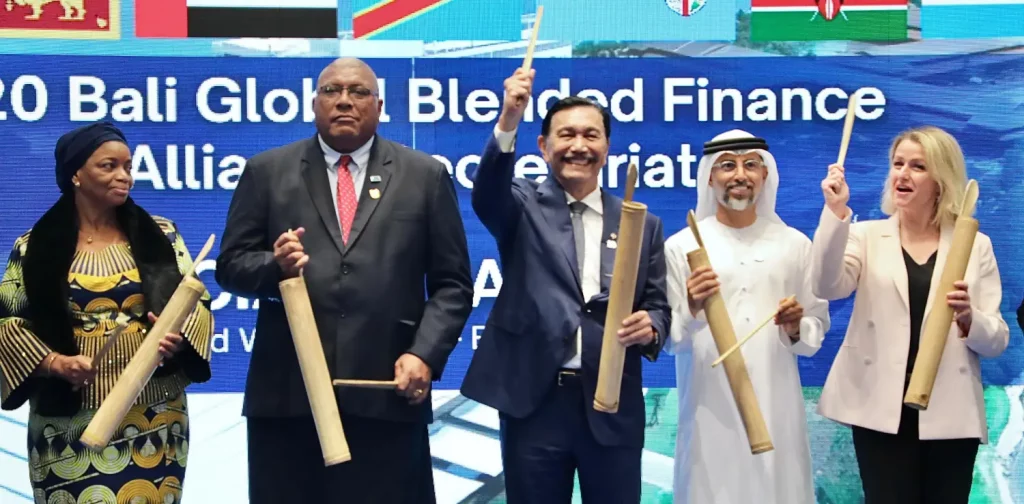
The launching of the Global Blended Finance Alliance Secretariat in Bali, Indonesia. | Photo: Indonesia Coordinating Ministry of Maritime Affairs and Investment.
Funding and investment are integral parts of sustainable development. Achieving the 2030 Agenda will not be possible if the public and private sectors at the national, regional, and international levels do not collaborate to mobilize funding for SDG actions. In this light, the government of Indonesia initiated the Global Blended Finance Alliance (GBFA) to accelerate investment in climate and SDG actions.
The Global Blended Finance Alliance
The 2030 Agenda for Sustainable Development outlines many targets and goals for people, planet, and prosperity. Some of them are urgent actions on climate change, eradicating poverty, and fostering a just and inclusive society for all. So, reaching all these goals and targets will require systemic collaboration between the public and private sectors.
During the G20 Bali Summit in November 2022, the government of Indonesia and partner organizations launched the G20 Bali Global Blended Finance Alliance (GBFA). Blended finance is “the strategic use of development finance to mobilize additional finance towards sustainable development in developing countries.” The organization was established to serve as a global community to accelerate investment in climate action and sustainable development.
“We don’t have time to reinvent the wheel. This is why we are launching the Global Blended Finance Alliance, which will build capacity across governments, the private sector, and philanthropy to do better blending,” said Luhut B. Pandjaitan, Coordinating Minister of Maritime Affairs and Investment of Indonesia, during the summit.
Bridging the financing gap
Encouraging all key actors in the finance sector to participate in bridging the funding and investment gap is crucial. Therefore, one of the objectives of the Global Blended Finance Alliance is to encourage the use of government and philanthropic finance to incentivize private investments in high-impact SDG-related business solutions. This will require the organization to partner with governments, philanthropic organizations, and private investors.
The organization also aims to support the standardization of blended finance data and framework to make it scalable and replicable in Developing Countries, the Least Developed Countries, and the Archipelagic Island States. Furthermore, fostering capacity building and knowledge sharing of best practices from other emerging markets is also highlighted to strengthen collaboration between developing countries.
In May 2024, the Coordinating Ministry of Maritime Affairs and Investment of Indonesia launched the Global Blended Finance Alliance Secretariat in Bali, Indonesia. Representatives from founding countries were present and signed the Letter of Intent, including Canada, the Democratic Republic of the Congo, Fiji, France, Kenya, Sri Lanka, and the United Arab Emirates.
The GBFA is expected to serve as the platform for implementing the G20 Blended Finance Principles in developing countries. As the world’s crises are getting more complex, a blended finance scheme is a necessary step to bridge the SDG financing gap, especially for climate actions.
Kresentia Madina
Madina is the Assistant Manager of Stakeholder Engagement at Green Network Asia. She holds a bachelor’s degree in English Studies from Universitas Indonesia. As part of the GNA In-House Team, she supports the organization's multi-stakeholder engagement across international organizations, governments, businesses, civil society, and grassroots communities through digital publications, events, capacity building, and research.
 Impacts of E-waste Pollution on Animals and Human Health
  Africa’s Solar Energy Surge: Why 2025 Was a Breakthrough Year
  Agrihoods: Integrating Farms and Urban Neighborhoods into Sustainable Communities
  Women in Waste Management: Asia’s Circularity Runs on Women. Its Policies Still Don’t
  Embracing the Business Value of Sustainability
  American Farmers Call for Government Support Amidst PFAS Contamination