

How Indonesia Could Shift to a Green & Inclusive Economy
Source: Asian Development Bank
As the world becomes increasingly aware of climate change and its effects, the shift to a green economy is making waves worldwide. From the energy sector in India, Singapore Green Plan, the Olympic Games in Tokyo to the beauty industry, it is apparent that the sustainability aspect is a trend and a necessity these days.
Green economy is an economic system that integrates nature, people, and the economy tightly. In theory, this concept is no stranger to Indonesia with its similarity with the economic concept of Pancasila, its national ideology.
Transforming to a greener and more inclusive economy not only serves to anticipate critical environmental damage but also offers substantial investment opportunities and opens employment. A report on Nature Risk Rising by World Economic Forum and PwC states that a massive and systemic economic transition might open up US$ 10.19 billion in business potential and 395 million people in employment by 2030.
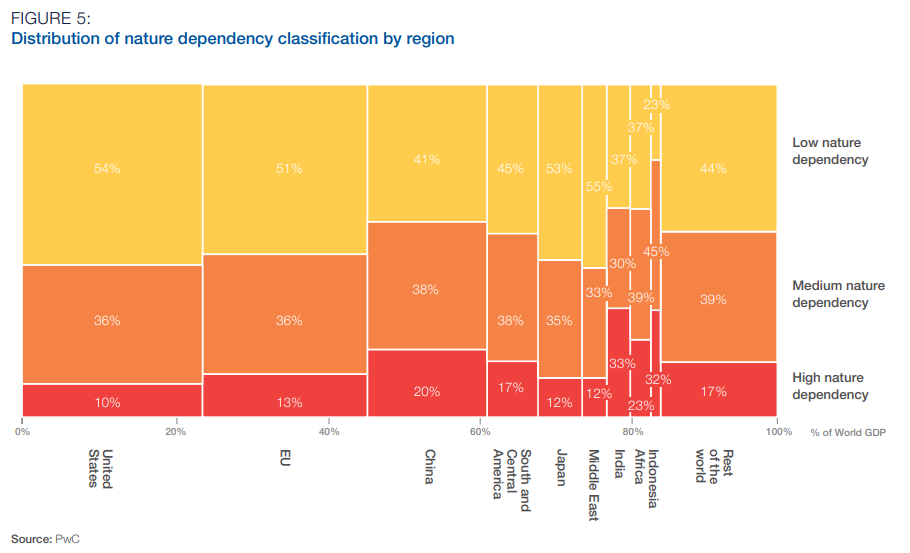
However, the same report exposes that the primary and extractive sectors still dominate Indonesia’s export. Indonesia, along with India, produces a third of its gross domestic products from industries that are very dependent on nature.
Furthermore, Indonesia’s economy is still reliant on the extractive sector. A study report from March 2021 by the Institute for Development of Economics and Finance (INDEF) and Greenpeace suggests that inconsistency in governance may be the root of the country’s obstacles. Contradicting policies and regulations are evident, as well as shaky implementations.
For example, Indonesia allocates 8% of its COVID-19 recovery stimulus to green initiatives. Yet, the government still gives a significant amount of subsidy for BUMNs (State-Owned Enterprises) in the extractive sector that produce massive carbon emissions, such as PLN (state-owned electricity company) and PT. Pertamina (state-owned oil and natural gas corporation).
A successful shift to a green and inclusive economy is still possible. Below are the recommended actions from the INDEF and Greenpeace report:
- In attracting global investment, the government must shift the focus from quantity to quality. Massive global investors are keeping their eyes on states and businesses with ESG (Environmental, Social, and Governance) aspects and focus, leaving the neoclassical economy behind. Indonesia needs to change its exploitative regulations.
- The government must stop giving incentives to exploitative and extractive sectors. Only increasing the incentive for green sectors is not enough for the transformation to renewable energy to happen in time.
- Indonesia’s export goods must change from primary commodity to value-added commodity. The value-added commodity enables better nature conservation and higher long-term profit.
- The government must be consistent in making policies and regulations. Right now, there are contradictory policies such as those on clean energy, minerals, and coals. Environmental and social costs must be considered in policy-making.
- Priority must go to micro, small, and medium enterprises and indigenous communities. The government must prioritize those entities for a successful transformation to a green and inclusive economy.
Editor: Marlis Afridah

Nazalea Kusuma
Naz is the Manager of International Digital Publications at Green Network Asia. She is an experienced and passionate writer, editor, proofreader, translator, and creative designer with over a decade of portfolio. Her history of living in multiple areas across Southeast Asia and studying Urban and Regional Planning exposed her to diverse peoples and cultures, enriching her perspectives and sharpening her intersectionality mindset in her storytelling and advocacy on sustainability-related issues and sustainable development.
 The Truth Behind Space Debris and the Urgency for Space Governance and Accountability
  Non-Economic Loss and Damage: Making sense of our intangible loss in a changing climate
  Unpacking SBTi’s Corporate Net-Zero Standard V2.0: Balancing Science and Business Realities
  Farmer Loneliness, the Overlooked Mental Health Crisis Within the Food System
  Conservation Paradox: Managing the Overabundance of Endangered Koalas in South Australia
  Green Burnout: Sustainability Workers and Climate Activists Are Quietly Falling Apart