

Indonesia-UAE Collaborations for Mangrove Restoration and Conservation Efforts
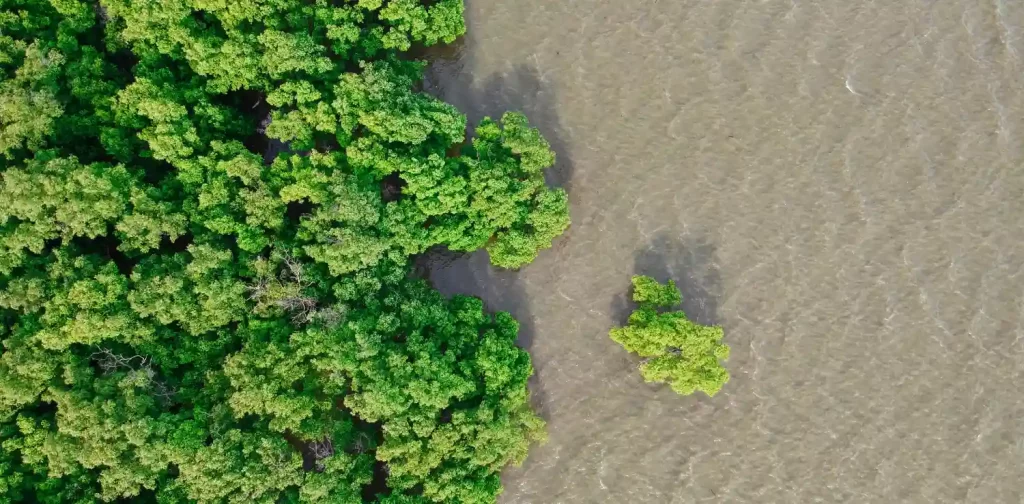
Photo: Waranont (Joe) on Unsplash.
Mangroves are essential for lives on land and below sea. They provide a home to many species, support food security, and help mitigate climate change impacts by absorbing carbon. Unfortunately, mangrove populations in many parts of the world are experiencing degradation and damage due to climate change and human activities. In this light, Indonesia and the United Arab Emirates have partnered to establish the International Mangrove Research Center (IMRC) in Bali, Indonesia, for mangrove restoration and conservation efforts.
State of World’s Mangrove
In 2020, the global mangrove areas reached 147,359km². The largest mangrove areas were located in Southeast Asia, spanning 48,222km². Indonesia houses one-fifth of the worldwide mangrove areas.
Mangrove forests have abundant benefits for people and other biodiversity. For instance, they have a significant role in preventing natural disasters and damage on land, providing shelter for small fishes and birds in migrations, and absorbing up to five times more carbon than tropical forests.
Unfortunately, global mangrove forests are shrinking significantly in recent decades, including in Indonesia. The Peatland and Mangrove Restoration Agency recorded that 637,000 hectares of mangrove ecosystems are considered critically damaged in Indonesia. The degradation is primarily caused by deforestation, mangrove forest conversion, and climate change. In this light, international collaborations with science and technology approaches are crucial in mangrove restoration and conservation efforts.
International Mangrove Research Center (IMRC)
The International Mangrove Research Center (IMRC) aims to help increase research and innovation and encourage knowledge exchange on mangroves among global communities. Indonesia and the United Arab Emirates agreed to establish the IMRC after Indonesia was appointed as the Leader of the Mangrove Alliance for Climate.
Furthermore, the research center will support the Mangrove Alliance for Climate’s mission to restore and protect 15 million hectares of global mangroves by 2023. This mission aligns with the Mangrove Breakthrough goals agreed during the COP28’s World Climate Action Summit on 2 December 2023.
“IMRC will be a forum for international cooperation for capacity development, including through knowledge exchanges and joint research by experts. By learning together, we can work together better,” said Erick Thohir, the Coordinating Minister of Maritime Affairs and Investment Ad Interim.
The IMRC hopes to support various initiatives for mangrove restoration and conservation efforts in Indonesia, including the Mangroves for Coastal Resilience Project, which focuses on strengthening the policy and agency in managing and rehabilitating mangroves and increasing job opportunities for coastal communities.
Mangrove Restoration and Conservation Efforts
Considering its abundant benefits for the people and planet, mangrove restoration and conservation efforts become crucial amidst the threats of climate change and other crises. Therefore, this calls for collaboration and synergy from all key stakeholders, including governments, businesses, and organizations, to ramp up the efforts and enforce necessary regulations for mangrove forest protection.
“Mangroves are the unsung heroes in our fight against climate change. They are the sentinels of our coasts and the guardians of our marine biodiversity,” said Mariam bint Mohammed Almheiri, the Minister for Climate Change and Environment of the United Arab Emirates.
Translator: Kresentia Madina
The original version of this article is published in Indonesian Green Network Asia – Indonesia.

Abul Muamar
Amar is the Manager of Indonesian Digital Publications at Green Network Asia. He holds a Master’s degree in Philosophy from Universitas Gadjah Mada and a Bachelor’s degree in Communication Studies from Universitas Sumatera Utara. He has over ten years of professional experience in journalism as a reporter and editor for several national-level media companies in Indonesia. He is also a writer, editor, and translator with a particular interest in socio-economic and environmental issues.
 India’s Supreme Court Declared Menstrual Health and Hygiene as Fundamental Rights
  Impacts of E-waste Pollution on Animals and Human Health
  Africa’s Solar Energy Surge: Why 2025 Was a Breakthrough Year
  Agrihoods: Integrating Farms and Urban Neighborhoods into Sustainable Communities
  Women in Waste Management: Asia’s Circularity Runs on Women. Its Policies Still Don’t
  Embracing the Business Value of Sustainability