

Singapore-US Partnerships for Green Shipping Corridors
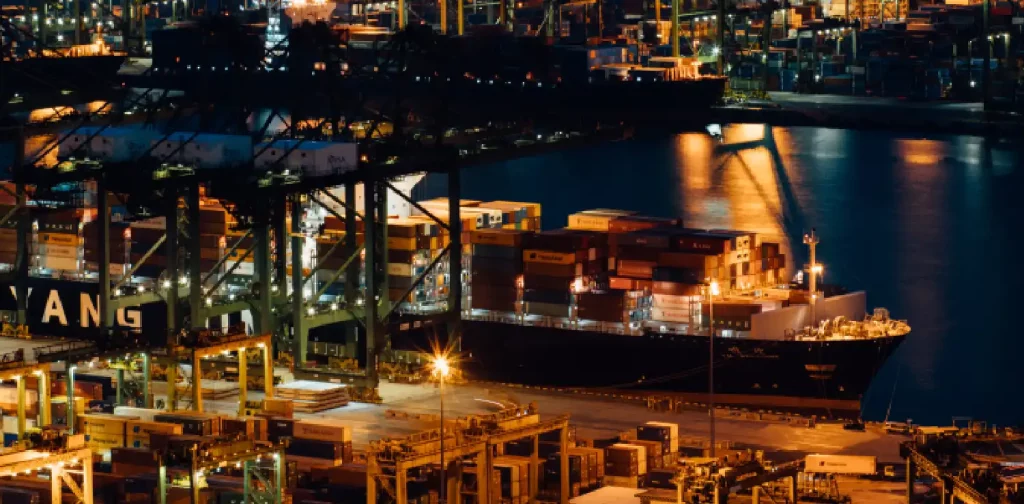
Photo: Hanson Lu on Unsplash.
The shipping industry plays an essential part in economic development as it enables the circulation of goods to fulfill global supply and demand. However, the sector also contributes to the global greenhouse gas emissions. In this light, Singapore and the USA collaborate to establish green shipping corridors to support decarbonization in the shipping industry.
Green Shipping Corridors
International shipping contributed 2% (706 Mt) of global CO2 emissions in 2022. The number had bounced back and almost reached the pre-pandemic level after experiencing a decline in 2020 due to the COVID-19 mobility restriction. Although it’s relatively small now, the figure can rise to 17% in 2050 without proper regulations in place.
In 2023, the International Maritime Organization released a strategy to reduce at least 40% of international shipping emissions by 2030. Decarbonization efforts for the shipping industry require international collaborations. One of them is implementing green shipping corridors. This system should support emissions reduction programs and measure its implementation. It includes deploying zero-carbon emissions ships and implementing policies and interventions by key public and private actors in the industry.
The Partnership Strategy
At COP27, the Maritime and Port Authority of Singapore (MPA), Port of Los Angeles (POLA), and Port of Long Beach (POLB) announced the collaboration plan to establish a Green and Digital Shipping Corridor (GDSC). Supported by C40 Cities, the partnership aims to accelerate decarbonization efforts and the deployment of digital technology solutions in the maritime industry. At COP28, the three ports released a Partnership Strategy for the GDSC.
The Green and Digital Shipping Corridor will span 14,000 kilometers across the Pacific Ocean. The MPA, POLA, POLB ports, and C40 Cities will collaborate with value-chain stakeholders from the fuel and maritime sectors to achieve several goals:
- Drive the efforts to achieve net-zero greenhouse gas emissions for the ships calling at the Port of Singapore, Port of Los Angeles, and Port of Long Beach as early as possible.
- Build consensus around green shipping best practices and standards.
- Accelerate technology and digital solutions development and deployment to support supply chain efficiency, resilience, and decarbonization, as well as reduce costs and improve the reliability of cargo movement.
- Work with stakeholders to scale the uptake of zero and near-zero emission technologies, fuels, and energy sources.
“The strategies we develop here can be used as a roadmap by a larger network of seaports and supply chain companies to invest in programs, technologies, software, and infrastructure to decarbonize international trade everywhere,” said Mario Cordero, the CEO of Port of Long Beach.
Ways Forward
Following the release of the Partnership Strategy, the three ports and C40 have commissioned a study to estimate the quantity of near-zero and zero-emission fuels required for the trade flows and vessel traffic between Singapore, Los Angeles, and Long Beach. Furthermore, the organizations will also begin to engage key stakeholders from the shipping and fuel supply value chains to support the implementation of the GDSC. The implementation of the green shipping corridors is hoped to be a step forward towards a sustainable shipping industry.
“Green shipping is only achievable through collaboration because no one stakeholder can afford to move unless they know others are likely to follow,” said Mark Watts, the Executive Director of C40 Cities.
Editor: Nazalea Kusuma

Kresentia Madina
Madina is the Assistant Manager of Stakeholder Engagement at Green Network Asia. She holds a bachelor’s degree in English Studies from Universitas Indonesia. As part of the GNA In-House Team, she supports the organization's multi-stakeholder engagement across international organizations, governments, businesses, civil society, and grassroots communities through digital publications, events, capacity building, and research.
 Women in Waste Management: Asia’s Circularity Runs on Women. Its Policies Still Don’t
  Embracing the Business Value of Sustainability
  American Farmers Call for Government Support Amidst PFAS Contamination
  Asia Pacific’s SDG Progress Faces Major Setbacks
  Exploring the Bidirectional Relationship Between Olympic Games and the Environment
  The Hidden Threat of Tire Pollution to Salmon Populations