

Contending the Age of Extraction by Tech Platform Giants
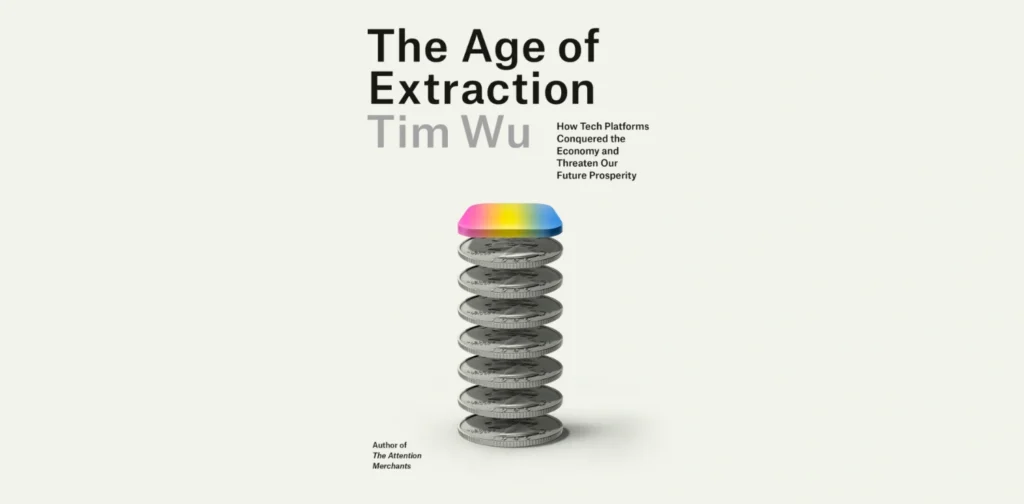
Cover of “The Age of Extraction: How Tech Platforms Conquered the Economy and Threaten Our Future Prosperity” by Tim Wu. | Publisher: Knopf (2025).
Years ago, anyone working in the fields of sustainability, social responsibility, and/or corporate reputation would have agreed: information and communications technology companies were among the most successful. They were prime examples of how companies could optimize the good parts of their products and business models. Their positive impacts were enormous, particularly in relation to knowledge optimization. Meanwhile, their negative impacts were rarely highlighted.
But that impression was short-lived. Their negative impacts were exposed: pornography, privacy violations, sales of user data, misinformation and disinformation, behavior modification, and so on. When Soshana Zuboff presented irrefutable evidence that Google and Facebook were manipulating our data and labeled the practice “Surveillance Capitalism”, the world woke up.
For Yanis Varoufakis, the behavior of these companies is no longer of a regular capitalist. They want something more certain instead. They become platform owners so that everyone else has to pay them rent, just like the landlords of old times. Therefore, Varoufakis says we are in the era of Technofeudalism—which he chose as the title of his latest book.
Not content with securing rents, they seek to squeeze platform renters out of everything they have. These parties have no way of escaping if they want to continue selling. Thus, everyone can see how service quality deteriorates while prices skyrocket. Cory Doctorow chronicles this phenomenon in his latest book, Enshittification: Why Everything Suddenly Got Worse and What to Do About It.
The Age of Extraction
When I stopped by Periplus last Friday, I came across the book titled The Age of Extraction: How Tech Platforms Conquered the Economy and Threaten Our Future Prosperity. It was written by Tim Wu, a close friend of Doctorow’s since his youth. Broader than Doctorow’s, this book presents a sharp and critical examination of how technology platforms are transforming not just the digital economy, but the economy as a whole—and how those changes pose risks to future shared prosperity. That was the brief explanation I read before deciding to buy and read it immediately.
Wu is a scholar—a law professor at Columbia University—and a longtime policymaker in the fields of antitrust and technology. He uses this book to connect the dots between the concentration of platform power, the extraction of value from users and suppliers, and their impact on democracy and the distribution of economic benefits and harms. In the introduction to The Age of Extraction, he asserts that the digital world, originally predicted to empower the masses, has in fact created a new economic class: the platform champions (owners and their cronies) and the vast majority of humanity (the rest of us) who are increasingly disempowered.
Paving the Way to the Dominance of Technology
In the first chapter, Wu reviews the history of competition regulation and the changes in the economic landscape that paved the way for platform dominance. He examines the post-World War II era in the United States, when antitrust was on the rise. Cases such as those against large telecommunications companies and other industries demonstrated that the state actually had the capacity to counter the concentration of power. However, starting in the 1970s and 1980s, law enforcement weakened, free-market philosophies became dominant, and antitrust regulation declined. Wu then argues that regulatory changes—along with technological developments—triggered the transformation from an industrial economy to an increasingly centralized platform economy.
In the next chapter of The Age of Extraction, Wu turns to the core of the extraction mechanisms employed by giant platforms. He shows how platforms not only provide services that “make things easier” for consumers, but also structurally design models that continuously capture users’ attention, sucking up data, time, and interactions as raw economic resources. Recommendation algorithms, user data collection, and the platform’s vertical integration of control over suppliers and consumers are all a part of this systematic extraction mechanism. Wu notes that convenience is both the most underrated and the most reliable element in enhancing the power and might of platforms.
Wu then broadens his discussion from the purely digital realm to “real-world” economic sectors such as healthcare, housing, finance, and general services. He shows that platform logic is increasingly permeating essential sectors. He writes, for example, how platform-based healthcare services tend to raise costs for consumers while lowering revenues for providers. Another example is how intermediary platforms for housing or financial services can act as gatekeepers, arbitrarily filtering suppliers and accumulating surpluses. Thus, the extraction economy is no longer limited to clicks and embedded ads, but has become a crucial part of everyday life and social infrastructure. This analysis reveals that the problem lies not in technology per se, but in how technology is positioned economically and politically.
Politics and Policy
In the following chapters, Wu introduces the next generation of challenges: generative AI, large-scale automation, and cross-platform data integration. These sectors further strengthen the dominant position of digital platforms. He emphasizes that AI is clearly not the deus ex machina for mass empowerment, but rather, learning from the past, has the potential to deepen extraction. Platforms that command large amounts of data (big data) can use AI for personalization, lower supplier costs, strengthen user lock-in, and create new barriers for competitors. Wu presents his scenario with a note of caution. We are not heading towards a frictionless era, but rather an era of large-scale extraction, if not regulated soon. The age of extraction looms.
In the penultimate chapter, Wu discusses the macroeconomic and political consequences of platform concentration. Wu argues that when economic power is concentrated in this small number of platform companies, social dynamics change. Income distribution becomes increasingly unequal, avenues for innovation narrow, and democratic space and public control continue to weaken. He warns that the accumulation of economic power can be a catalyst for democratic dysfunction and the rise of authoritarianism. He outlines five stages: the monopolization of large industries; the extraction of monopoly profits that create a winner-loser divide; the emergence of mass discontent; the failure of democratic institutions to respond; and, finally, the emergence of a “strongman” who claims to represent the people.
Finally, in the final chapter of The Age of Extraction, Wu formulates a series of policy recommendations. He calls for strengthening independent and respected antitrust enforcement, implementing utility or essential service regulations for platforms that serve as social infrastructure, and demanding neutrality and transparency for companies that control access. He also highlights the necessity of a role for unions and suppliers to countervailing power. However, Wu is also understanding and realistic. He acknowledges that the political obstacles are enormous. Reforming the structure of platform economy requires optimizing state capacity, public support, and legislative courage—all of which are currently often absent.
Platform Economy, in Consideration
For me, The Age of Extraction is essential reading for anyone who wants to understand how today’s digital economy is more than just technological hype. It’s about economic power transforming social and political structures. Wu’s greatest strength lies in his ability to craft a coherent narrative, connecting the industry’s history with current and future challenges, and offering a coherent policy roadmap without getting too bogged down in technical jargon.
His writing style is straightforward, his analogies are relevant, and even readers from non-technical backgrounds like myself can follow the arguments. In the context of developing countries, the sections on how platforms impact essential sectors—such as health and housing—are highly relevant for local reflection.
However, I found the book having several limitations. First, its strong pessimistic tone sometimes makes the space for political and institutional maneuvering feel narrow. Wu hypothesizes how economic concentration can contribute to the rise of authoritarianism and democratic dysfunction—arguments that may surprise some, or at least be provocative—but he also lacks a thorough analysis of the political variables that could alter these outcomes, such as differences in national contexts or country-specific policies.
Second, because the book is concise and easy to digest, at times, it feels like Wu sacrifices the depth of argument for the sake of narrative fluency. There are moments where readers like me, who would have liked more substantial empirical data—for example, cross-sector statistics, quantitative analysis of market trends, or wages paid to platform companies—feel the emptiness. Wu’s choice of a synthetic approach makes it highly communicative, but it also means that empirical evidence is sometimes presented in an overly concise manner, without in-depth data appearance.
Third, in the solutions section—although Wu presents a list of policies—he also acknowledges the political difficulties in implementing them. For readers seeking concrete political strategies—how to build coalitions, win legislative support, or manage industry resistance—the book provides only a foundational and introductory guide, but not always the practical, operational tactics.
The Age of Extraction as a Departure Point
Still, I highly recommend The Age of Extraction to anyone seeking a deeper understanding of the platform economy and its impacts. This book is highly successful in opening discussions and broadening insights, using language accessible to policy observers, managers, interdisciplinary academics, and even general readers like myself. For readers seeking an in-depth empirical review or a detailed political guide to implementation, this book is not a data-intensive monograph, but rather an ideological and analytical roadmap—one that must then be linked to sectoral research or local contexts.
In the context of the information and communications technology industry, including and especially AI, The Age of Extraction provides a solid foundation for understanding that technology is not, and never has been, a neutral asset. It always comes with economic and political power that may be enormous and ever-growing. Therefore, technologies like AI need to be carefully regulated and controlled, before we are all reduced to become raw materials in the 21st-century extraction economy.
Regarding control and regulation, when I finished reading the book, a question remained in my mind: is it possible?
Editor: Abul Muamar
Translator: Nazalea Kusuma
The original version of this article is published in Indonesian at Green Network Asia – Indonesia.
Co-create positive impact for people and the planet.
Amidst today’s increasingly complex global challenges, equipping yourself, team, and communities with interdisciplinary and cross-sectoral insights on sustainability-related issues and sustainable development is no longer optional — it is a strategic necessity to stay ahead and stay relevant.

Jalal
Jalal is a Senior Advisor at Green Network Asia. He is a sustainability consultant, advisor, and provocateur with over 25 years of professional experience. He has worked for several multilateral organizations and national and multinational companies as a subject matter expert, advisor, and board committee member in CSR, sustainability, and ESG. He has founded and become a principal consultant in several sustainability consultancies as well as served as a board committee member and volunteer at various social organizations that promote sustainability.
 What Fading Butterfly Colors Reveal About Environmental Stress
  The Right to Be Cold and What It Means for Indigenous Inuit
  All Pain, No Gain for Women from the Tobacco Industry’s So-Called Generosity
  Upholding the Women in Agriculture Who Are Feeding Africa
  The Role of Trade Unions in Peacebuilding
  Red Flags in the EU’s Industrial Accelerator Act (IAA)