

Hamdan bin Zayed Initiative: Abu Dhabi’s Path to Achieve the World’s Richest Seas
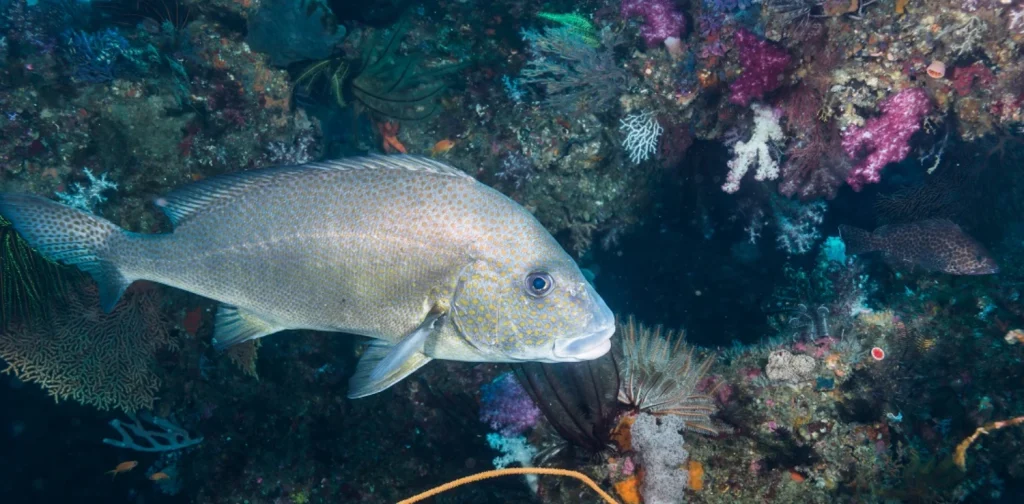
Painted Sweetlips, one of Abu Dhabi’s overexploited fish species. | Photo: EAD.
Our oceans and seas are full of treasures. Not the fairytale kind, but the real treasures of the planet’s rich biodiversity and ecosystems. This richness contributes to our survival—as food and ingredient sources as well as for planetary health. Unfortunately, the wellbeing of our seas is declining, urging increased conservation and preservation efforts worldwide. In the UAE, the Environment Agency – Abu Dhabi (EAD) takes the lead on marine conservation and has launched the Hamdan bin Zayed initiative with a vision as the world’s richest seas.
Abu Dhabi’s Marine Ecosystems
Abu Dhabi’s marine ecosystems lie at the southern boundary of the Arabian Gulf in the United Arab Emirates. The UAE capital’s seas contain corals, seagrasses, mangroves, salt marshes, and many other unique habitats. Moreover, these habitats are home to many different marine species like fish, sea turtles, dolphins, and dugongs.
Sadly, these rich biodiversity and ecosystems are under threat. A combination of global warming and harmful human activities, such as polluting and overfishing, put Abu Dhabi’s marine life in danger. Besides environmental destruction, this scenario would also put the region’s food security at risk.
In this light, the EAD has been leading the city’s collaborative conservation efforts. These efforts vary, from implementing fishing bans to reviving the coastline’s land and sea areas. Notably, Abu Dhabi’s marine restoration initiative became one of the UN’s First 10 World Restoration Flagships in December 2022.
Launching the Hamdan bin Zayed Initiative
On February 4, 2026, the EAD launched the Hamdan bin Zayed initiative. The announcement came during the meeting of the Global Councils for SDGs at the World Government Summit 2026.
Also called the World’s Richest Seas initiative, it seeks to significantly increase sustainable fish stocks in the emirate. The Hamdan bin Zayed initiative’s aim to achieve one of the highest densities globally by 2030 comes after a major milestone for Abu Dhabi as it achieved a 100% Sustainable Fishing Index by the end of 2025, a victorious improvement from 8% in 2018. The EAD attributes this transformative progress to the success of the integrated regulatory and scientific approach.
President of the UAE, Mohamed bin Zayed Al Nahyan, said, “The launch of this initiative represents a continuation of an approach grounded in science, innovation, and the regulation of marine practices – one that enhances the sea’s productivity while preserving its natural balance for the benefit of future generations and contributes to strengthening our food security.”
Toward the World’s Richest Seas
EAD Secretary General Dr. Shaikha Salem Al Dhaheri elaborated on the Hamdan bin Zayed initiative. She said, “Expanding the network of protected areas to cover 20% of the emirate’s total area represents one of the initiative’s core pillars, providing effective protection for sensitive habitats and strengthening their capacity for natural regeneration.”
She added, “The agency continues to implement high-impact programs grounded in science and innovation, including the establishment of Abu Dhabi Coral Gardens, the deployment of artificial reef modules, the regulation of fishing practices, and the enhancement of fish stocks. This will ensure the achievement of the initiative’s goals by 2030.”
The Abu Dhabi Coral Gardens aims to establish new healthy marine sites through the deployment of 40,000 artificial reef modules. This number is set to reach 80,000 by 2030 with support from partnerships across multiple sectors. The goal is to create a resilient marine infrastructure capable of attracting fish, increasing biodiversity and strengthening natural productivity across the emirate’s waters.
Additionally, the Hamdan bin Zayed initiative will include a suite of complementary programs, supported by science, policy, and advanced technology. One of them is the Coral Rehabilitation Project, with a target to increase the number of cultivated coral colonies to four million. Another notable one is the Abu Dhabi Mangrove Initiative, which aims to plant 50 million mangrove trees by 2030.
Food Security and Ocean Sustainability
Ultimately, the EAD is aiming for the greatest possible environmental impact. The Agency noted, “By strengthening scientific monitoring and assessment programmes, building local and international partnerships that safeguard marine ecosystems and ensure their long-term resilience and supporting the national food security system through the sustained growth and renewal of natural resources, it ensures that the sea will remain a vital lifeline for the community for generations to come.”

Co-create positive impact for people and the planet.
Amidst today’s increasingly complex global challenges, equipping yourself, team, and communities with interdisciplinary and cross-sectoral insights on sustainability-related issues and sustainable development is no longer optional — it is a strategic necessity to stay ahead and stay relevant.
 Upholding the Women in Agriculture Who Are Feeding Africa
  The Role of Trade Unions in Peacebuilding
  Red Flags in the EU’s Industrial Accelerator Act (IAA)
  Untangling the Root Causes Underneath Lesotho’s Suicide Crisis
  Looking into the Inadequate Legal Recognition for Women’s Tenure Rights Across the Global South
  The Disproportionate Cost of Data Centers for Local Communities