

Strengthening Transboundary Water Governance with the BRIDGE Initiative
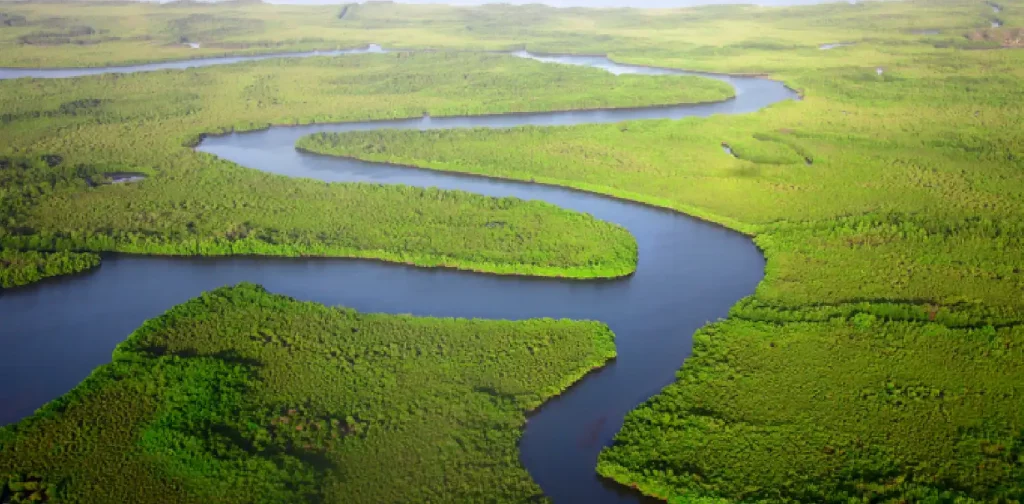
Photo: Dan Roizer on Unsplash.
We need water to live. While the earth might seem to have an ample supply, water scarcity still occurs in many parts of the world. In this case, good governance is critical to sustainable and efficient water resource use globally. The International Union for Conservation of Nature has worked to strengthen water governance through the BRIDGE initiative.
What is Water Governance?
Water governance refers to the framework, decision-making process, and implementation of water resource use and management policies. It involves governments at all levels, lawmakers, the private sector, organizations, and communities as key actors.
Effective water governance plays a central role in establishing regulations and policies governing inclusive and equitable water usage to meet the needs of people and the planet. It is also a key instrument in tackling water scarcity and other water-related challenges and promoting sustainable water policy.
There are three dimensions of water governance according to the OECD:
- Effectiveness in defining, implementing, and reaching targets of sustainable water policy.
- Efficiency in maximizing the benefits of sustainable water management and minimizing planetary and societal costs.
- Trust and engagement build public confidence and ensure stakeholders’ inclusiveness in water management.
IUCN’s BRIDGE Initiative
Over 300 river basins and lakes around the world cross national borders. Countries that share these water sources must build a cooperative relationship to ensure peace, water security, economic development, and environmental preservation. However, the United Nations noted that in 2022, around 60% of transboundary river basins lack cooperative arrangements. Meanwhile, the existing treaties were considered weak in implementation.
Established in 2011, the IUCN’s Building River Dialogue and Governance (BRIDGE) initiative aims to build dialogues, cooperation, and governance in transboundary river basins worldwide. The initiative operates on national and international levels in Asia, Africa, and the Americas based on a strategic process:
- Utilizing demonstration and making cooperation operational in a basin through joint action.
- Facilitating learning through training and capacity building for multiple stakeholders across multiple scales.
- Fostering dialogue for consensus building through demonstration actions and learning.
- Implementing leadership programs to empower key actors in water management.
- Providing advice, support, and technical assistance.
In Southeast Asia, the BRIDGE initiative has supported and mobilized transboundary water governance and dialogue in the Sesan, Sre Pok, and Sekong (3S) River Basins that flow through Cambodia, Lao PDR, and Vietnam. It facilitated several regional dialogues assessing the Mekong River Agreement signed by related countries in 1995 and other possible opportunities for a more robust legal framework. Furthermore, BRIDGE also established a Water, Energy, Food, and Ecosystems (WEFE) Nexus in the 3S basin as the foundation for a more integrated approach to natural resource management in the river basins.
“Water governance, despite the word, is not a government issue only. It is a multi-level approach where civil society organizations play a key role,” said Vishwa Ranjan Sinhan, IUCN Asia Water Programme Officer.
Equitable Water Access for All
Some of the earth’s resources are finite and bound to run out sometime in the future. As we share this space with our fellow humans and other biodiversity, it is our responsibility to ensure everyone has access to those resources for generations to come, including water, without creating environmental expenses. Effective and efficient water governance is critical to ensure the above goal is achieved and supports sustainable development progress. IUCN’s BRIDGE initiative becomes an example of a tangible action that relevant organizations can do to promote water governance, strengthen peace, and create a world where no one is left behind.
Editor: Nazalea Kusuma

Kresentia Madina
Madina is the Assistant Manager of Stakeholder Engagement at Green Network Asia. She holds a bachelor’s degree in English Studies from Universitas Indonesia. As part of the GNA In-House Team, she supports the organization's multi-stakeholder engagement across international organizations, governments, businesses, civil society, and grassroots communities through digital publications, events, capacity building, and research.
 Impacts of E-waste Pollution on Animals and Human Health
  Africa’s Solar Energy Surge: Why 2025 Was a Breakthrough Year
  Agrihoods: Integrating Farms and Urban Neighborhoods into Sustainable Communities
  Women in Waste Management: Asia’s Circularity Runs on Women. Its Policies Still Don’t
  Embracing the Business Value of Sustainability
  American Farmers Call for Government Support Amidst PFAS Contamination