

How Human Behaviour Becomes the Real Engine of Sustainability Action
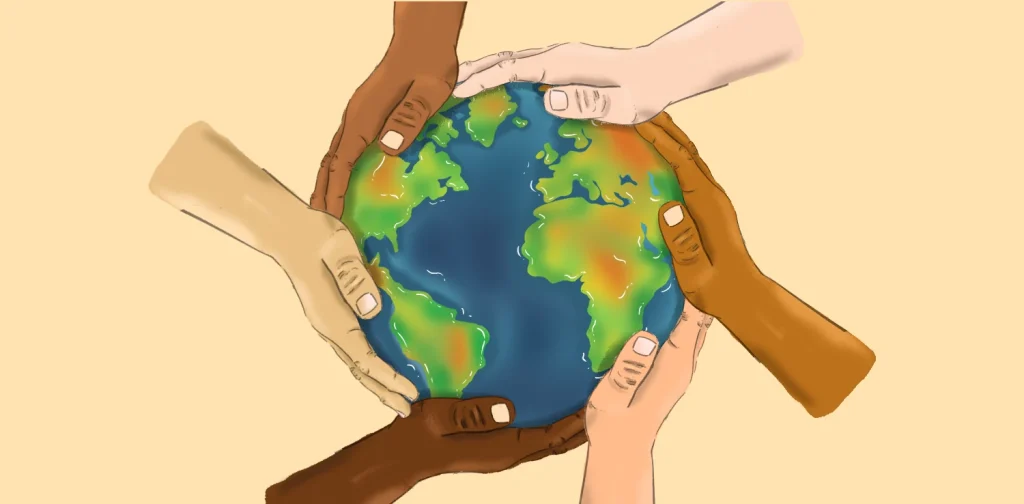
Illustration by Irhan Prabasukma.
Humanity stands at a defining moment. The triple planetary crisis of climate change, biodiversity loss, and pollution continues to expand in both scale and urgency. With challenges this vast, the reflex is to look towards technological breakthroughs and monumental policy shifts for the answers. Yet, an essential dimension of progress remains far more intimate: the cumulative power of human behaviour. While science, diplomacy, and innovation are indispensable, none can achieve their intended impact without societies willing to internalise and act upon the changes.
Meaningful transformation begins when individuals and communities recognise that their behaviours have the power to push systems to respond. It requires the willingness to question norms and strengthen personal responsibility. It also requires looking beyond ourselves to acknowledge the profound influence of social expectations on collective outcomes.
Human Behaviour in Environmental Governance
The concept remains true in environmental governance. Human behaviour plays a role of planetary consequence. Values, choices, and patterns of action shape public discourse and enable the policy and investment frameworks that follow—for better or for worse. In moments of uncertainty, people look to one another and to trusted leaders, making behavioural insight an essential component of environmental governance. Environmental agreements require public legitimacy; climate action demands social participation; and adaptation and mitigation rely on public understanding, trust, and engagement. Without these elements, even the most advanced strategies struggle to take root.
Of course, scientific disciplines remain the backbone of this process. Climatologists, ecologists, engineers, and marine biologists provide the empirical foundation upon which decisions must be built. Then, policy specialists and diplomats translate these insights into frameworks to guide nations and institutions.
Yet, the effectiveness of these efforts ultimately rests on a simple truth: environmental ambition becomes reality only when people choose to integrate sustainable behaviours into their daily lives. When human behaviour aligns with evidence, progress accelerates; when it does not, momentum stalls.
Case Study: Abu Dhabi
Abu Dhabi’s experience offers compelling evidence of what becomes possible when human behaviour becomes a central pillar of environmental strategy. For instance, when fish stocks fell to only 8% of sustainable levels in 2018, the crisis demanded more than scientific assessment. It required deep engagement with fishermen whose participation was essential to any solution.
Through dialogue, co-designed behavioural interventions, strengthened monitoring, and shared responsibility, sustainable fish stocks rose to 100%. This case represents one of the fastest documented recoveries globally. Moreover, it demonstrates that human behaviour, supported by science and policy, can alter the trajectory of ecosystems.
A similar shift followed the introduction of Abu Dhabi’s Single-Use Plastic Policy. What began as a regulatory measure quickly evolved into a collective movement. Communities adopted reusable alternatives and retailers adjusted their operations. All in all, a wider culture of accountability took shape.
These behavioural patterns translated into measurable impact. Since the ban in 2022, 490 million single-use plastic bags have been avoided, with a 95% decrease in grocery bag use, among others. Additionally, the introduction of 170 Reverse Vending Machines and Smart Bins has supported the recovery of 267 million single-use plastic bottles since 2023. Together, these changes amounted to the prevention of 116,000 tonnes of greenhouse gas emissions, the equivalent of removing 185,620 cars from the roads in a single year.
From Human Behaviour to Real Progress
Such outcomes reveal a consistent pattern. Human behaviour is powerful, but it cannot stand alone. When individuals are equipped with knowledge, presented with viable alternatives, and supported by visible examples of shared commitment from humans and corporations alike, they adjust their behaviour. Then, when communities adjust their behaviour, markets shift in response and policy gains renewed momentum. In this way, behaviour becomes both the spark and the engine of environmental progress.
The path ahead demands renewed attention to the human dimension of environmental action. Advanced science will continue to expand what is possible. Policy will continue to guide what is required. Yet the success of both depends on the willingness of people to put knowledge to practice. Better yet, this willingness must be met with enabling interventions that address the intersectional reality of the people for real, meaningful transformations to happen.
Ultimately, human behaviour remains the most powerful and most immediate tool available to us. When guided by science, inclusively supported by policy, and reinforced by social norms, it becomes a force capable of reshaping systems and strengthening resilience for generations to come, for people and the planet.
Editor: Nazalea Kusuma

Co-create positive impact for people and the planet.
Amidst today’s increasingly complex global challenges, equipping yourself, team, and communities with interdisciplinary and cross-sectoral insights on sustainability-related issues and sustainable development is no longer optional — it is a strategic necessity to stay ahead and stay relevant.

Dr. Shaikha Salem Al Dhaheri
Dr. Shaikha Salem Al Dhaheri is the Secretary General of the Environment Agency – Abu Dhabi. She also serves as a Council Member of World Economic Forum’s Global Future Council on Human Science of Environmental Action.
 Red Flags in the EU’s Industrial Accelerator Act (IAA)
  Untangling the Root Causes Underneath Lesotho’s Suicide Crisis
  Looking into the Inadequate Legal Recognition for Women’s Tenure Rights Across the Global South
  The Disproportionate Cost of Data Centers for Local Communities
  Will the EU Ban on Destroying Unsold Clothes Reduce Textile Waste?
  How Extreme Heat Affects Human Livability