

Clearing the Air of Despair Surrounding the Climate Crisis with Data
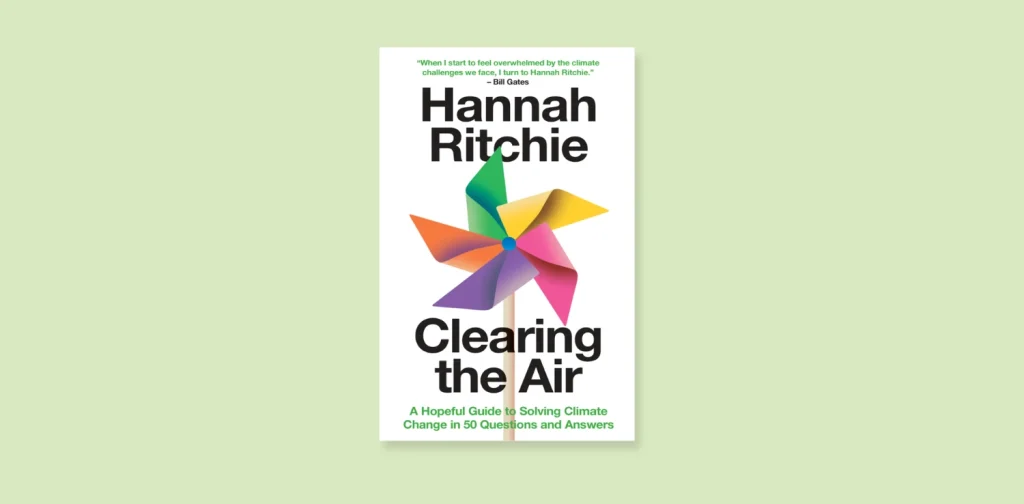
“Clearing the Air: A Hopeful Guide to Solving Climate Change in 50 Questions and Answers” by Hannah Ritchie. | Publisher: The MIT Press (2026).
For anyone who stays up-to-date on news about the climate crisis from modern mass media—myself included—the world often feels like a documentary about a planned extinction. Each morning, we are presented with narratives of impending ecological collapse. The stories range from ecosystem tipping points being crossed to uncontrollable extreme weather. By afternoon, public discourse often suggests that the “green” solutions currently on offer—such as solar panels, wind turbines, and electric vehicles—are merely costly manipulations that damage the environment in other ways. This narrative fatigue breeds chronic climate anxiety and even a sense of fatalistic despair that paralyzes society’s will to fight.
However, reading Hannah Ritchie’s latest work, Clearing the Air: A Hopeful Guide to Solving Climate Change in 50 Questions and Answers, evokes a sensation akin to throwing open the windows in a stuffy, smoke-filled room. It is fresh and clear, inspiring the courage for rational, positive thinking. Ritchie is a senior data scientist at Our World in Data and a researcher at the University of Oxford. In 2024, she gave us the optimistic Not the End of the World. Now, she has returned with an approach that refuses to peddle empty utopias or simply wallow in despair.
A Complete and Balanced Narrative of the Climate Crisis
Ritchie’s book went through a rigorous quantitative approach, yet presented in an engaging, accessible style. Through it, Ritchie weaves answers to 50 of the most pressing questions into a cohesive narrative. The work elegantly dismantles myths of hopelessness one by one, transforming widespread skepticism into a pragmatic conviction. It convinces you that the climate crisis is a monumental civilizational challenge, but one that is entirely solvable through the right combination of science, technology, policy, and behavioral change. Ritchie articulates all of this with remarkable clarity.
Renowned historian Rutger Bregman praises the author, in which I wholeheartedly agree. He said, “If there were a Nobel Prize for clear thinking, Hannah Ritchie would have my vote. She doesn’t just cut through the noise—she vaporizes it.”
The breadth of Ritchie’s analysis is evident from the very beginning of the book. She directly challenges the common perception that Earth is spiraling out of control toward extreme temperature increases of 5°C or 6°C by the end of the century. Such doomsday scenarios are actually rooted in outdated assumptions from an era when the world took no climate action whatsoever. Based on current energy policies and global technological transitions, the trajectory of global temperature rise has been curbed to a range of 2.5°C to 3°C. While this level of warming still entails dangerous climate risks, the quantitative reality reveals a crucial point: climate actions taken over the past two decades have not been in vain and have successfully steered human civilization away from the worst-case scenario.
In Clearing the Air, Ritchie emphasizes a crucial yet often overlooked philosophy. She reminds us that there has never been a point in history where anything was truly “too late”. Every reduction of a tenth of a degree Celsius (0.1°C) holds immense significance for saving thousands of ecosystems and millions of human lives from climate catastrophe.
Equally striking is Ritchie’s revelation of a profound perception gap within society. Global survey data indicates that the overwhelming majority of people across the globe—including in nations often labeled as skeptical—actually fully support climate action and the transition to clean energy. The primary obstacle to change is not a lack of public sympathy, but rather manufactured political polarization and disinformation propaganda from parties with a vested interest in maintaining the status quo of the fossil fuel industry.
Mythbusting
This transitional journey leads us to a fundamental re-evaluation of the role of fossil fuels and the potential of renewable energy. While fossil fuels undoubtedly drove the Industrial Revolution, our reliance on them now exacts an exorbitant price. Hence, we are dealing with massive climate damage and the premature deaths of millions due to toxic air pollution. Fortunately, Ritchie emphasizes that developing nations need not replicate the West’s polluting development patterns. With the plummeting costs of clean technology, developing countries have a golden opportunity to leapfrog directly to renewable energy-based infrastructure.
Ritchie also systematically dispels the myth that energy transitions are always slow, spanning centuries. The rate at which solar and wind energy have been adopted over the past decade has far outpaced any other energy source in history. Furthermore, massive electrification—such as replacing conventional vehicles with electric ones and utilizing heat pumps—can dramatically boost systemic energy efficiency. Given that the internal combustion engines found in gasoline-powered vehicles waste up to 80% of their energy as heat, a shift to full electrification could actually reduce global total energy demand by 40% while delivering the exact same economic benefits.
Furthermore, Ritchie addresses public skepticism regarding the carbon footprint of renewable energy and the threat of associated waste by presenting an irrefutable Life-Cycle Assessment. Life-cycle emissions from solar and wind energy are proven to be 19 to 84 times lower than those of coal. Regarding waste accumulation, the volume of coal ash generated by global coal-fired power plants in a single month far exceeds the total estimated solar panel waste expected to accumulate worldwide over the next 35 years.
As for the issue of flexibility—specifically when the wind is not blowing or the sun has set—a combination of grid-scale batteries, long-distance transmission, and pumped-hydro storage has proven capable of maintaining grid stability safely and economically. And in the realm of nuclear energy, Ritchie demonstrates that public fear is vastly disproportionate to reality. She states that nuclear power is among the safest and cleanest energy sources ever created by humanity, boasting safety levels per terawatt-hour comparable to those of wind and solar power.
Pragmatism in Championing Sustainability
This pragmatic perspective continues. It extends to a discussion of the land transport sector, mineral mining, and the transformation of the food industry.
In the electric vehicle (EV) sector, the “emissions debt” incurred during battery manufacturing is fully offset within just the first one to three years of use. Therefore, EVs significantly cut carbon emissions while completely eliminating tailpipe emissions in urban areas. Clearing the Air also addresses concerns regarding a potential crisis involving critical minerals—such as lithium, nickel, and cobalt. Ritchie reassures the public with data showing that proven reserves are actually increasing, driven by advancements in exploration technology and the emergence of alternative battery chemistries. Furthermore, the total volume of materials requiring extraction for the global clean energy transition is far smaller than the 15 billion tons of fossil fuels we currently extract and burn each year.
Meanwhile, the food and agriculture sector, which accounts for approximately one-third of global emissions, is also under intense scrutiny. Ritchie demonstrates that the global adoption of plant-based diets would reduce global agricultural land use by up to 75%. This would then free up vast areas for reforestation and natural carbon sequestration. Even for heavy industries—such as cement and steel manufacturing, aviation, and long-haul shipping—that have long been labeled “hard-to-abate”, innovations involving green hydrogen and blast furnace electrification are now paving the way for highly rational solutions.
The quantitative realities and key messages Ritchie presents offer both a stark reflection and a highly relevant roadmap for us all. Take Indonesia, for example. As one of the world’s largest coal producers and the holder of the planet’s largest nickel reserves, Indonesia stands at the very forefront of the global energy transition dilemma. The nation’s reliance on coal-fired power plants exacts a heavy toll on public health due to chronic air pollution in major cities. Yet, with abundant tropical sunlight, unparalleled geothermal potential, and a strategic position in the global battery supply chain, Indonesia possesses all the essential assets to leapfrog toward a self-reliant, clean economy. The prerequisite is that nickel downstreaming must adopt rigorous environmental and social standards, balanced by a commitment to protect, restore, and regenerate the tropical rainforests and peatlands across the archipelago—vital natural bulwarks for global carbon sequestration.
My Takeaway
Ultimately, after all the data has been presented and the analysis conducted, it is impossible to close Clearing the Air with a sense of despair. The book is a firm call to action. It calls us to stop wasting time arguing over myths that science has already thoroughly debunked, and start building the infrastructure for the future. Hannah Ritchie reminds us all never to let perfection become the enemy of the good. The climate solutions available to us today may not be 100% free of environmental impact. Still, they are thousands of times cleaner, safer, and more sustainable than clinging to the destructive, fossil-fuel-based status quo.
To me, the most important message of this book is that every individual choice we make represents the most powerful force at our disposal when combined with civic pressure to drive rational, data-driven public policy. A clean future—featuring fresh city air, abundant low-cost energy, and a restored Earth ecosystem—is not merely a utopian dream. It is a reality within reach, ready for us to bring about together. With a message this clear, this book is sure to rank among the best books on sustainability of 2026, or perhaps even the best of the decade.
Editor: Abul Muamar
Translator: Nazalea Kusuma
The original version of this article is published in Indonesian at Green Network Asia – Indonesia.

Co-create positive impact for people and the planet.
Amidst today’s increasingly complex global challenges, equipping yourself, team, and communities with interdisciplinary and cross-sectoral insights on sustainability-related issues and sustainable development is no longer optional — it is a strategic necessity to stay ahead and stay relevant.

Jalal
Jalal is a Senior Advisor at Green Network Asia. He is a sustainability consultant, advisor, and provocateur with over 25 years of professional experience. He has worked for several multilateral organizations and national and multinational companies as a subject matter expert, advisor, and board committee member in CSR, sustainability, and ESG. He has founded and become a principal consultant in several sustainability consultancies as well as served as a board committee member and volunteer at various social organizations that promote sustainability.
 Indonesia’s Greenwashing Diplomacy at COP31 and Beyond
  The Textile Industry Is Growing, and So Is Textile Wastewater
  EESG: We Need a New Economic Narrative for Sustainability in the Age of AI, Energy Crisis, and Geopolitical Divide
  The Continued Struggle for Equality and Dignity in Women’s Sportswear
  Behavior Change for the Planet: Is composting worth it?
  Building Bridges Between Environmental Policy and Mental Health