

Denmark Proposes New Agricultural Tax for Livestock Farmers
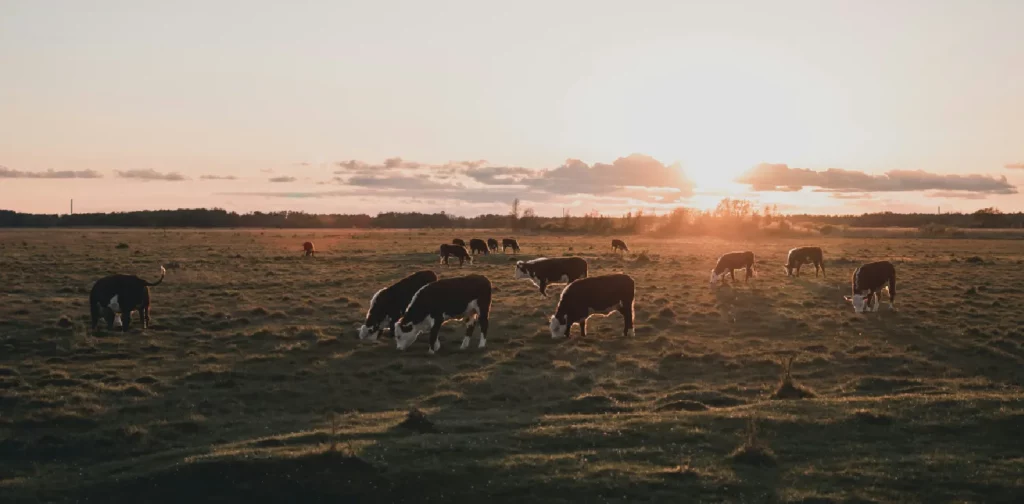
Photo: Febiyan on Unsplash.
The agriculture sector is known for its enormous carbon emissions. This includes livestock farming, where cows and pigs produce methane gas from their digestive processes. Methane gas is another form of carbon emissions, reportedly more potent than carbon dioxide. In June 2024, the government of Denmark proposed an agricultural tax to be enforced on livestock farmers as part of its mission to achieve climate neutrality.
Livestock Emissions
According to the Food and Agriculture Organization, livestock supply chains account for 14.5% of global anthropogenic greenhouse gas emissions. Cows and other cattle’ digestive system produces methane as the residue, which comes out in the form of burps and farts.
As of June 2022, Denmark had around 1.4 million cows. Agriculture plays a huge role in Denmark’s economy. Therefore, it is important to reform the agriculture sector in order to maintain the country’s economy while achieving net-zero targets. Statistic Denmark reports that one cow typically produces about six metric tonnes of CO2 equivalent annually. Thus, reducing them will be critical to the country’s climate goal of achieving climate neutrality by 2045.
In June 2024, the Government of Denmark and the parties in the Green Tripartite reached an agreement for structural reform in the country’s agricultural sector. The agreement includes an agricultural tax, where the government will tax livestock farmers for the emissions produced by their cows, sheep, and pigs.
Denmark’s Agricultural Tax Proposal
The agricultural tax will require Danish livestock farmers to pay 300 kroner (approximately USD 43) per tonne of carbon dioxide equivalent in 2030. The tax will increase to 750 kroner (USD 108) in 2035. However, the farmers are also subjected to a 60% income tax deduction. Therefore, they will only pay 120 kroner (USD 17.3) per tonne in 2030 and 300 kroner in 2035.
The bill still requires approval by the 179-seat parliament and will be passed after receiving broad-based consensus. Previously, the government, representatives of farmers, industry players, and unions had reached a compromise on the agricultural tax. This occurred after months of protests by European farmers over climate mitigation measures and regulations that negatively affected their income.
Denmark’s Minister of Foreign Affairs, Lars Løkke Rasmussen, called this the biggest recent restructuring of the Danish landscape. He stated, “At the same time, we will be the first country in the world with a CO2 tax on agriculture. It is another example of what we can achieve when we conduct politics across the middle.”
Meanwhile, other targets and actions include establishing Denmark’s Green Area Fund with initiatives such as forest restoration, strategic land acquisition, nitrogen reduction, and aiming for at least 20% protected areas of nature.
Editor: Nazalea Kusuma
Co-create positive impact for people and the planet.
Amidst today’s increasingly complex global challenges, equipping yourself, team, and communities with interdisciplinary and cross-sectoral insights on sustainability-related issues and sustainable development is no longer optional — it is a strategic necessity to stay ahead and stay relevant.
Kresentia Madina
Madina is the Assistant Manager of Stakeholder Engagement at Green Network Asia. She holds a bachelor’s degree in English Studies from Universitas Indonesia. As part of the GNA In-House Team, she supports the organization's multi-stakeholder engagement across international organizations, governments, businesses, civil society, and grassroots communities through digital publications, events, capacity building, and research.
 Addressing the Rising Challenges of Photovoltaic Waste Management
  Salt in the Wound: Cautioning Saltwater Intrusion amid Global Water Crisis
  How Overtourism Pushes Local Communities Out of Their Own Homes
  Why the World Still Doesn’t Have a Global Plastics Treaty
  Understanding the Regional Impacts of Climate Change on Malaria in Africa
  Challenging Interdependence and the Inequality of Imagining the Future