

Prescribing Beyond Profit for CEOs’ Anxiety
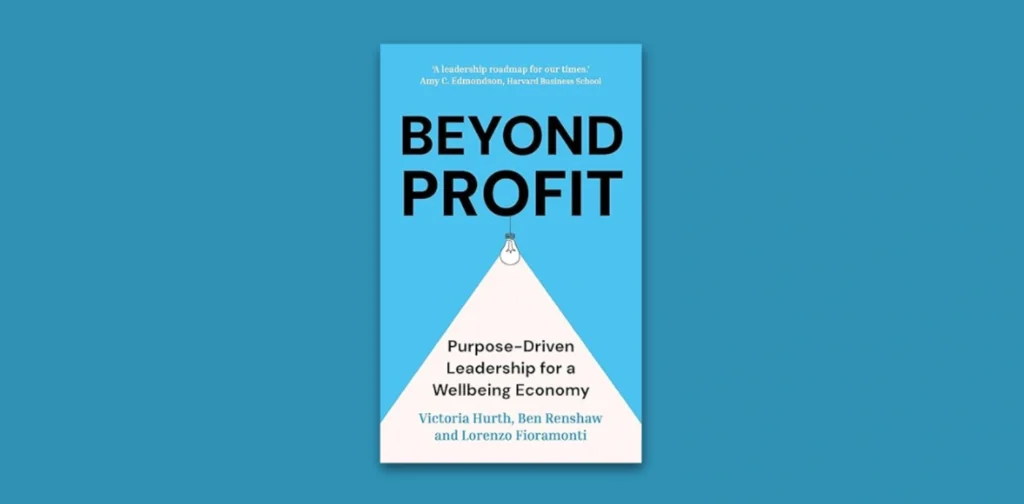
Cover of “Beyond Profit: Purpose-Driven Leadership for a Wellbeing Economy” by Victoria Hurth, Ben Renshaw, and Lorenzo Fioramonti.
“Each of us is put here in this time and in this place
to personally decide the future of humankind.
Do you think you were put here for something less?”
– Chief Arvol Looking Horse –
One morning in London, a CEO sat in his office overlooking the Thames, staring at a spreadsheet filled with green—all indicators pointed to growth. The stock was up 12% a year. Dividends were shared on time. Analysts at Bloomberg were writing up positive notes. But when he got home that night, his eleven-year-old daughter asked him in a tone that was a little too serious for her age: “Daddy, is your company helping save the Earth or destroying it?”
That question, recounted in an interview for the book “Beyond Profit: Purpose-Driven Leadership for a Wellbeing Economy”, haunted the CEO for months. He realized he didn’t have an honest answer. Worse yet, he realized the system he served wasn’t even designed to ask, let alone answer, such questions.
This book, “Beyond Profit”—a collaboration between Dr. Victoria Hurth, a governance expert who led the development of ISO 37000; Ben Renshaw, a leadership coach whose clients include Unilever and Heathrow; and Prof. Lorenzo Fioramonti, a former Italian Minister of Education and critic of GDP-based economics—is an attempt to take that eleven-year-old’s question seriously.
Moreover, it is not just a self-help manual for guilty executives nor is it a naive anti-capitalist manifesto. It is something rarer and more dangerous: a systemic diagnosis delivered with remarkable clarity, followed by prescriptions that demand a re-engineering of the fundamental purpose of modern organizations. And that, in my opinion, is why this book is so special.
Collapsed Logics
The authors call the system that now dominates the business world—in which short-term financial interests will somehow magically result in collective wellbeing—“Logic 1”. It’s so deeply ingrained in our minds and hearts that questioning it feels like questioning gravity. The difference is that gravity doesn’t make the Earth warmer, while Logic 1 does.
The numbers presented at the beginning of this book are simple and brutal. Global GDP has soared from $4.5 trillion to over $100 trillion in the past few decades. Yet collective wellbeing—what humans truly desire: mental health, social cohesion, clean air for our children and grandchildren—is declining. Not just slowing, but declining. So, more than 70% of OECD countries now measure wellbeing directly, and the results are alarming. Beyond a certain point, economic growth no longer correlates with better lives. Instead, it correlates with higher anxiety, more fragmented communities, and increasingly fragile ecological systems.
Fioramonti, who has spent his career studying what he calls the “tyranny of GDP”, clearly wrote “Beyond Profit” with a barely controlled rage. He depicts the modern economy as a machine that methodically extracts value from nature and society to concentrate it in the hands of a handful of shareholders, while simultaneously destroying the foundations that enable that machine to operate. This isn’t a metaphor, Fioramonti says, but a literal description of how so many large corporations operate today.
The Hardware of Transformation
What sets this book apart from others with similar titles that I’ve read—those promising Conscious Capitalism—is its combination of moral idealism and almost obsessive technical precision. Hurth—whom I knew from when she spent five years facilitating the development of ISO 37000, a governance standard endorsed by 164 countries—doesn’t speak in abstractions. When she talks about organizational purpose, she refers to the definition codified in PAS 808:2022, the first national consensus standard (UK) on purpose-driven organizations. The definition: a reason to exist that is an optimal strategic contribution to the long-term wellbeing of all people and the planet.
That sentence—dry, bureaucratic, and precise—actually contains a highly revolutionary force. It overturns a fundamental assumption: profit is not the goal of a company, but a means. Companies are not formed and exist to make money; they exist to contribute to collective wellbeing, and money is one of the resources that makes that contribution possible. All three authors use oxygen as a metaphor: vital to life, yet no one would say that the purpose of life is to breathe in as much oxygen as possible. I’ve been using food as a metaphor for profit for years, but oxygen seems just as good, if not better.
However, redefining purpose isn’t enough. This is why the book devotes long chapters to what Hurth calls the hardware of transformation. She refers to the actual governance mechanisms that ensure that those noble goals don’t evaporate when quarterly or annual pressures arrive. ISO 37000 outlines three governance functions: direction (what the organization exists for), oversight (whether it is moving toward it), and accountability (who is accountable if it isn’t). Without this hardware—top management with a redefined mandate, a metrics system that measures social and ecological impact as seriously as EBITDA, a fully transparent reporting mechanism—the goals are little more than a public relations exercise.
The Software of Transformation
Then, there is the software: leadership. This is where Renshaw comes in, and the tone of the book shifts from technical to almost spiritual. He wrote about leadership as a “courageous practice of service”, but not in the heroic sense as most people think it. It is heroic in that it means seeing the humanity of employees not as obstacles to be controlled through fear and financial incentives, but as the company’s most important asset to be nurtured. He tells us about the leaders he coaches—senior executives in multinational corporations—who often confess that they are more afraid of board meetings with shareholders demanding quarterly growth than of the climate failures their children will face. And this must change.
There are moments in “Beyond Profit” where Renshaw’s narrative feels almost too intimate. He wrote of a CEO who broke down in tears when he realized he’d spent twenty years of his career serving a cause he didn’t believe in; a director who resigned after the board rejected his proposal to integrate employee wellbeing metrics into executive compensation. But these moments are crucial—and I’ve personally witnessed the sobs of corporate leaders experiencing their moments of epiphany countless times. They remind me that systemic transformation isn’t just about spreadsheets and small shifts in organizational structure. It is also about people finding the courage to say no to a system that makes them richer but leaves their hearts empty.
An Economy that Serves Wellbeing
The concept of “Wellbeing Economy” that Fioramonti advocates as a replacement for GDP might sound like an oxymoron to many who dare to ask. An economy whose goal is not growth? Where does that exist? But the authors diligently point out that this is no fantasy. New Zealand, Scotland, and Iceland—not countries known for their economic radicalism—have adopted so-called “wellbeing budgets”, where fiscal allocations are truly guided by the impact on collective wellbeing, not just growth. Michelle Obama’s initiative for food reform in American schools, while controversial, is another example of the same logic: sometimes—or perhaps often?—the long-term good requires rejecting short-term industrial interests.
“Beyond Profit” outlines the four principles of Wellbeing Economy with a precision reminiscent of a political manifesto: Purpose (the economy should serve wellbeing, not the other way around), Prevention (preventing harm before it occurs), Pre-Distribution (designing a just system from the start, not fixing it after the damage has occurred), and People-Powered (direct participation in economic decision-making).
Furthermore, what makes this argument so compelling is the data. During the 2020–2022 period—when markets were volatile and many tech companies lost up to 80% of their valuations—companies with regenerative business models demonstrated striking resilience. They weren’t immune to the crisis, but they recovered more quickly and maintained investor confidence better. The reason, the authors argue, is social capital: when stakeholders—especially employees, customers, and communities—believe that an organization cares about more than just profit, they remain loyal even when quarterly numbers are poor. This isn’t altruism; it’s a strategy to survive—thrive, even. They prove that doing good isn’t at odds with doing good business—over the long term, they are one and the same.
The Gaping Chasm Toward Beyond Profit
Nevertheless, I clearly sense a gaping chasm between the vision outlined in “Beyond Profit” and the reality most leaders face today. The authors acknowledge this—they’re not naive—but perhaps haven’t addressed it seriously enough. How, exactly, can a public company subject to quarterly analysis and investors who can sell shares in milliseconds, adopt an intergenerational decision horizon? How can a board of directors, whose members are chosen based on their commitment to shareholder value, suddenly shift their mandate to serving the wellbeing of all people and the planet?
The authors argue that this requires changing the rules of the game in the macroeconomy—policy reforms, fiscal incentives, new legal infrastructure enforced by the state. They’re right, of course. But those rules won’t change without a strong political coalition, and building such a coalition requires challenging the powerful and deeply entrenched oligarchic interests in many countries. This book, I feel, doesn’t sufficiently explore the actual political battles that would be required to make this happen for most companies. Certainly, there are companies like Patagonia that have achieved this without any political change at all. But not all CEOs are Yvon Chouinard.
There’s also an unresolved tension between moral idealism and business pragmatism. The authors point to data that shows purpose-driven companies outperform their competitors in the long run. But “long-term” itself is a slippery concept. For a CEO whose contract is three years and whose compensation is tied to stock performance, long-termism is a luxury he can’t afford—literally.
Furthermore, there is the question of who, exactly, is meant by “all and the planet.” When the interests of “all people” conflict—and they will—who will decide what trade-offs need to be made? The authors offer a framework (stakeholder engagement, transparency, accountability) but don’t sufficiently explore how that framework would work in a real-life conflict of interest situation. For instance, when pharmaceutical companies have to choose between maximizing access to life-saving drugs in developing countries versus maintaining profit margins that allow for R&D investments for future diseases, how will “the wellbeing of all people” translate into concrete decisions? In my time accompanying executive management, these deliberations are complex, and I wish there were deeper insights that could guide the executives in these matters.
The Eleven-Year-Old’s Question
However, criticizing the book for not providing comprehensive answers might be missing the point. Beyond Profit is not a technical manual for a painless transition to benevolent capitalism. It is, at its core, a provocation—an invitation to ask questions most of us are too afraid to seriously ask.
A few months ago, I had a conversation with a senior vice president at a bank. We talked about governance, the reliability of ESG data, and the resilience of purpose-driven companies. When I shared the metaphor of how food is to humans what profit is to a company, he roughly stated, “Money is just a symbol, and symbols can never be the ultimate goal. Of course, I’ve always known that. But for my entire career, I’ve been taught to treat that symbol as if it were the goal. And now, I don’t know how to stop.”
That, perhaps, is the book’s most important contribution. It understands the language and offers a framework for the anxiety many corporate leaders already feel. It suggests that feeling that something is deeply wrong with the system is not just an individual’s moral failing—it is a rational response to a system that is indeed broken. And, it offers something even rarer: evidence that alternatives are not only possible but, in some cases, already exist.
As for the CEO whose daughter asked about his company’s role on Earth, well, I imagine he began the slow and often painful process of changing the board’s mandate, adopting new metrics, and building an internal coalition that believed change was possible. Years later, his company might still not be a perfect model of the WellBeing Economy. His stock might have dropped when he turned down acquisitions that would have been profitable but didn’t align with his (new) values. Some investors might have walked away. Yet the company still exists, it’s still profitable, and—perhaps most importantly—when his daughter asks him what he’s doing now, he has an answer he can honestly give.
Perhaps that, in the end, is the most important measure of a corporate leader’s success: not just quarterly growth or market valuation, but the ability to look their children in the eye and explain, without shame, that they have done their best for the future with the time they have on this earth—just like the wise words of Chief Arvol Looking Horse at the beginning of this article.
Editor: Abul Muamar
Translator: Nazalea Kusuma
The original version of this article is published in Indonesian at Green Network Asia – Indonesia.

Co-create positive impact for people and the planet.
Amidst today’s increasingly complex global challenges, equipping yourself, team, and communities with interdisciplinary and cross-sectoral insights on sustainability-related issues and sustainable development is no longer optional — it is a strategic necessity to stay ahead and stay relevant.

Jalal
Jalal is a Senior Advisor at Green Network Asia. He is a sustainability consultant, advisor, and provocateur with over 25 years of professional experience. He has worked for several multilateral organizations and national and multinational companies as a subject matter expert, advisor, and board committee member in CSR, sustainability, and ESG. He has founded and become a principal consultant in several sustainability consultancies as well as served as a board committee member and volunteer at various social organizations that promote sustainability.
 The Invisible Infrastructure: What ASEAN’s Carbon Market Needs Most
  Indonesia Ruled to Recognize Chronic Illness as a Disability
  Clean Cooking as a Developmental Multiplier in Africa
  Congo Basin Peatlands Are Releasing Ancient Carbon
  From Anxiety to Action: How Youth Climate Activism Is Evolving
  India’s Supreme Court Declared Menstrual Health and Hygiene as Fundamental Rights