

The Warning Signals of Climate Change
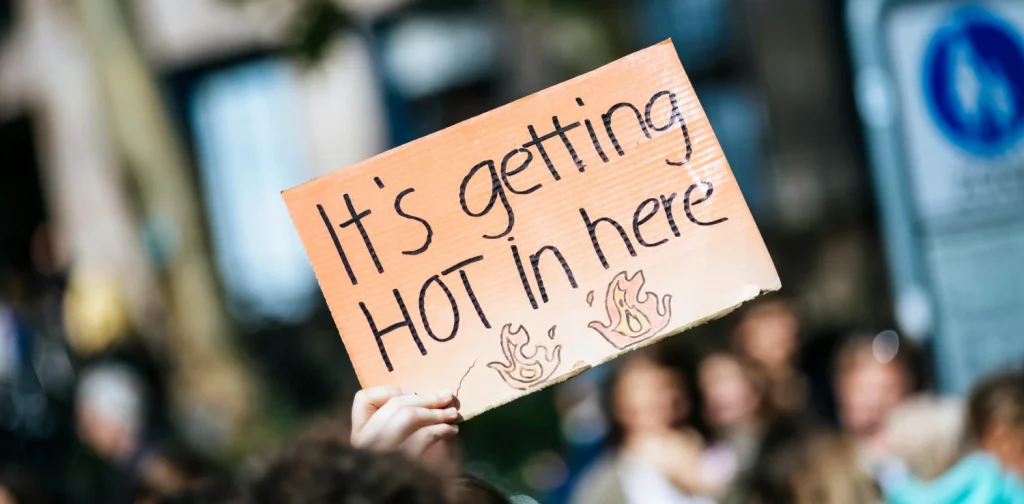
Photo: Markus Spiske on Unsplash.
From hotter days to rising food prices, climate change is reshaping our lives in many ways. It is no longer an issue of the future, but is actively altering current reality and costing us a decent life. Warning signals are ringing across the globe as the 1.5°C threshold is dangerously close to being exceeded.
The Warming Signals
One prominent part of how we understand the severity of climate change is through rising temperatures. In recent years, the record for hottest year since pre-industrial era has been broken multiple times. This trend aligns with the ever-increasing CO2 emissions, which hit an all-time high of 37.8 Gt CO2 in 2024, based on data by the International Energy Agency (IEA). The CO2 concentration in the atmosphere is now at least 50% higher than the pre-industrial levels. Carbon dioxide, along with methane and nitrous oxide, are the primary greenhouse gases contributing to climate change.
Consequently, the increased concentration of greenhouse gases in the atmosphere has disrupted the Earth’s energy imbalance, as reported by the World Meteorological Organization (WMO). This means that the energy that comes to the Earth is bigger than the one released back into space, building up heat in the oceans, atmosphere, as well as on land.
Our health and wellbeing bear the brunt of these prolonged hot days. Studies found that on average, people aged 18–40 can lose around 50 livable hours to extreme heat per year. The condition is worse for older people aged 65 and above, who can lose around 900 hours each year on average. Additionally, outdoor workers, street vendors, and other vulnerable communities are more exposed to extreme heat without proper cooling systems or social protection to cope.
Warning Signals: Glaciers and Seas
On a broader scale, rising temperatures have set off warning signals in other territories. For one, the increased heat has been dissolving a big chunk of the world’s glaciers. Glaciers store around 158,000 cubic kilometers of Earth’s freshwater, which sustains almost every part of our lives from agriculture to energy production. From the North to South Pole, glacier loss has been happening more rapidly.
The scale of global warming will significantly influence the rate of glacier extinction. A study published in Nature painted a worrying projection of glacier extinction, which is expected to peak between 2041 and 2055. Maintaining under the +1.5°C scenario will result in a 2041 peak with around 2,000 annual losses. Meanwhile, the under +4°C scenario will lead to way more glacier loss for a longer time, reaching its peak around 2055 with around 4,000 glacier loss annually.
Melting glaciers and rising ocean heat contribute to accelerating sea level rise globally, threatening coastal communities and ecosystems. WMO has noted that the global mean sea level reached around 11 cm higher at the end of 2025 than it was in 1993. Additionally, permafrost is thawing. This process releases carbon into the air and contaminants into rivers.
Beyond tangible loss, climate change can also slowly erase traditions and culture, as experienced by the Indigenous Inuit in the Arctic. For instance, landscape shift has disrupted the intergenerational transfer of knowledge on ice safety, making it less accurate and applicable in today’s context.
Warning Signals: Drought and Water Scarcity
At the same time, climate change influences the frequency, intensity, extent, and duration of droughts across the globe. Research warns that rising temperature can disrupt hydrological cycles of evaporation, condensation, and precipitation, triggering more frequent flash drought and increasing drought-sensitive areas.
More frequent drought has immense impacts on agriculture, especially in developing nations whose economies depend on agricultural productivity. Somalia is among the countries experiencing severe drought, caused by a failed rainy season at the end of 2025. Limited agricultural production due to water scarcity and pasture depletion has led to food insecurity, where 6.5 million suffer from acute hunger. The country contributes only about 0.09% of the global carbon emissions on record, yet is experiencing the impacts of climate change most severely.
Moreover, water scarcity exacerbated by climate-induced droughts reflects the inability of global water resources to keep up with soaring demands. Experts have warned of a water bankruptcy, where long-term water use has ‘bankrupted’ water resources to the point of irreversibility. This includes the world’s major underwater reservoirs, which show long-term declining trends due to overextraction and declining quality due to contamination. Water availability is closely tied to human and planetary health, and its absence disturbs the flow of life.
Climate Change Intervention with Rights and Inclusion
The link between one catastrophe to another means that climate change is not an isolated issue. Rather, it will continue to strike our most vital sectors and creep its way to others without an accelerated effort to halt it.
Beyond just fancy jargon and brand-new technologies, climate change mitigation and adaptation measures must be rooted in a rights-based approach that does not leave anyone behind. In the context of climate justice, this means acknowledging the disproportionate impacts of the crisis to the most marginalized groups. Beyond that, it also means centering their knowledge, perspectives, and experiences in the dialogues and decision-making processes related to climate change.
Emerging efforts such as climate litigation, loss and damage mechanism, and nature-based solutions offer viable ways to integrate the rights of human and nature in the face of crisis. Ultimately, the path to a world where people and nature can thrive must be built by the commitment, collaboration, and real actions of leaders in governments and businesses, with participation from everyone.
Editor: Nazalea Kusuma

Co-create positive impact for people and the planet.
Amidst today’s increasingly complex global challenges, equipping yourself, team, and communities with interdisciplinary and cross-sectoral insights on sustainability-related issues and sustainable development is no longer optional — it is a strategic necessity to stay ahead and stay relevant.
 Indonesia’s Greenwashing Diplomacy at COP31 and Beyond
  The Textile Industry Is Growing, and So Is Textile Wastewater
  EESG: We Need a New Economic Narrative for Sustainability in the Age of AI, Energy Crisis, and Geopolitical Divide
  The Continued Struggle for Equality and Dignity in Women’s Sportswear
  Behavior Change for the Planet: Is composting worth it?
  Building Bridges Between Environmental Policy and Mental Health