

Singapore’s New Net-Zero Sustainable Building Is a School
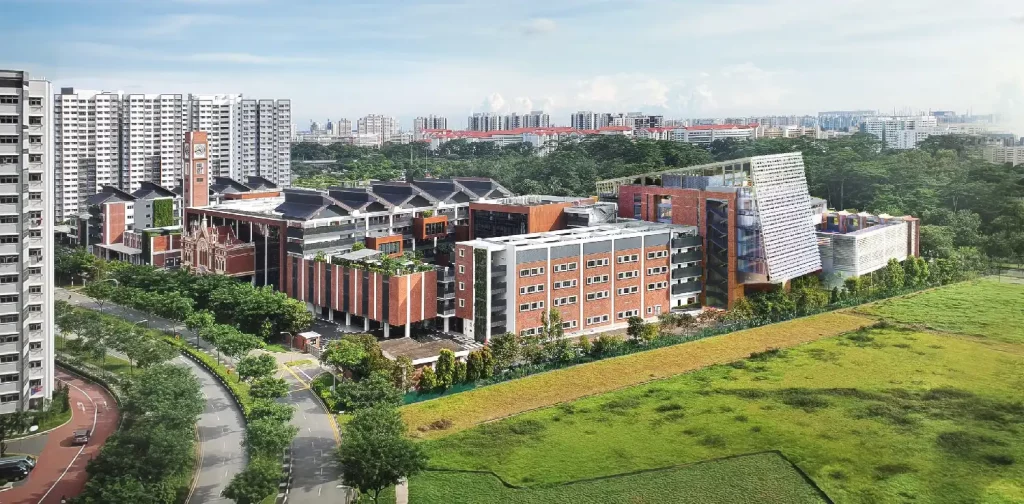
Mock Image of the Greenhouse at Dulwich College Singapore. | Photo: Education in Motion.
Sustainability in education is a growing topic. From physical buildings to curriculums, there are ways for academic institutions to contribute to sustainable development. The Greenhouse at Dulwich College Singapore is one example of a net-zero sustainable building in the education sector.
Singapore’s Green Mark 2021
Singapore’s buildings make up over 20% of the country’s carbon emissions. Data from 2019 also revealed that they accounted for over one-third of total energy consumption. Hence, the Singapore Green Plan 2030 includes a focus on ‘sustainable building’, such as through the Green Mark 2021 scheme.
Green Mark 2021 is an internationally recognized certification tailored for green buildings in the tropics. The assessment involves a comprehensive scoring system and verification process on energy performance and other sustainability sections – health & wellbeing, whole life carbon, resilience, maintainability, and intelligence.
The ‘net-zero building’ category falls under Zero Energy (ZE). ZE buildings supply all energy consumption, including plug load, from renewable energy sources. Among them are seven buildings at the Nanyang Technological University Singapore. In May 2023, the Greenhouse at Dulwich College (Singapore) joined the lineup.
The Greenhouse at Dulwich College
Dulwich College Singapore is a part of Education in Motion (EiM), an international educational institution with over 11,000 students across five countries. As of 2023, five EiM schools have received green building certifications.
EiM Co-founder and CCO Karen Yung said, “It is our earnest belief that schools have a big role — the responsibility, even — to drive the sustainability agenda and make the world a better place through the way we operate, and the way we educate young minds.”
In partnership with DP Architects, the Greenhouse is a seven-story net-zero building set to launch later in 2023. It is designed to achieve over 100% energy savings and reduce about 216 tons of CO2 emissions. Besides its Green Mark Zero Energy certification, the building earned Health and Wellbeing, Intelligence, and Maintainability badges.
The sustainable building strategies at the Greenhouse include:
- renewable energy production with Building Integrated Photovoltaics (BIPV) and kinetic floor tiles;
- energy efficiency through Smart technologies and an architectural design that lowers the need for artificial lighting and air conditioning;
- resource optimization by using low-carbon concrete and recycled wood for interior design as well as recycled rainwater;
- health and wellbeing consideration through greenery, natural elements, and air quality sensors.
Sustainable Building for All
As urban areas rapidly grow, buildings get built and rebuilt. Changing the way buildings operate will significantly contribute to sustainable development. Some cities and nations across the globe are already working towards net-zero buildings. However, cost is one of the main challenges to sustainable building. Hopefully, with the advancement of practice, knowledge, and technology, sustainable buildings can be available for everyone soon.

Nazalea Kusuma
Naz is the Manager of International Digital Publications at Green Network Asia. She is an experienced and passionate writer, editor, proofreader, translator, and creative designer with over a decade of portfolio. Her history of living in multiple areas across Southeast Asia and studying Urban and Regional Planning exposed her to diverse peoples and cultures, enriching her perspectives and sharpening her intersectionality mindset in her storytelling and advocacy on sustainability-related issues and sustainable development.
 Impacts of E-waste Pollution on Animals and Human Health
  Africa’s Solar Energy Surge: Why 2025 Was a Breakthrough Year
  Agrihoods: Integrating Farms and Urban Neighborhoods into Sustainable Communities
  Women in Waste Management: Asia’s Circularity Runs on Women. Its Policies Still Don’t
  Embracing the Business Value of Sustainability
  American Farmers Call for Government Support Amidst PFAS Contamination