

Secretary-General Reveals the UN’s Priorities for 2023
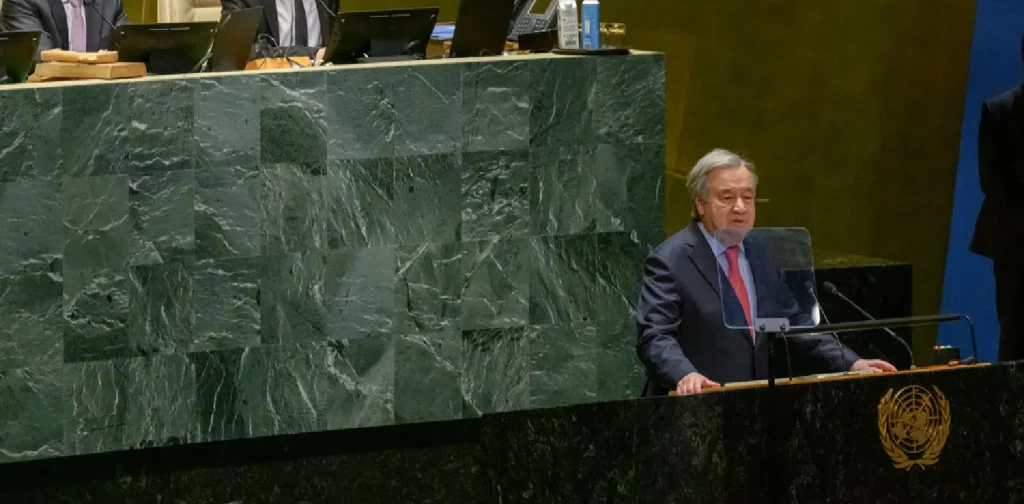
Photo by United Nations.
The year 2023 marks the halfway point in implementing the Sustainable Development Goals (SDGs). Yet, the world is as uncertain as ever–conflicts, disasters, and discrimination still permeate our everyday lives. In his briefing for the General Assembly, the United Nations Secretary-General António Guterres highlighted the UN’s priorities for 2023.
The need for course correction
“We have started 2023 staring down the barrel of a confluence of challenges unlike any other in our lifetimes,” said Guterres at the beginning of his briefing. With wars, climate crises, global poverty, and geopolitical division, it is clear that a course turnaround is needed.
However, despite knowing how to turn things around and the consequences of inactions, the issue lies in the need for long-term thinking and commitment. Guterres saw that many politicians, decision-makers, and people of power are too focused on the present, with little consideration for the future. “Don’t focus solely on what may happen to you today – and dither. Look at what will happen to all of us tomorrow – and act,” he added.
UN’s priorities for 2023
To create fundamental progress, the Secretary-General outlines seven points that will become the United Nations’ priorities for 2023:
- Peacebuilding — stating the need for a New Agenda for Peace to address various current conflicts. The agenda should recognize the need for new peace missions with proper leadership and guaranteed funding.
- Socio-economic rights and the right to development — emphasizing fundamental reforms and resource mobilization to alleviate poverty and economic gaps.
- The right to a clean, healthy, and sustainable environment — focusing mainly on cutting emissions and achieving climate justice. A specific call-out was directed toward fossil fuel producers and their enablers to set a credible course for net-zero operations.
- Respect for diversity and the universality of cultural rights — calling for governments, regulators, media, and civil society to stop the spread of misinformation and disinformation on the internet regarding certain races, religions, and gender.
- The right to full gender equality — commissioning an independent reviewer to assess the UN’s capacity around gender equality and doubling measures to empower women in various fields.
- Civil and political rights as the basis of inclusive societies — advancing fundamental freedoms, encouraging systemic participation from civil society in the UN’s work, protecting civic space around the world, and strengthening support for laws and policies that protect the right to participation and freedom of expression, including a free and independent media.
- The rights for future generations — envisioning next year’s Summit of the Future to bring the topic of ‘making peace with nature’ and ‘ensuring inclusive digital for all’ to the forefront of the discussion. A new UN Youth Office is planned to be up and running to support the UN’s work to be more creative, diverse, multilingual, and inclusive.
“As we look to priorities for this year, a rights-rooted approach is central to achieving our ultimate priority: a safer, more peaceful, more sustainable world. The Charter and the Universal Declaration of Human Rights point the way out of today’s dead end. They are a source of solutions and a source of hope. Let us draw from that source, let us draw from that hope, and act decisively before it is too late. Time is short. And the clock is ticking,” said Guterres to end his briefing.
Editor: Nazalea Kusuma

Kresentia Madina
Madina is the Assistant Manager of Stakeholder Engagement at Green Network Asia. She holds a bachelor’s degree in English Studies from Universitas Indonesia. As part of the GNA In-House Team, she supports the organization's multi-stakeholder engagement across international organizations, governments, businesses, civil society, and grassroots communities through digital publications, events, capacity building, and research.
 From Anxiety to Action: How Youth Climate Activism Is Evolving
  India’s Supreme Court Declared Menstrual Health and Hygiene as Fundamental Rights
  Impacts of E-waste Pollution on Animals and Human Health
  Africa’s Solar Energy Surge: Why 2025 Was a Breakthrough Year
  Agrihoods: Integrating Farms and Urban Neighborhoods into Sustainable Communities
  Women in Waste Management: Asia’s Circularity Runs on Women. Its Policies Still Don’t